The Real Cost of One Michelin Star
Boston paid handsomely to bring Michelin’s prestigious guide to the city. It got a single starred restaurant—and a lot of questions.
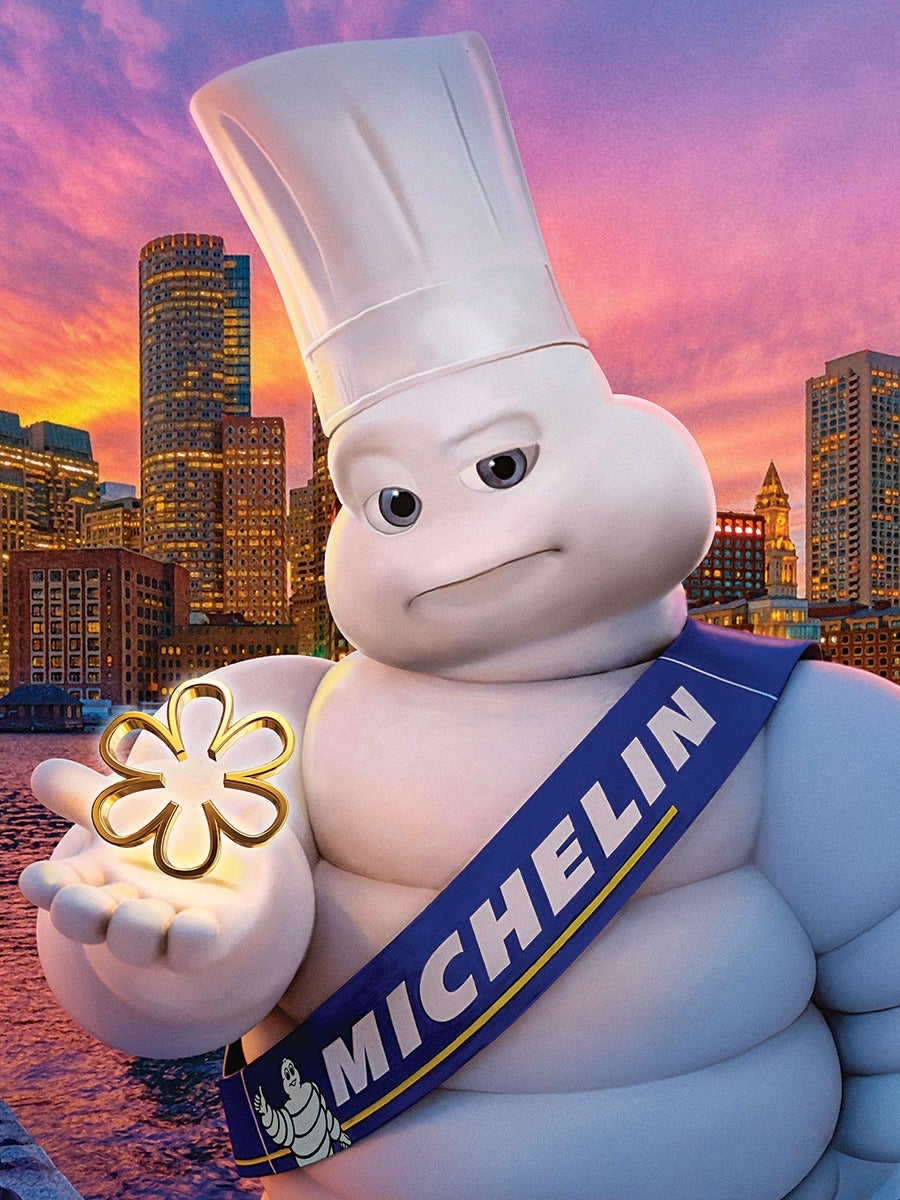
Illustration by Dale Stephanos
In the weeks before Michelin announced its first-ever Boston selections, whispers among dining insiders spread across town faster than whipped butter. The first question—“Did you hear who got an invite to the gala?”—was always chased by a second, more scandalous follow-up: “Did you hear who didn’t get an invite?” And underneath it all, the real question: Was Boston about to justify the estimated seven-figure bet it had placed on the world’s most prestigious restaurant guide?
Even those who received the coveted invite remained very much in the dark. The organization had sent out emails to every restaurant included in Boston’s guide, but they were vague. Each chef who found a golden ticket in their inbox didn’t know if they were about to be crowned with a coveted star or score one of Michelin’s other designations, like “recommended” restaurant, which denotes good cooking that isn’t yet star-worthy (but could be in the future).
The anticipation hung thick at the Kimmel Center for the Performing Arts in downtown Philadelphia on Tuesday, November 18. The opening reception that night was crowded with chefs from Boston, Philly, Chicago, New York City, and DC—all of whom would see their fates revealed in one joint ceremony.
Familiar faces from Boston’s dining world gravitated toward one another—Erin Miller of Urban Hearth, Chris and Pam Willis of Pammy’s, Carl Dooley of Mooncusser—while servers carrying platters of canapés weaved through the crowd. Bibendum, the walking, talking stack of tires that serves as the Michelin mascot, beckoned guests to take photos alongside him on the step-and-repeat.
After an hour, ushers waved attendees into the auditorium. This was it. After decades of watching talent and attention drain to New York City and its many Michelin dining spots, Boston restaurants were, for the first time ever, about to be crowned with Michelin stars. Some of the most renowned chefs in the country, including Thomas Keller, of three-Michelin-starred Per Se, and Daniel Humm, of the three-Michelin-starred Eleven Madison Park, sat in the audience. It was showtime.
The Boston crowd erupted when Michelin’s very first award of the night went to a hometown hero: Chompon “Boong” Boonnak, of Brookline Thai restaurants Mahaniyom and Merai, won Michelin’s “Exceptional Cocktails” award for the Northeast Cities. It was just about the strongest start that anyone could ask for. A shocked Boonnak made his way to the stage.
Then came the Boston guide selections. Stars are the highest honor, followed by Bib Gourmands—“exceptional food at great value”—and “recommended” restaurants, the inspectors’ nod to good cooking that hasn’t yet risen to the level of a Bib or a star.
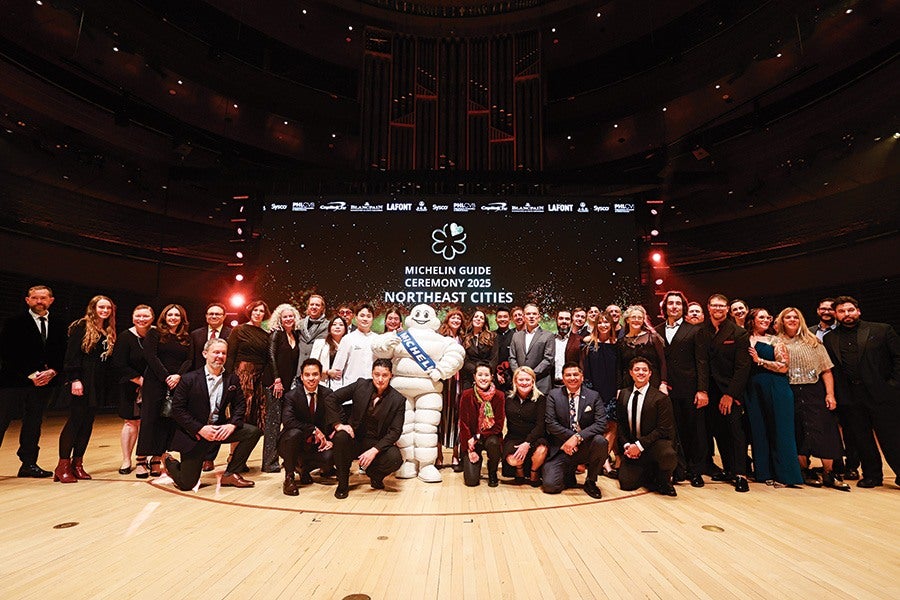
In November, the city’s dining-scene luminaries gathered in Philadelphia for the unveiling of Boston’s first-ever Michelin Guide. / Photo by Marc Patrick/BFA.com
The presentation started with the recommended list. Five restaurants were called, then 10, then 15, then 19. Asta, Mooncusser, Nightshade Noodle Bar, Wa Shin—tasting-menu spots that had surfaced on just about every Boston prediction list published over the past six months—rolled across a gigantic screen above the stage.
For those in the building who had noticed all the Boston-area chefs milling around the reception, something was becoming uncomfortably clear: The city wasn’t going to walk away with an armful of stars. By the time it was over, 19 restaurants had earned recommended status, and six got Bib Gourmands. One restaurant—South End spot 311 Omakase—took home a star.
The reaction was immediate and merciless. Local content creators Marc Lewis and Marwa Osman, of @thecitylists, held up the list and its meager handful of picks as evidence that Boston’s restaurant scene has a long way to go. Boston.com polled nearly 100 readers and found that 74 percent disagreed with Michelin’s selections. How had local darlings like chef Cassie Piuma’s Sarma, Comfort Kitchen in Dorchester, or Italian favorite Tonino been left out entirely? Had Boston bet big just for this?
The answer was, for better or for worse, yes. And the story of how Boston got here had been years in the making. In recent times, Michelin—the more-than-century-old French tire company turned global restaurant arbiter—has become a worldwide marketing juggernaut and money-making machine with a simple business model: Tourism boards pay for new guides. And Boston’s tourism arm, Meet Boston, led by president and CEO Martha Sheridan, paid handsomely for a three-year deal. (Meet Boston declined to disclose the exact figure, but other U.S. cities, such as Atlanta, have paid sums around $1 million for three years. The Boston Globe reported in May 2025 that the partnership between Meet Boston and Michelin “costs just over $1 million.”)
It was a move initially championed by local hotels and chefs alike. Yet the results—26 restaurants, one star—left kitchen insiders with a burning question: Was it even worth it?
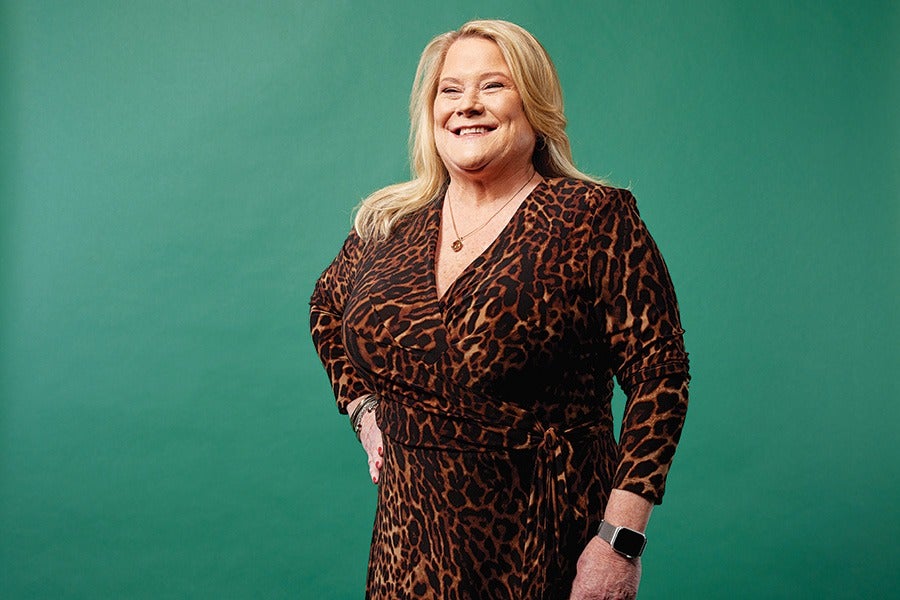
Meet Boston CEO Martha Sheridan, who initially resisted Michelin but changed course after hearing from local chefs. / Photo by Ken Richardson
Three years earlier, when Sheridan heard the word “Michelin,” her mind snapped to images of white tablecloths, cosseting servers, and a guide that only promoted exclusive restaurants in expensive neighborhoods. Tasked with championing Boston to the world as head of Meet Boston, the city’s tourism organization, she wasn’t interested in ponying up the estimated seven figures to promote that image.
In spring 2023, I approached Sheridan while I was the editor of Eater Boston, writing a story about why Boston didn’t have a Michelin Guide and how the organization’s pay-to-play model worked. When I asked whether she would consider paying for the guide if it came calling, she said no. “Making that kind of investment for what would likely be a smaller subset of our restaurant community probably wouldn’t make a lot of sense for us,” Sheridan said at the time.
The story, published on May 3, landed like a grenade. Some cheered Meet Boston, praising the organization for not paying into Michelin’s scheme. “The next time your NYC friends shit on Boston food, you can tell them Boston’s food is so good that we don’t need to pay to play,” @BostonFoodGuide posted on TikTok. Others thought the decision was shortsighted and didn’t take into account Michelin’s impact within the restaurant industry. “Challenge and pushing for competition is the way to bring a better food scene in our city,” Bonde Fine Wine Shop, a boutique Cambridge shop, wrote on Instagram.
One of the people reading the story was Tom Schlesinger-Guidelli, a lifelong Boston-area resident who had spent years working inside some of the area’s most sought-after restaurants, including one-time Cambridge hot spot Craigie on Main. He now runs Alcove, a neighborhood-y waterfront spot with a deep wine list in Boston’s West End.
Even though Schlesinger-Guidelli worked with Meet Boston as a culinary ambassador for the city at the time, Sheridan’s take didn’t sit right with him. “I wasn’t really a fan of that response,” he says. “I’m a rising-tides-lifts-all-boats kind of guy, and the more focus and attention that we have on the city’s culinary scene is an opportunity for us to continue to get better, and continue to be looked at throughout the country, and the world, in a way that I think that many of the chefs, restaurateurs, bartenders, wine professionals, and cooks deserve to be looked at—as real restaurant professionals.”
He had another reason to worry. Boston’s food media scene was shrinking fast. Fewer local outlets were writing about Boston’s restaurants, which meant fewer reasons for the rest of the country to pay attention. The Improper Bostonian and the Boston Phoenix had folded years ago, and there was only one full-time restaurant critic left covering the city. In the aftermath of 2020, when Boston needed more coverage of its restaurants, there had never been less. “I didn’t feel like we had the resources locally to advocate for ourselves nationally,” Schlesinger-Guidelli says. “And I felt like we were losing talent as a result of it.”
So Schlesinger-Guidelli decided to do something about it. Two days after the Eater story came out, he was on the phone with his publicist, Martha Sullivan, who has worked for decades as a restaurant rep for some of the Boston area’s top chefs. “I said, ‘Well, why don’t we get in a room with Meet Boston?’” he recalls. “These are great people. I think we can have an honest conversation about why we think [Michelin] is important—and why it might not be.”
It wasn’t a sure bet that they would be open to talking, Sullivan told him. “Some people make a decision and move on,” she says. “I didn’t know if the book was closed.” But she decided to give it a try. Later that same day, she reached out to Sheridan and her communications director, Dave O’Donnell. “I said, ‘Hey, I saw the article in Eater. I would love to share with you some input from other chefs. Would you be open to coming to Alcove?’”
Eighteen minutes later, Sheridan responded. She was in.
Three weeks after that, the Meet Boston duo headed to Alcove for a roundtable lunch with Schlesinger-Guidelli, Sullivan, Pam and Chris Willis of Pammy’s, Trevor and Kate Smith of Thistle & Leek, Douglass Williams of Mida, and Carl Dooley of Mooncusser. Inside Alcove’s private dining room, over a casual spread of salads and sandwiches, the chefs opened up, one by one, about their experiences working in Michelin-starred kitchens in other cities and countries.

Decoding Michelin
The five factors inspectors use to award stars—and what each rating means.
MICHELIN’S 5 CRITERIA
- Quality of ingredients
- Harmony of flavors
- Mastery of cooking techniques
- Chef’s personality on the plate
- Consistency in execution
WHAT THE RATINGS MEAN
★★★ Exceptional cuisine, worth a special journey
★★ Excellent cooking, worth a detour
★ High-quality cooking, worth a stop
Bib Gourmand: Exceptional cooking at a great value
Recommended: Good cooking, not yet star-worthy
Dooley recalled that when he worked in Washington, DC, prior to Michelin launching a DC guide, the city was known for politics, and that’s about it. Now, its restaurant scene regularly commands national headlines. Williams laid out what it would mean for Boston’s next generation of cooks to be able to have a shot at Michelin without decamping to New York or Chicago. The group talked through Michelin’s different categories, and how it didn’t only spotlight $300 tasting-menu spots. “One of the real fears was that we were going to do all this work and figure this all out, and one restaurant was going to be the only thing that mattered,” Schlesinger-Guidelli says. “[We were] trying to have a conversation about how much bigger Michelin is than just the stars.”
Throughout the lunch, Sheridan and O’Donnell listened more than they talked. “It wasn’t a ‘you should, you should, you should,’” Sheridan says. “It was just more like, ‘listen to our perspective’ kind of thing, and educate us.”
Afterward, the talent-retention argument stayed with Sheridan. “It builds a legacy,” she says. “I’m all about legacy. This organization, we’re building a legacy for tourism in Boston. I hadn’t thought about that aspect of it. I only thought about the guide itself, the dining experience.”
If Michelin could help attract and retain chef talent in Boston, making the city a more attractive place to take big swings—and keep pushing Boston forward as a culinary destination—then Sheridan was listening. “I have always wanted to elevate Boston’s culinary scene,” she says.
But she wasn’t going to beg. Though Sheridan was ready to have another look at Michelin after the lunch, she didn’t want to simply go knocking on their door. “I wanted it to be their idea and not mine, because I felt like, if we’re going out to them—and I knew they had a pricing model—like, I wanted them to not think we were chasing it, right?”
So she and O’Donnell reached out to John Fraser, a New York City–based chef and restaurateur who was expanding to Boston with a mini food hall and steakhouse inside Downtown Crossing’s Winthrop Center. Fraser had run Michelin-starred restaurants in New York, and his newer Tampa restaurant, Lilac, had just won a Michelin star following the hospitality group’s recent expansion into Florida.
The pair listened to Fraser’s pro-Michelin perspective before O’Donnell dropped a hint at the end of the conversation. “If you ever hear about them wanting to engage with us,” he said, “just let them know that we’re, you know, perhaps more open-minded than they might have thought if they read the Eater article.”
The stage was set.
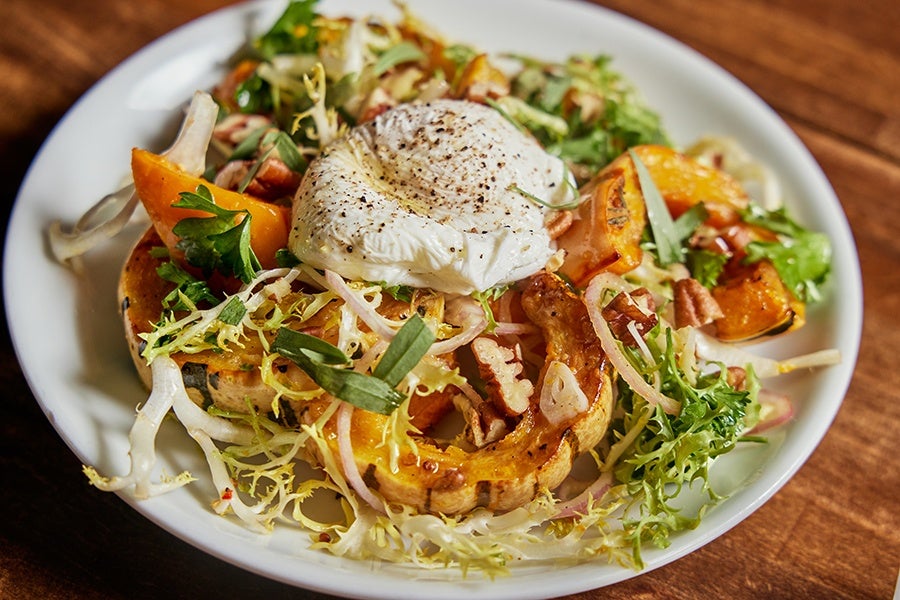
Thistle & Leek. / Photo by Brian Samuels
By the end of 2023, Michelin reached out to O’Donnell and Sheridan. It’s not clear whether the company heard Meet Boston had changed its mind, but in any case, Michelin had conducted a “destination assessment,” according to a spokesperson, and deemed the Boston area worthy. Thus the courtship began. Michelin put its best foot forward, presenting case studies and statistics positioning itself as a marketing tool for city tourism organizations. A Michelin-commissioned Ernst & Young study shared with Meet Boston offered data points like these: 57 percent of frequent travelers said they’d extend their stay at a destination if there were Michelin restaurants nearby, and 61 percent of frequent travelers, when presented with two similar tourism options, said that the existence of Michelin “is decisive” in where they choose to go.
Around this time, according to O’Donnell, restaurant inspectors started coming to Boston. Michelin was hedging its bets. If Meet Boston eventually agreed to pay for a guide, the organization wanted to make sure that there would actually be something to publish. (“We don’t reveal specifics about the inspectors’ methods, but generally the process takes several months, at least,” according to a Michelin spokesperson.)
As the talks grew more serious, Sheridan and O’Donnell had one more important task: convincing a slew of local hoteliers that Michelin was worth the price tag. Early on in her tenure as CEO of Meet Boston (at the time, the Greater Boston Convention & Visitors Bureau), Sheridan had spearheaded the formation of the Boston-Cambridge Tourism Destination Marketing District (TDMD), which includes all hotels within the two cities with 50 or more rooms. The idea was that since destination-based marketing has a direct impact on hotel bookings, it was in Boston hoteliers’ best interest to fund those marketing efforts. A 1.5 percent fee gets tacked onto hotel guests’ bills, with the money set aside for tourism marketing projects and development.
The move had helped Meet Boston grow from an annual budget of $10 million to $50 million, according to Sheridan—but not without stipulations. Instituting the TDMD also involved the formation of a committee of hoteliers overseeing how Meet Boston spends those millions of dollars. It was that committee that Sheridan and O’Donnell now needed to convince that the Michelin play was worth it. “We suddenly were playing the role of those chefs at Alcove,” O’Donnell says. They had gone from completely writing off Michelin to thinking it was worth the considerable sum it charges tourism boards. Now, they needed to walk the hoteliers through a similar shift in perspective.
Carlos Bueno, general manager of the luxury Back Bay hotel Raffles Boston, recalled the TDMD board meeting at Meet Boston’s office downtown, where the Michelin play came to a vote. Reps from Michelin presented statistics on how the guide boosts foot traffic and hotel bookings. Sheridan and O’Donnell brought in Schlesinger-Guidelli, Williams, and Cambridge chef and restaurateur Will Gilson of Puritan & Company to talk about what the guide would mean from a dining-scene perspective—basically, a 20-minute version of the lunch at Alcove. Williams recalled reiterating the same points to the assembled hoteliers that he had at Alcove, though by this point, he was ready for someone to just make a decision already.
The hoteliers weren’t easy to convince. The estimated million-dollar price tag was significant, especially for a proposal where the benefit to hotels wasn’t immediately clear (as opposed to, say, supporting Boston’s bid to be a World Cup host city). Ultimately, though, the hoteliers began to see Michelin as a selling point, especially if they were going to compete with cities like Orlando or San Antonio for meetings and convention business. Raising Boston’s profile as a dining destination, they decided, would translate into more business for their hotels. The expenditure got their stamp of approval.
O’Donnell then went across the river and served up a similar pitch to the Cambridge Office for Tourism board, since Cambridge would be footing about 25 percent of the bill. Some of the committee members, including the office’s executive director, Candice Beaulieu, had already warmed to the Michelin proposal. Revenue from the city’s meals tax had been declining, an indicator that residents might not be dining out as much. This was a way to spotlight Cambridge restaurants on a much larger scale than, say, a restaurant guide on Cambridge’s tourism website.
The committee voted in favor of the proposal, and the deal was done. Greater Boston was getting a Michelin Guide. “It felt incredible,” O’Donnell says.
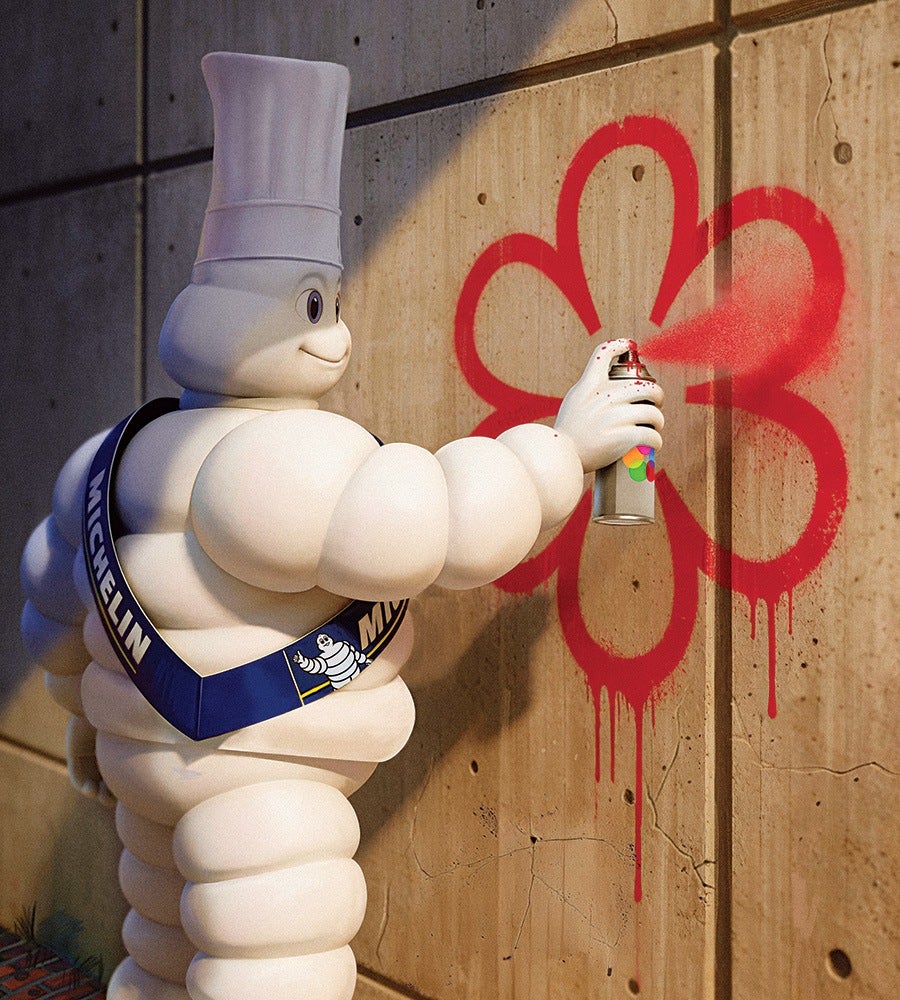
Illustration by Dale Stephanos
On Monday, May 12, 2025, the announcement went wide. Michelin was heading to Boston. The online reactions came fast and furious, from pure excitement to shock and dismay that Boston was, in fact, going to pay to play after initially saying it would never.
While diners debated who would make the Michelin list, chefs tied on their aprons and got to work. Dooley Googled the names of solo diners booked at Mooncusser to see if anyone might be visiting under a suspicious alias. At 311, the South End Japanese sushi spot that ultimately earned Boston’s only Michelin star, co-owner Carrie Ko kept an eye on diners, too, wondering if they were inspectors. Jason Doo, chef-owner of American-Chinese restaurant and tiki bar Wusong Road, posted an ad on Instagram offering to pay diners who were familiar with Michelin to come eat at the restaurant and test whether it would make the cut for a Bib Gourmand. Chef Robert Sisca turned the occasional tasting menus at Back Bay French restaurant Bistro du Midi into a nightly affair, just in case that might make the restaurant more attractive to Michelin.
A few weeks ahead of the mid-November launch of Boston’s first guide, the whispers started circulating. Michelin didn’t release a list of awardees to Meet Boston ahead of time, so everyone was left to piece together who made the cut on their own. Chris and Pam Willis of Pammy’s had received an invite to the awards ceremony in Philly, and so had Michael Serpa of Select Oyster Bar. Dooley and Rachel Miller, of French-Vietnamese tasting menu Nightshade Noodle Bar in Lynn, were in. The entirety of Columbus Hospitality Group (Mistral, Ostra, and Mooo…, among others) and Himmel Hospitality Group (Grill 23 & Bar, Bistro du Midi, the Banks Seafood and Steak, and Harvest) were out. Not one of the properties within powerhouse Xenia Greek Hospitality (including Kaia, Bar Vlaha, and Krasi) had gotten a Michelin ticket. “By the time we got to Philly, I was aware of about 18 of the 26 or so,” O’Donnell says. “But [we had] no idea if these were stars, Bibs, recommended, whatever.”
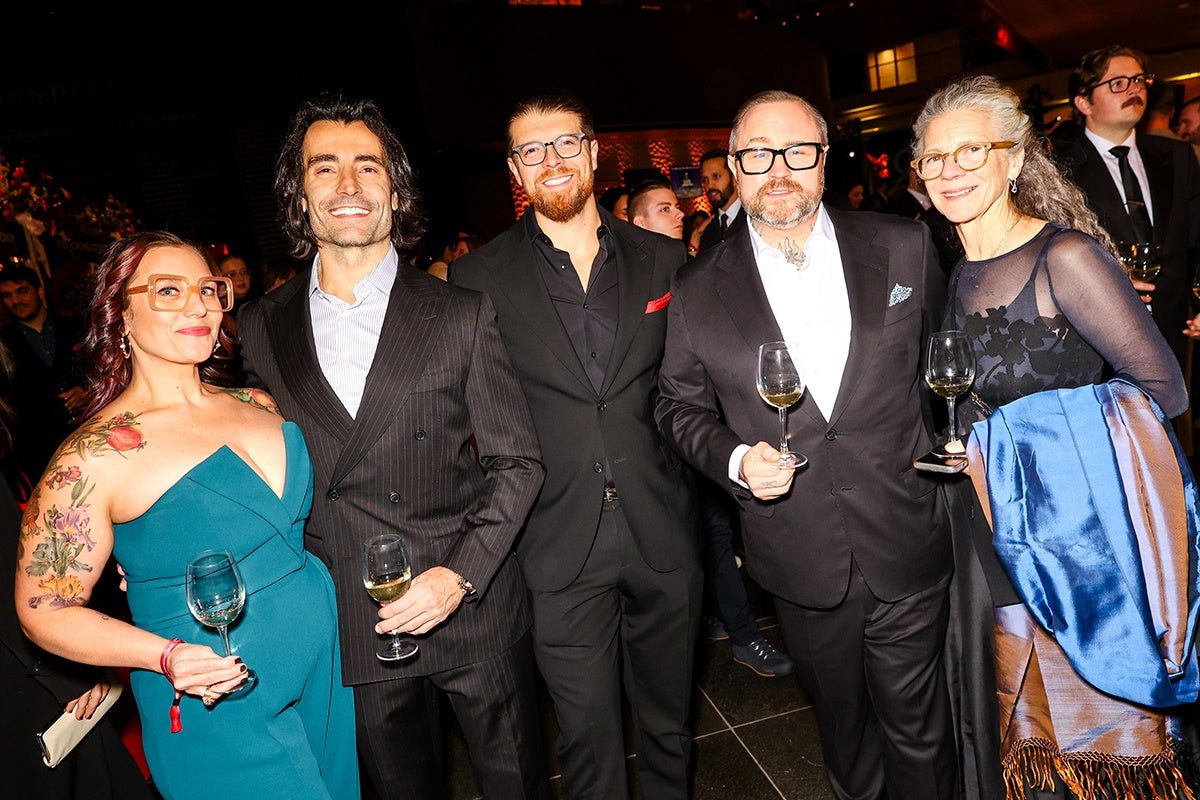
From left: Karen Akunowicz (Fox & the Knife, Bar Volpe), Eric Papachristos and Jon Mendez (A Street Hospitality), Jamie Bissonnette (BCB3 Hospitality), and Jody Adams (A Street Hospitality). / Courtesy
Then came the ceremony. There were some highs: Boonnak had nabbed a big-deal cocktail award for the region, beating out New York, DC, Chicago, and Philly for the honor. A couple of restaurant owners received nods for all of their spots: Chef Karen Akunowicz swept up Bibs for both of her Boston restaurants, Fox & the Knife and Bar Volpe, and Michael Pagliarini and Pamela Ralston, the duo behind Cambridge restaurants Giulia and Möeca, were awarded recommended status for both of their places. A third of the selections were for Asian restaurants, including Uyghur, Thai, and Japanese spots, tipping a hat to Boston’s strong Asian food scene. The inaugural guide also underscored Boston as a hub for talented female chefs, with Akunowicz, Ana Sortun (Oleana), Jody Adams and Amarilys Colón (La Padrona), Rachel Miller (Nightshade Noodle Bar), Erin Miller (Urban Hearth), Tracy Chang (Pagu), and Kate Smith (Thistle & Leek) all receiving recognition.
Yet there was no mistaking the feeling in the air that Boston’s guide was, well, thin. South End omakase restaurant 311, run by the husband-and-wife team of chef Wei Fa Chen and Carrie Ko, took home the city’s only star. Where was Cassie Piuma’s Sarma, the eight-time James Beard honoree? How about Boston’s hottest new restaurant in recent memory, Comfort Kitchen? Or the elder statesmen of Boston’s fine-dining scene, like O Ya and Uni? It didn’t help that another of Boston’s Northeast rivals, Philly, was also getting its inaugural guide that night. Everyone in the audience watched as the (admittedly more populous) city beat Boston out with 33 restaurant selections, including three one-star awards.
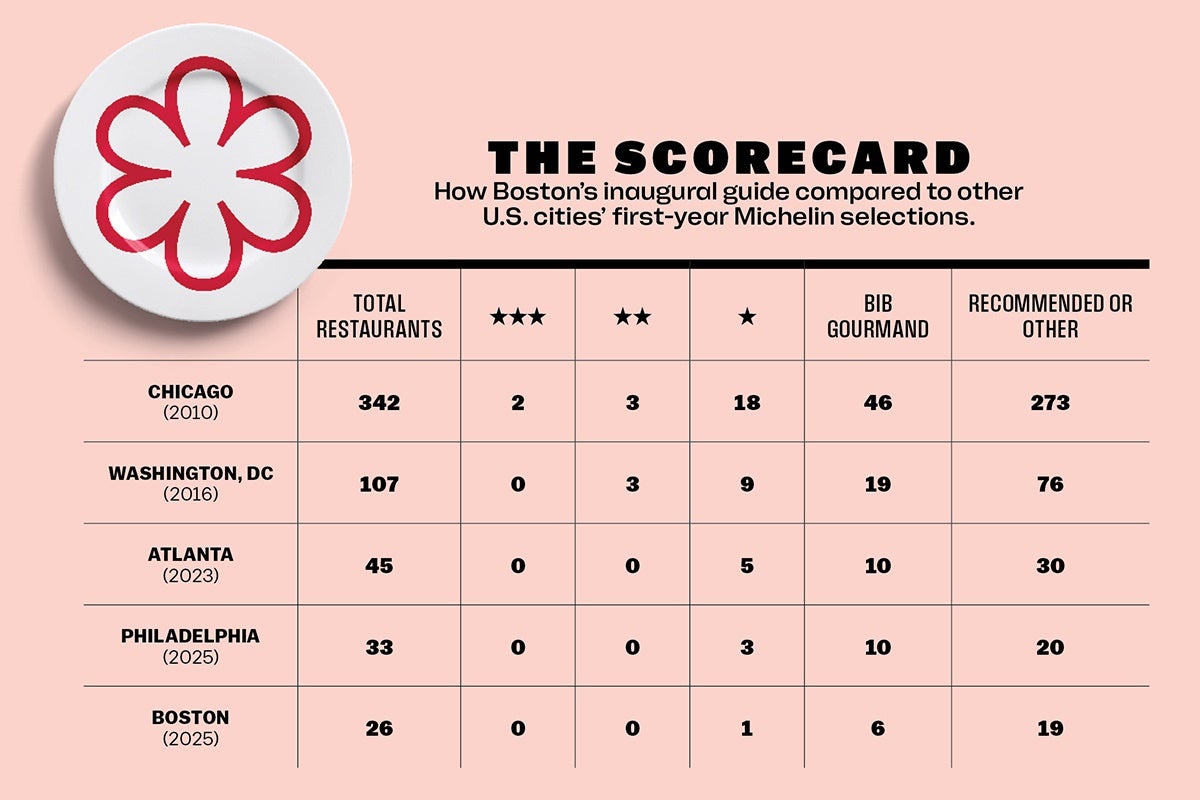
The next morning, the headline practically wrote itself: “Boston Scores Just One Michelin Star After Paying to Get Rated,” a Bloomberg story blared. Locally, the coverage was kinder, cheering on the whole group of restaurants in the guide versus singling out the lone star. Still, no one’s prediction list had guessed this outcome. For chefs like Dooley, who won “recommended” status for Mooncusser but was hoping for a star, the guide felt like a gauntlet thrown. “I think there was a little bit of an emotional letdown, like, ‘Oh, we didn’t do so well as a city,’” Dooley says. “But then, I think that immediately turned to—certainly for me—the competitiveness to be like, ‘Okay, we’ve got work to do.’”
For Ko and Chen, the moment was pure validation. A few years earlier, after supporting Ko in her dream to launch a medspa, the couple had turned to focus on Chen’s dream to open his own restaurant. Every decision involved sacrifice. Chen trained at the then-three-Michelin-starred sushi restaurant Masa in New York City, driving back to Boston every week to spend his one day off with Ko. When the pair signed the lease on the South End space, they ran through their savings and were using credit cards to make up the difference and get the restaurant off the ground. Ko worked a second job during the day until almost a year after the restaurant opened. They opened without a liquor license and were unable to get one until nine months later.
Still, they knew exactly what they wanted. In Chen’s bio on 311’s website, he stated that he was striving for “Michelin-level excellence” in the restaurant, two years before Michelin announced its entry into the city. The duo is meticulous about sourcing in every area of the restaurant; Ko can say exactly where, when, and from whom they bought each piece of serveware used during dinner service. The pair fought tirelessly to convince high-end seafood purveyors who mostly did business in New York to expand deliveries to Boston. In one instance, the president of a Japanese company was more willing to work with 311 after dining at the restaurant and determining that Chen was talented enough to carry their products.
The couple recently spent upward of $3,400 for 20 pounds of Oma tuna, a legendary type of bluefin tuna caught near the town of Oma, located on the northernmost tip of Japan’s Honshu Island. Ko did some quick calculations during a recent interview on the restaurant’s one closed day per week. The price per pound of Oma tuna worked out to about $20 per slice served during the omakase. The current price of dinner at 311 is $280 for 18 courses. Between their uncompromising sourcing standards and the constant spiking of ingredient costs due in part to the tariffs levied over the past year, “we don’t make money from the food,” Ko says.
This way of running a restaurant is not feasible for everyone, nor should it be the only yardstick that determines a successful restaurant. Fellow South End resident George Mendes, a longtime chef who ran his own Michelin-starred restaurant Aldea in New York City for a decade before moving to Boston to lead culinary operations at Raffles, then branching out on his own with a forthcoming South End tasting-menu spot, is careful to explain that Michelin isn’t the only gauge by which to determine a great restaurant. The organization states plainly that it only cares about what is on the plate. “It’s really putting the chef under a microscope,” Mendes says.
Despite how difficult it is to win Michelin’s favor, Mendes and Ko both expected Boston to earn more accolades. Ko says that she and Chen were both surprised but also sad to be the only ones on stage receiving a Boston star that night. Mendes, for his part, wasn’t surprised that 311 earned a star—but he was surprised that it was the city’s only star, given the “depth of talent” that exists in Boston’s dining scene. “There are so many talented chefs, and I’ve eaten in so many great restaurants [here],” he says.
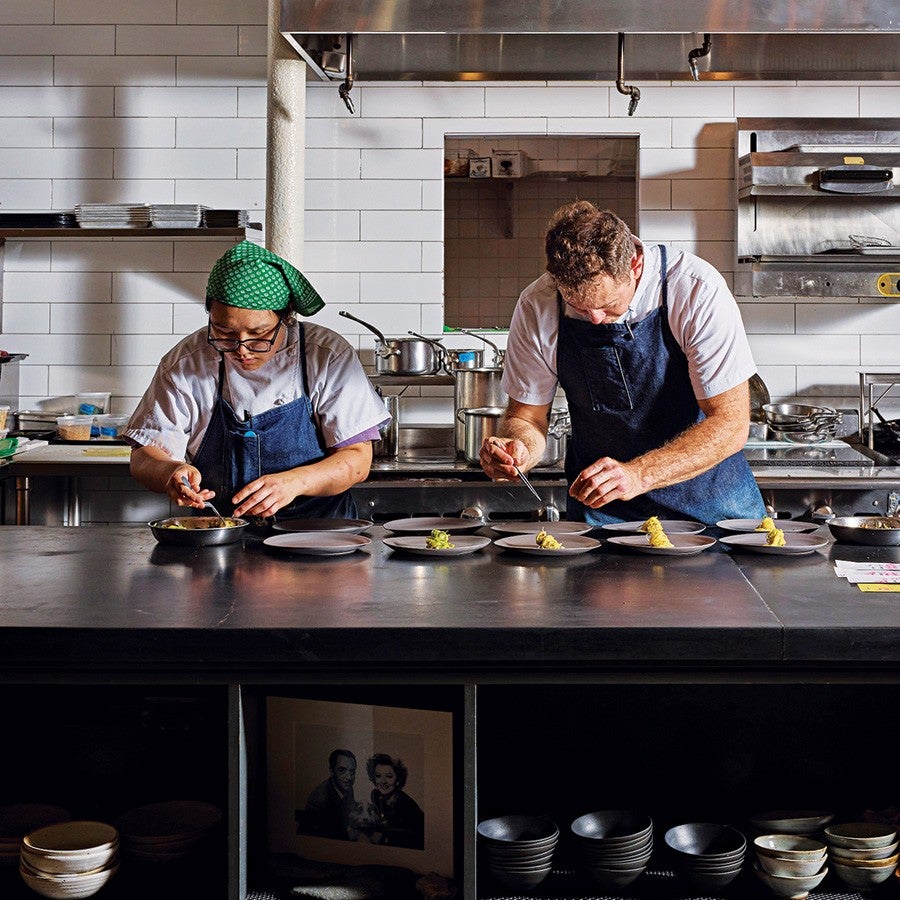
Asta’s kitchen team, including chef-owner Alex Crabb. / Photo by Kristin Teig
Due to the way Michelin shrouds its operations in secrecy, it’s impossible to know exactly how the inaugural guide was shaped. Michelin doesn’t disclose how many inspectors it dispatches to a new city or how many restaurants it visits to determine its inaugural lists. Still, when Nyacko Pearl Perry heard that the Michelin Guide was launching in Boston, she knew right away that Comfort Kitchen, the Dorchester hot spot that she co-owns with partner Biplaw Rai, probably wouldn’t make the cut.
It didn’t matter that the restaurant had swept up just about every local restaurant award available, or that it had secured a James Beard nod in every award cycle since it opened three years ago. Comfort Kitchen doesn’t fit the bill for Michelin, “and I say that even not knowing exactly what they’re looking for,” Perry says. For starters, it’s run by a Black chef, the menu focuses on tracing the spice routes out of the African diaspora, and it’s located in Dorchester, which historically does not see a lot of shine as a dining destination. There are far fewer African restaurants in Michelin’s guides versus French or Italian fare; and who knows which neighborhoods the non-local inspectors were visiting when they touched down in Boston. (Michelin, for its part, notes that its inspectors have “no set quota on the types of restaurants or cuisine types included in a selection.”)
Perry also acknowledges that the restaurant has evolved significantly in its three-year lifespan. “We are working on consistency,” she says. “It’s a growth area for us, as it is for many restaurants.”
David Doyle, the Jamaica Plain restaurateur who co-owns Centre Street hot spots Tres Gatos, Tonino, and Casa Verde, is more forthright in his criticism. “Michelin as an arbiter of taste, for me, is a little suspect,” he says. Doyle believes the standards that Michelin looks for, especially in its star ratings, are at odds with what it takes to build a successful restaurant in Boston: warm service, a community focus, and the kind of price point that can sustain regulars. The organization, in his mind, wasn’t interested in restaurants that function as cornerstones of their community and pack dining rooms on Monday nights.
“That whole notion of scarcity bugs me because there’s an implication that we just don’t have a lot of restaurants that qualify for whatever their standards are,” Doyle says. “I’m opposed to the idea, because, for those of us involved in the restaurant world here who take pride in what we offer, I feel like it automatically excludes a lot of wonderful chefs, and a lot of wonderful concepts that are beloved in their neighborhood and that really succeed as restaurants.” (The online uproar when Tonino didn’t get a Michelin nod, even with proven Boston talent Luke Fetbroth leading the kitchen, was almost visceral.)
Perry and Doyle’s critiques point to a larger question that Michelin faces in every city it enters: Can a European institution built on French fine-dining traditions recognize excellence in restaurants that don’t fit that mold? Michelin’s thin first guide—with no selections in Roxbury, Dorchester, Jamaica Plain, Mattapan, or Hyde Park, as well as the entire cities of Somerville and Quincy, which were all within Michelin’s stated geographic bounds—didn’t reflect the full wealth of neighborhood spots and immigrant-run kitchens that are a strength of the Boston dining scene.
A spokesperson for Michelin wrote in an email that inspectors worldwide are focused on five criteria when grading a restaurant: the quality of ingredients, mastery of cooking techniques, the “harmony of flavors,” how well the chef’s personality comes through on the plate, and consistency in execution. Whenever the organization expands to a new geographic location, the inspection team conducts “an initial study” of the area to “evaluate the main major culinary hotspots for the inaugural selection,” according to the spokesperson. They focused on “the metro Boston area” for the initial guide and expect to see the selections grow in the coming years. “It is only the beginning of our story with Boston, and as the Michelin Guide works on a long-term scale, we observe very often the extension of its geographical scope within a country, a region, or a state over time,” the spokesperson said.
Still, whatever Michelin’s blind spots, the hoopla that follows the organization wherever it goes translates into tangible benefits, according to every chef I spoke with for this story. Mendes predicts a stronger relationship with suppliers as chefs are more motivated to dial into their ingredient supply chain and work more closely with specific farmers in the region. Schlesinger-Guidelli hopes that Michelin aspirations will help stave off corporatism and guide developers toward favoring ambitious, independent restaurant ideas. Williams is already looking forward to the day when he can dine in a Michelin-starred restaurant run by one of the next generation of chefs coming up through the city’s kitchens. Now that inspectors are allegedly slipping in and out of Boston’s restaurants throughout the year, all diners will benefit from chefs who will be more on their toes, Dooley says. After all, Michelin recognition could be hanging in the balance.
Sheridan, who originally rejected the idea of Michelin because she didn’t want to pay for yet another spotlight on Boston’s white-tablecloth steakhouses, now calls that fear “unfounded” in the face of the guide’s initial selections, with its mix of Uyghur, Thai, Korean, and Hunanese restaurants alongside New England seafood stalwarts like Neptune Oyster. “It’s tamping down that feeling that people have about that sort of outdated perception of Boston’s dining experience,” Sheridan says. “When I hear the disparagement [about Boston’s dining scene], it sits so wrong with me.”
Still, was that worth an estimated seven-figure investment? Sheridan says it’s too early to tell. Chefs in the guide have been seeing upticks in sales, but the more important gauge to Meet Boston will be the overall buzz about Boston restaurants and whether Michelin’s presence boosts the number of hotel bookings in the city. “I think, really, years two and three are going to be what tell us, What does this really mean for us?” Sheridan says.
Bueno, Raffles’ general manager, says that post-guide launch, he remains “100 percent on board” with the decision to pay for Michelin. “When you’re making an investment like that, I don’t think you’re looking at 26 restaurants, or 50, or 100,” Bueno says. “You’re looking at the number of lives that we have the opportunity to impact. We take a look at the opportunity to elevate our city.” On that, Michelin promised many returns. Bueno noted, though, that when the contract comes up for renewal, the board will look at those statistics that Michelin initially presented to the TDMD and closely measure how they lined up with reality.
Back in Jamaica Plain, Doyle says Tonino will keep doing what it does best—friendly service, exacting standards, a packed dining room on Monday nights. If Michelin doesn’t notice, he notes, perhaps that says more about them than it does about us.
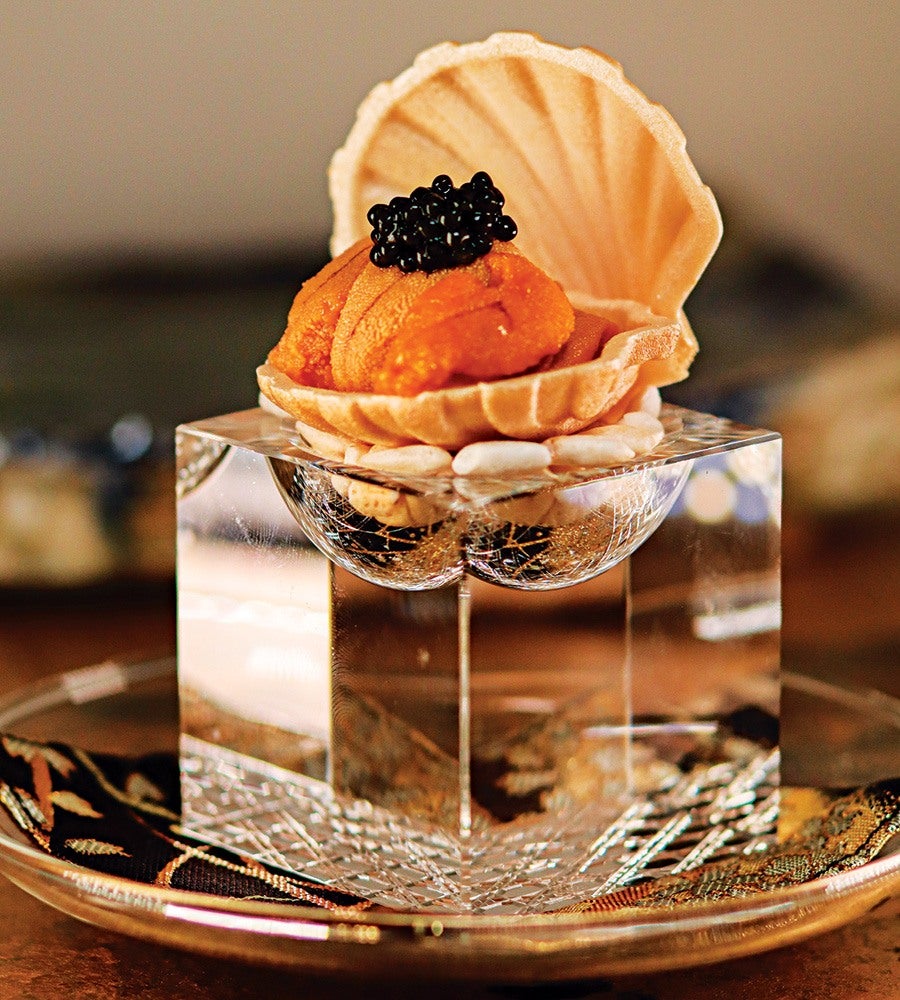
311 Omakase. / Photo via FWA Creative
The Complete List
All 26 restaurants that made Boston’s inaugural Michelin Guide.
ONE STAR
311 Omakase (South End; Omakase)
BIB GOURMAND (6)
- Bar Volpe (South Boston; Italian)
- Fox & the Knife (South Boston; Italian)
- Jahunger (Cambridge; Uyghur)
- Mahaniyom (Brookline; Thai)
- Pagu (Cambridge; Spanish-Japanese)
- Sumiao Hunan Kitchen (Cambridge; Hunanese)
RECOMMENDED (19)
- Asta (Back Bay; New American)
- Carmelina’s (North End; Italian)
- Giulia (Cambridge; Italian)
- La Padrona (Back Bay; Italian)
- Lenox Sophia (South Boston; New American)
- Moëca (Cambridge; Seafood)
- Mooncusser (Back Bay; Seafood)
- Neptune Oyster (North End; Seafood)
- Nightshade Noodle Bar (Lynn; French-Vietnamese)
- Oleana (Cambridge; Eastern Mediterranean)
- Pammy’s (Cambridge; Italian)
- Select Oyster Bar (Back Bay; Seafood)
- Somaek (Downtown Crossing; Korean)
- Thistle & Leek (Newton; British)
- Urban Hearth (Cambridge; New American)
- Toro (South End; Spanish)
- Wa Shin (Downtown; Japanese)
- Woods Hill Pier 4 (Seaport; New American)
- Zhi Wei Café (Downtown; northwestern Chinese)
For full descriptions of each Michelin-recognized restaurant, including what Michelin liked about them and what we like, read more here.
This article was first published in the print edition of the March 2026 issue with the headline: “One-Star Town.”
Related
- Our List of the Top 50 Restaurants in Greater Boston
- A Wish List for the 2026 Michelin Boston Guide
- Michelin Recognizes These 26 Greater Boston Restaurants
- The Michelin Guide Is Coming to Boston. Cool?