Remembering Jeff Lawrence, Weekly Dig Founding Publisher
He was a "thug who wanted to be an artist." He was a boss who paid in burrito gift cards. He was fun, impossible, and absolutely necessary—and he will be dearly missed.
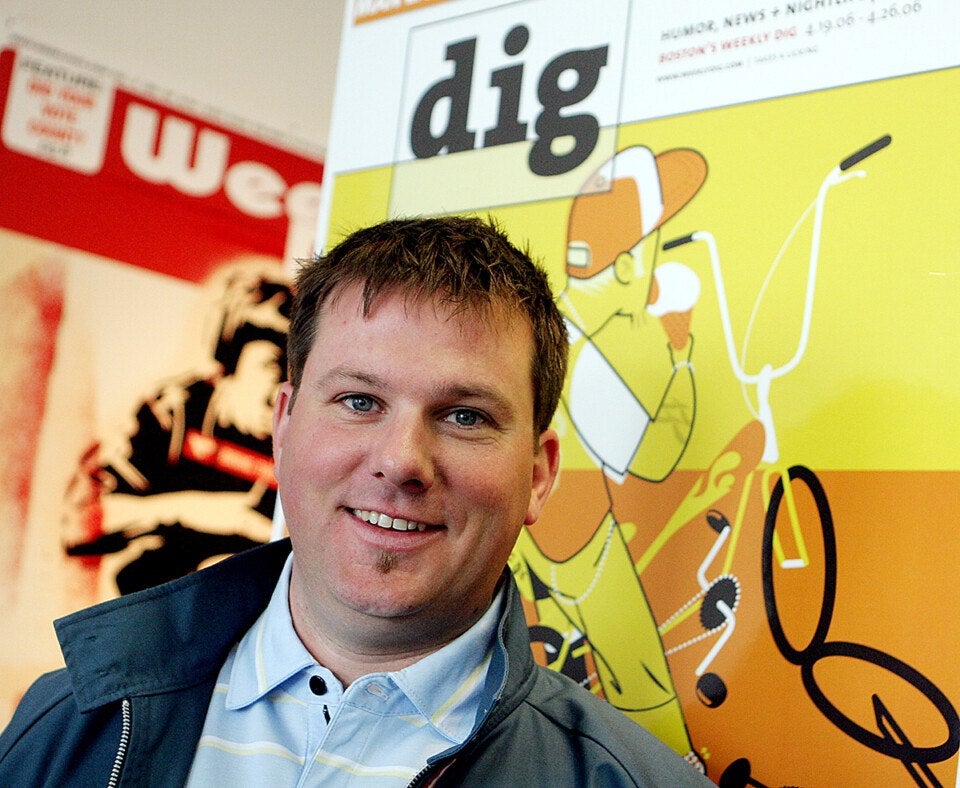
Jeff Lawrence, then-president of the Weekly Dig, in the paper’s office in 2006. / Photo by Angela Rowlings/MediaNews Group/Boston Herald via Getty Images
It’s every man’s dream at some time or another to punch his boss in the face. But thanks to Jeff Lawrence, I actually got to do it, because my boss was Jeff Lawrence.
And last week, we lost him. Jeff was the founding publisher of the Weekly Dig. He loomed large over this town for a while, made a lot of noise, had a lot of laughs, caused a lot of trouble, and launched dozens of careers in journalism, the arts, business, and politics. In the process, he shed more hilarious, harrowing, and hair-raising stories than any human being I’ve ever met—stories that everyone who knew him are still telling to incredulous civilians two decades later.
Jeff was also the founder of a music magazine called Shovel in the mid-90s, which led to an alternative weekly paper that, over its hard-fought two-plus decade run, was alternately called The Weekly Dig, Boston’s Weekly Dig, The Dig, DigBoston, and probably some others I’m forgetting. I was the editor-in-chief of this publication from 2003 to 2007, and I think we went through three names in that time alone. But the inability to decide what the paper was even called was apropos. Instability, and anarchy, and a gleeful refusal to honor journalistic, business, or social norms was part of the Dig’s DNA. And that was because all those things were part of Jeff’s DNA. They might have been all of his DNA.
Who was he? He’s hard to capture in words. But if you had to pick one, it would be “complicated.” Or, more politely, “complex.” One old friend from the Dig extended universe described Jeff last week as “A thug who wanted to be an artist.” And there’s something to that. Jeff loved music, but couldn’t play music. He loved writing, but couldn’t really write. He loved print media, but he couldn’t edit. He loved business, but when he put on a tie he looked like someone had dressed a bear up as a joke.
In other words, Jeff was an amateur. Now, others of that stripe—recall the Latin root of the word “amateur” is amāre, or “love”—generally go do something else for work, and enjoy these passions recreationally in their spare time. The problem with Jeff, though, is that he was Jeff. He entered the world a fully formed Jeff, and that Jeff happened to be uniquely unsuited for the demands of conventional employment and the genteel strictures of respectable society.
Others could make compromises. Jeff was hopelessly and immutably himself. He was like an animal thrust into an ecosystem for which it was wholly unsuited. For most living things, the choice would be binary: adapt or die. Jeff did neither. Instead, he simply willed a whole new ecosystem into existence—an ecosystem in which a rogue organism like himself could flourish. An ecosystem in which he could be maximally Jeff Lawrence. And that was The Dig.
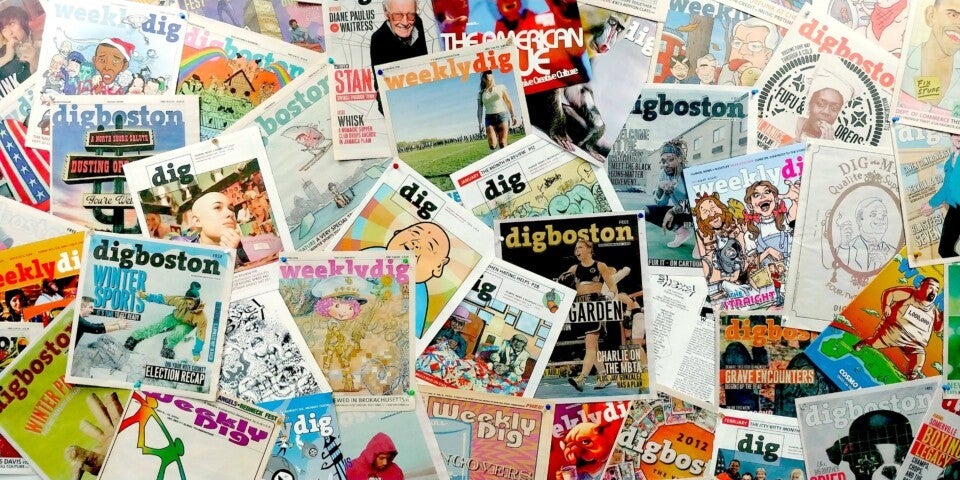
The Dig and its many iterations. / Via Facebook
The Dig was many things, but chiefly, I think, it was the product of Jeff’s limitations. I mean this in the best possible way. Instead of being an artist or writer or photographer himself, Jeff created an arena in which artists and writers and photographers could flourish, and then he defended it to the utmost, like an ogre at the gate.
There was simply nothing Jeff wouldn’t have done to keep The Dig alive. This was the role he was born to play. In service of his paper, Jeff was tenacious, tireless, ruthless, shameless, fearless, and incapable of ever taking a no. He was a bullshitter and a truth-teller, a heretic and a true believer, a charmer and bully, a gangster and a clown, a best friend and a blood enemy. His confidence was unshakable, his optimism psychotic. He had all these tools at his disposal, and he deployed them freely and without hesitation.
He was a bullshitter and a truth-teller, a heretic and a true believer, a charmer and bully, a gangster and a clown, a best friend and a blood enemy. His confidence was unshakable, his optimism psychotic.
The problem is, when your defense of an organization knows no bounds, it knows no bounds, and many of Jeff’s tactics were routinely brought to bear against his own staff. His go-to move when times were lean was to try to pay people in gift cards he got in exchange for giving ad space to a taco place on Commonwealth Ave. You’d be behind on rent, buying your pants used at The Garment District, barely managing to remain clothed and fed and alive on the meager salary he paid, and on pay day this grinning half an asshole would have one of those meaty arms around you, trying to convince you that you don’t need money to buy food. You can just buy food with these gift cards from a taco place!
There were many such maneuvers, and Jeff got away with all of them. Why? Because he had created something we all wanted to be a part of, something that existed nowhere else, and offered an unparalleled amount of creative freedom and hilarity. But he also got away with everything because he knew he would be forgiven. Because you couldn’t not forgive him. He was infinitely forgivable. And he knew it. As one former colleague said last week, “That man made me madder than just about anybody else I’ve ever known, but I could never stay mad.” I feel the same. I got into three full-on fistfights with the man in my time with the paper, including one that was so savage that, afterward, at a Cambridge bar, a bartender looked at me and ask the immortal question: “Dude, do you have blood in your hair?” And did I ever!
I don’t even remember what any of these fights were about. But I do remember that I’d come to work the next day, bruised and grouchy and usually hungover, and Jeff would come practically skipping in as if nothing had happened, and we’d be laughing again by 10am. That’s how it went with pretty much everybody. He’d do or say some horrible thing, and you’d lose it, and then he’d give you a look and all would be forgiven.
It was a testament to who he was, and what he was like to be around, that when he died last week, even the people he had serially screwed over were beside themselves with grief.
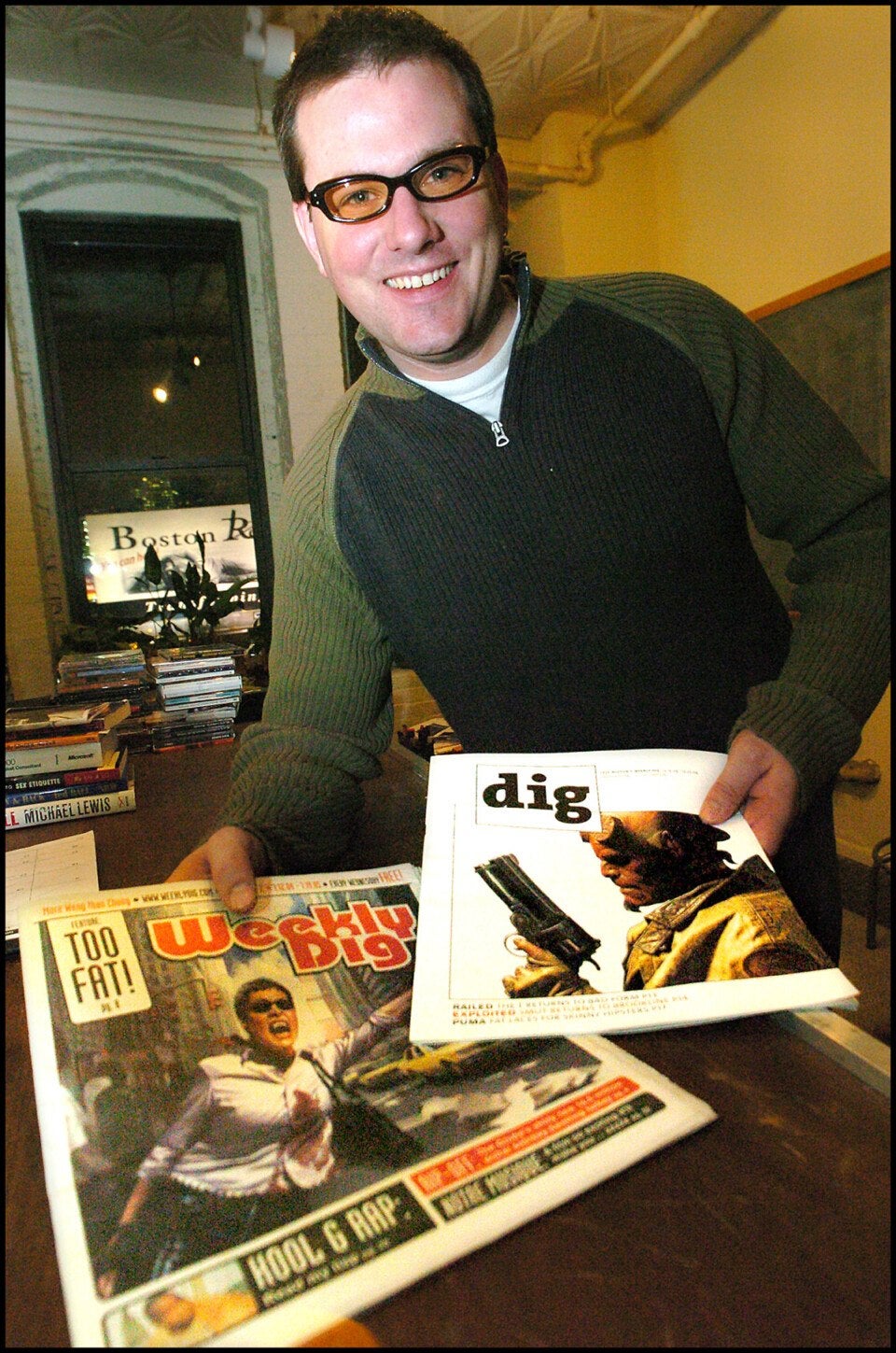
Publisher/President Jeff Lawrence comparing the old and the new covers of the Dig in 2005. / Photo by Michael Seamans/MediaNews Group/Boston Herald via Getty Images
But all that is to miss the defining characteristic of life with Jeff: Fun. He was massively, recklessly, ruinously fun. And it wasn’t conventional fun, either. Fun with Jeff had a real edge to it. It wasn’t like going to a party and having some laughs with your friend. It was like an ostrich got into your house and went berserk.
There are too many stories to fit in this space. But here are a couple of my favorites.
Once, we were in San Antonio for a newspaper convention. We were signed up for some panel, and we got bored almost immediately, as was our wont, and went and found an empty bar nearby. It had a laughably underage bartender and no cash register. Just a box of cash. We grabbed a couple beers and started playing pool. Then the bar started filling up with Mexican day-laborers. So Jeff started playing pool with them. The problem was, he was winning. And not just winning, he was eviscerating these guys, and making a lot of noise, and talking a lot of shit, and playfully jostling with people, like he did with everyone.
I was watching this scene from the bar, and I detected a change in the air pressure in the room. The mood had shifted. These guys had had enough. So I waved Jeff over.
“Hey, I think we gotta get out of here,” I said, indicating the room.
“Nahhh,” he said. “These guys are great!”
“I’m telling you,” I said.
And then one of the men approached Jeff, “Hey,” he said. “You’re leaning on my cousin.”
“What?” Jeff said, smiling.
“You’re leaning on my cousin.”
And Jeff turned around, and realized that he’s got this guy’s small and very unhappy cousin pinned against the bar behind him. Jeff jumped.
“Oh shit!” he said, laughing.
I took him by the arm, apologized to the man and his cousin. We beat a hasty exit and nearly died laughing on the way back to the hotel.
Then there was the time we were in Little Rock for another newspaper convention. In addition to very nearly getting hit by lightning on a city sidewalk in the middle of the day (“That was weird,” Jeff said), we stayed up all night at some riotous honky-tonk on the outskirts of town, leaving just in time (7:30am) to make our early flight. But then, as our former publisher (Jeff was President at that time) and myself waited for the cab to the airport, Jeff disappeared. We couldn’t find him anywhere. Our publisher was panicking that we’d miss the flight.
So I headed out to try to find Jeff. Eventually I found him: smoking a joint on the lawn of the Arkansas State House. I told him we had a plane to catch, and he said, “Gimme a sec.” Looking up at the State House, he took a huge drag off the joint, blew it at the building, flicked the joint into the grass, and said, “Okay, now we can go.”
We made it to the airport with maybe ten minutes to spare. Our publisher was practically hyperventilating at this point. Jeff noticed this, and thus decided it was time for a drink at the bar at the airport. The colleague was fully freaking out, but Jeff still wouldn’t let him leave. Not until the gate agent finally called all three of our names would he relent.
We made the plane at the last possible second, and as we walked up the aisle past all the annoyed travelers, Jeff was smiling and exclaiming, “Sorry everybody! That was us! That was our bad!”
He apologized all the way to his seat. And I have to imagine those people forgave him just like we always did.

Lawrence in 2007. / Photo via Getty Images
He was only 54. But an early end was, in some way, written in the stars. He never quite outgrew his youthful invincibility complex. That’s what made him so fun, and inspired, and daring, but it also marked him for an early exit. I remember him talking about his two kids, which he did incessantly, always with a sense of amazement at their intelligence, maturity, and solidity of character. It was hard not to see the relief that lived inside that amazement. May they have all his daring, his sense of infinite possibility, his humor and hope, but may they run long with it.
Jeff Lawrence took up a lot of space in his abbreviated time on this earth. He lived life at a roar and did it surrounded by people he loved. He made some beautiful things and some wild messes and some unforgettable scenes, and he did all of it with his full self. For a while, he gave Boston something no one else could have. And in so doing, he gave a few of us nothing less than our lives.
For those of us fortunate to have known him, his voice still rings in our ears, his anarchic spirit is burned into our DNA, and we can still feel that hammy arm on our shoulders as he sweetly talked us out of our own pay. Jeff didn’t believe in heaven, but I hope it exists. If only because I like to imagine Jeff Lawrence up at the pearly gates, talking, charming, wheedling, strong-arming, and trying to buy his way into the forever with a handful of gift cards.
Joe Keohane, who was also a staff writer at Boston magazine, is the author of The Power of Strangers: The Benefits of Connecting In a Suspicious World, and the co-author of the Thurber Prize-winning novel, The Lemon, under the pseudonym, SE Boyd. He lives in New York.