My Father Got a Green Card for Free. I Came to America and Got Stuck.
What happens when the American dream has a $30,000 price tag, a 15-year waiting list, and changing goal posts.
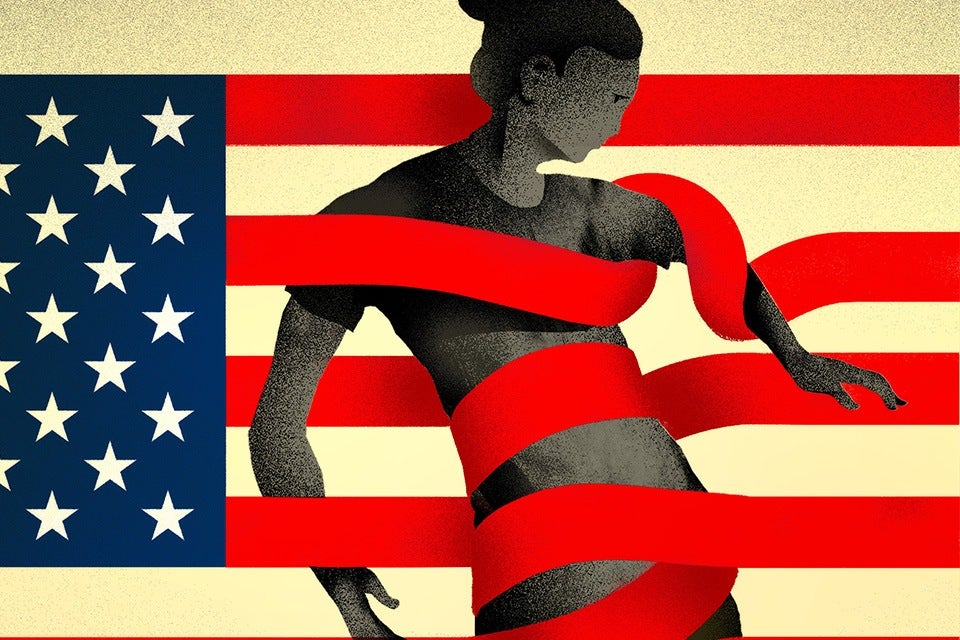
Illustration by Brian Stauffer
Two suitcases, $400 in traveler’s checks, and a two-year plan. That’s what I arrived at Logan Airport with in 1999, leaving behind my family and my job as a reporter in India to pursue a master’s degree in journalism at Emerson College—all at my father’s urging.
As an only child, my father alternately doted on me and feared for me—often with good reason. At the time, democracy in India was fragile, and being a journalist meant I often had to navigate shady liaisons between politicians and thugs in seedy bars where few women ventured. Journalists who asked too many questions often disappeared.
After a colleague was suspiciously found dead in a case that was never quite resolved, my father had seen enough. An engineer and inventor, he had lived and worked in the United Kingdom and United States during the 1960s and ’70s, before I was born. He firmly steered me toward pursuing higher education in a country where democracy was alive, journalism was noble, and public accountability was high. Particularly, a country where he felt he wouldn’t have to worry about his daughter getting killed just for doing her job.
In a city that often felt like a small town, I lived with roommates in a basement apartment in Allston, where I kept the two slit windows to my tiny bedroom closed because they faced the exhaust pipes of parked cars above ground. During our weekly calls, my father inquired about my studies, whether I was eating well, and if I was staying positive. On his advice, I found a local Salvation Army thrift store to buy warm clothes, pots and pans, and a boom box that I left on, vibrating all night on the wooden floor, to keep the mice at bay.
After graduating, I was hired as a cub reporter at the now-defunct Boston Herald–owned Community Newspaper Company, at the time the largest publisher of local newspapers in eastern Massachusetts. I took out a loan to buy a secondhand car—the job demanded I have one—armed myself with a paper map of the city and basically wrote the entire neighborhood’s news in the Allston-Brighton Tab for the princely sum of about $12 an hour.
After a year, the company agreed to sponsor my first employment-based H-1B visa so I could continue to work at the paper. Over the next six years, I worked hard, won awards, and built community. I was the only reporter of color in the multipaper newsroom and one of the lowest paid, despite having a master’s degree in journalism and experience at a major English daily in India. I loved the work and the newsroom camaraderie, and I never thought of asking for more.
As I moved up the newsroom ranks, though, I hit a snag. The two rounds of three-year H-1B visas allowed for foreign workers were about to run out, and it was time to decide whether I wished to go through the process of applying for residency to stay in the United States. I was conflicted. On the one hand, I missed my home and family. On the other, I had a new life, new friends, and sometimes boyfriends. I joined a Bengali music chorus. I volunteered at soup kitchens. I traveled to Martha’s Vineyard with my white friends, cooked chicken korma with my Bangladeshi friends, drank cheap beer with fellow reporters, celebrated Halloween and Thanksgiving, and moved to a nicer apartment in Somerville. I loved my “home” and didn’t want to be displaced. And I wanted to continue the work that I was doing in a country where I could still ask hard questions without fearing for my life.
The United States my father envisioned sending me to—shaped by his own experience as an immigrant—was a very different America than the one I encountered.
In the 1970s, my father worked as a designer of audio technology and had built a business with his best friend, whose family now lives in Ohio and has adopted me as one of their own. My mother, a lawyer, worked in the prosecutor’s office in Michigan, making—my father proudly stated—more money than his inventions drew in the early years of their marriage.
They lived the American dream in a ranch-style house in Benton Harbor. They cooked turkey for Thanksgiving, exchanged gifts at Christmas, cooked rice and dal at home, bought KFC for takeout, plowed snow in the winter, listened to music on the record player and speakers my father designed, and vacuumed a large orange shag carpet with another of his inventions—a Kirby vacuum cleaner.
Still, my mother’s view of life as an immigrant was less shiny. She missed home and her family. Despite her advanced degrees and motivating work, she felt isolated. Four years into their marriage, she flew home mid-pregnancy in 1974. She wanted to deliver her baby surrounded by family in the tradition of generations born at her Turf Road home. She decided not to return. So my father, who had just sold a patent for creating an automatic dual-capacity record player to Harman Kardon, refused royalties, took a lump sum, and rushed to relocate to Calcutta—a city he had not lived in for years—to be with his family. The company would go on to sell more than a million record players, he later told me with zero regret.
Back in Calcutta, my mother enjoyed working as a lawyer and came home to freshly cooked meals, buoyed by a supportive multigenerational family. My father traveled frequently as a consultant, and when he came home, my grandmother and her extended family indulgently poked fun at him for his western ways as he read childcare books and insisted on holding his baby daughter close for skin-to-skin contact. While my mother mainly listened to Indian classical music, his prototype record player smoothly crooned Louis Armstrong, Nat King Cole, Johnny Cash, and the Beatles as he rocked me walking up and down the black-and-white-checkered balcony of my grandmother’s 200-year-old house. I went on to grow up in Calcutta, listening to the same records on the player my father built. And eventually, I followed in his footsteps to become a different sort of migrant.
Years later, each time I traveled home to visit, I brought my father copies of the newspapers with my bylines in them. Flipping through my coverage of local government, cops and courts, assorted features, and the occasional scoop that beat the Boston Globe and the Herald, he wondered why I wasn’t doing more meaningful work in America. I said I’d get there, but really, I had no roadmap, no mentors. I was a hamster on a wheel, barely managing to make ends meet in a difficult industry and facing mounting debt.
When I called my father in 2007 to tell him I was applying for permanent residency and to ask for the $10,000 needed to start the process, he reacted with shock. “What do you mean you have to pay for a green card?” he asked incredulously over the clunky Nokia handset that was my first cell phone. “They just gave me one. I returned it when I left.”
“Things are different now,” I muttered. He insisted that filing for a more permanent status was important for my career and my stability in America. He wired the money to the Boston law firm that represented me, and I thanked him, mentally promising to pay him back.
That day never came. In 2008, I was home on a visit to India when he died suddenly of a heart attack. I looked at his lifeless body laid out in festive raw silk on a metal hospital bed, the white cotton wool stuffed up his nose rudely contrasting with the half smile on his brown face. Through the fog of shock and disbelief, I felt a wave of relief: He wouldn’t have to worry about my future in America anymore.
My father’s voice echoed in my mind: “You belong to the model minority, you work hard, America wants you.” But my reality made it hard to believe him.
Most green-card applicants get their approval within a few years, but Chinese and Indian nationals face the longest waits because of sheer volume and a per-country annual cap on the numbers of visas allotted, irrespective of population or the number of applicants. The system has a hierarchy: Doctors and researchers get first preference, followed by those with higher education degrees earned in the United States or equivalent work experience. Despite earning my master’s in America, I didn’t qualify for this category because of a minimum salary requirement that, as a journalist, I missed by thousands of dollars. Instead, I was forced into the lowest employment category—the one with the longest backlog.
While my application sat in the queue waiting to be picked up, I cycled through demanding, underpaid journalism jobs, reapplying every three years to keep my work visa current throughout the wait for residency. When anxiety crept in about the glacial pace, my father’s voice echoed in my mind: “You belong to the model minority, you work hard, America wants you.” My reality made it hard to believe him. Not really, I’d think. I’m not a lawyer or an engineer.
With my father gone, my extended network—cousins, friends, his old friends in Ohio—became my immigration check-in committee. I dodged their questions and bristled when they suggested I just get married, buy a house, or start a business. In an America growing increasingly polarized about immigration, making major life decisions felt too risky. What if something went wrong and I had to abandon everything?
Instead, I took lower-paying jobs, stayed in positions years longer than my peers, and watched opportunities slip by because I needed employers willing to sponsor my work visa—something not every media outlet would do. The government prefers you maintain the same position, salary, and employer throughout the process, and switching jobs means essentially starting over.
Still, I believed in the work. I covered stories that would have made my father proud: Cambridge police racially profiling Harvard professor Henry Louis Gates as he was breaking into his own home in 2009; ICE agents targeting undocumented workers at a Somerville garage; the passage of same-sex marriage in Cambridge; the election of America’s first Black president; the Standing Rock protests; the Flint water crisis. The journalism mattered, so I kept going.
In 2019, the national nonprofit news organization where I worked laid off its reporters in the midst of union negotiations and refused to renew my visa in one swift blow. It seemed like time to go home. But like many first-generation immigrants, I no longer knew what or where home was. My father was gone, and the home he’d made so welcoming for me no longer existed. My mother had demolished it and built a small apartment building in its place, moving into one of the flats. Most of my friends had left Calcutta, and the city I grew up in had also changed beyond recognition.
My American friends and family reminded me that my father had wanted me to live in this land of opportunity. So I scrambled for another job—any position where an employer would sponsor my visa and cover the costs. I found one doing communications for a nonprofit, which qualified as journalism-adjacent work in keeping with my degree, and I took it.
That same year—11 years after I first applied—my green-card application finally became current, meaning it had reached the top of the pile. Now that it is current, I have to apply for a new work visa annually instead of every three years. (The government assumes that once your application becomes current, residency will be approved within a year, but that is not the reality for people like me, from countries with long backlogs.) It’s been six years, and I haven’t been denied or approved for residency, so I’m still waiting, filing forms and paying fees, thousands of dollars deeper in debt. As I write this essay, President Donald Trump signed a proclamation proposing a $100,000 annual fee on H-1B visas. For now, it applies only to new applicants, not existing ones. But it’s hard to feel hopeful when the rules keep changing.
I have now lived and worked in the United States for more than 25 years—longer than I ever lived in India—and spent 17 of those years waiting for the elusive green card. I work as an investigative reporter in Vermont, documenting the havoc a second Trump presidency is wreaking on undocumented workers, refugees, immigrants, student protesters, and even citizens of color. As the backlog for Indian applicants crosses 11 million pending cases this year, I try not to think about what this crackdown means for longtime legal workers like me who are waiting, in limbo, for permanence.
My work has drawn threats, doxing, hate mail, and social media calls to “go back home,” but it feels more meaningful now than ever. I have a purpose and a unique perspective. I like to think I’m helping to fight for democracy in a fragile but still free nation.
At the same time, I’m grateful my father isn’t alive to see the state of his beloved American democracy or the embattled profession he ultimately felt proud I’d chosen. Mostly, I’m relieved he can no longer witness his daughter’s precarious future in the country that once simply handed him a green card.
This article was first published in the print edition of the November 2025 issue with the headline: “Permanently Temporary.”