Sam Kennedy Runs the Red Sox, Owns Zero Pairs of Red Socks
The Brookline native talks chocolate chip cookies, high school grudge matches with Theo Epstein, and why—hopefully—Boston fans don’t hate him as much as he sometimes thinks they do.
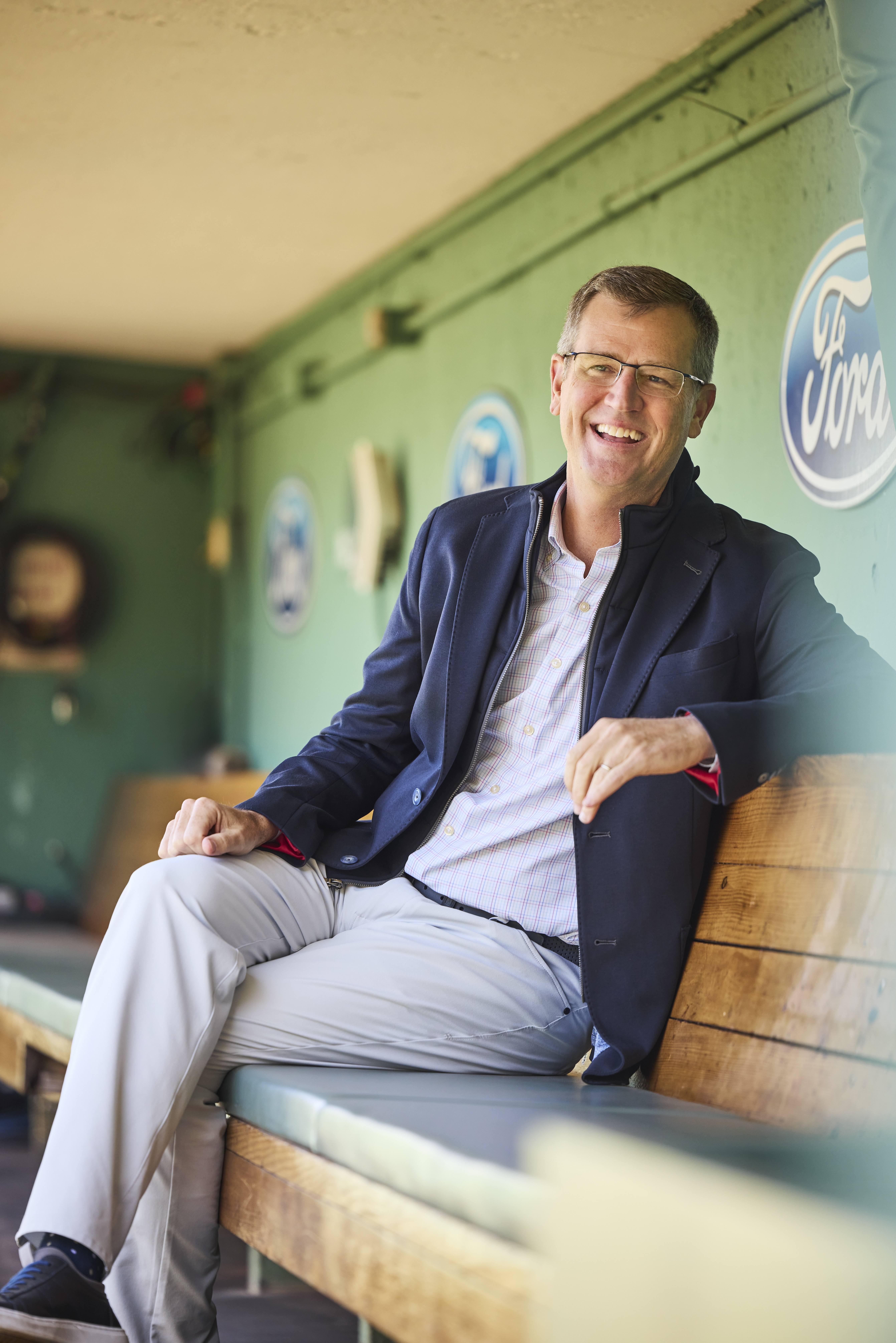
Photo by Pat Piasecki
This interview was originally published in our June 2025 issue. We are recirculating it now, timed to the Red Sox making the playoffs.
In the rarefied world of Boston sports management—where fan scrutiny is relentless and success is measured exclusively in championships—Red Sox president and CEO Sam Kennedy has mastered the high-wire act. Between orchestrating neighborhood development plans as head of Fenway Sports Group Real Estate, reuniting with his below-the-belt-punching Brookline High teammate Theo Epstein (see below), and serving on boards from Dana-Farber to Camp Harbor View, not to mention reportedly hooking up former Governor Charlie Baker with a job at the NCAA, Kennedy still finds time for his ritual of walking an empty Fenway Park before each home game. His most consequential power, though, is controlling the city’s mood, which swings dramatically with each win or loss. His only weakness? The chocolate chip cookies at Fenway—after all, even proven champs need a little comfort food in the late innings.
Best perk of the job?
Without question, being less than a mile from my parents, who are in their early eighties. My dad only comes to 70 or 75 games a year. [Laughs.] Fenway is where I grew up, and having my family around to share these past two-and-a-half decades, to share in all the highs and lows, is the best. When things are bad, I hear it first from my dad, so the criticism we get on the airwaves or in the Boston Globe is nothing compared to criticism from your own father.
I’m a huge fan of Honeygrow and Cava. I’m in and out of there quickly most days, but in the ballpark, I eat in the suite most nights.
Favorite Fenway snack?
It’s 81 nights a year sitting in there, so you’ve gotta be careful about what you eat. It’s tough, though. I can’t say no to the chocolate chip cookies. That’s my weakness during late innings.
Your three most prominent characteristics as a manager?
The answer would probably be better coming from somebody else, but number one, hopefully, is empathy for the role that people play. Understanding the challenges of their jobs. I grew up in baseball, and I’ve had a lot of different roles, so being empathetic toward people in every different position. Two, I would hope that people would say I bring a passion for the organization, and third would be a sense of urgency. We really cannot waste this golden opportunity. We’ve won four World Series championships in our time, and we’re really hungry for more.
Expectations for the rest of the season?
Definitely the playoffs. I feel we have a team that’s a much more balanced roster, and I think we have a chance to qualify for post-season. Once you get into October, anything is possible.
Do you have a game-day habit or routine?
I do, and I’ve been doing it since 1993, whether I was an intern for the Yankees, a mid-level employee at the Padres, or CEO of the Red Sox. I walk around the park, like five hours before the gates open, and just do a snapshot in my mind of an empty park. It’s the coolest visual, and I never, ever take for granted that I get to come to work here each and every day.
Best fan encounter?
That’s easy. I’m a frequent Dunkin’ visitor, like multiple times a day sometimes, but definitely every day. Most days, people are very kind, a lot nicer than what you might think, given the vibe on talk radio or digital media. One day, there was a young mother and her five- or six-year-old kid. It was after a fan fest where we literally got booed off the stage, and she said, “You know, Sam, I don’t know you, but you seem like a really nice guy. I just want you to know we don’t hate you as much as you think we do.”
How about an awful fan encounter?
I don’t have one. If you’re gonna be in baseball, and I can say this with certainty, having been in other markets: The Red Sox matter more to New England than any other franchise. So every time we’re booed, or there’s negativity, I know the anger is rooted in passion, and it will change quickly when we’re winning. I’ve participated in four parades, and you go from being an idiot, literally a moron, to “We love you!” “Will you run for mayor?” Any negativity is rooted in pure love for the team.
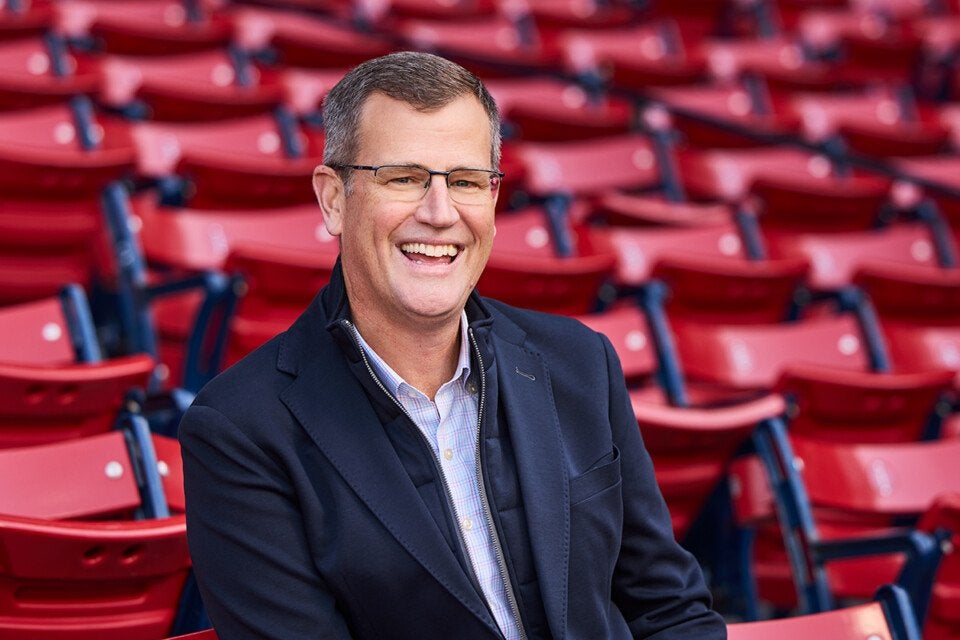
Photo by Pat Piasecki
Do you have a favorite sports-radio personality or baseball writer?
I have to say I’m a huge fan of Alex Speier [of the Globe] because he reminds me a lot of Peter Gammons. I grew up reading Peter Gammons’s baseball notes column. Peter hooked a generation of young people, and I think Alex provides a sort of modern-day Gammons approach. When it comes to talk radio, I don’t have a favorite there.
Anybody that you just wish didn’t have a microphone or a keyboard?
No. I actually worked for WFAN in New York, in the days of Don Imus and Mike and the Mad Dog, so I understand the talk-radio game. The media landscape is very crowded, and only certain personalities can really cut through the noise. A lot of that content needs to be in the shock and awe category to get picked up, and there’s a perception that positivity doesn’t sell. I disagree with that, but there’s this feeling that the more negative, the more listeners, or clicks, or follows you’ll have, which equates to dollars.
At Brookline High, who was the alpha male, you or Theo Epstein?
The funniest thing is we were literally the two slowest kids on the baseball team, and this wouldn’t be allowed in 2025, but we were sort of hazed by our coaches. We’d have to do wind sprints, and the further you fell behind, the longer you had to stay in the race. It always got down to us, and Theo and I would have to race each other. He was faster than me, so he usually beat me, but one time, I actually had a chance to beat him. He literally went to give me a high-five as we passed each other, like, “Come on, we got this. We’re teammates.” And then he punched me right below the belt to make sure I didn’t beat him. [Laughs.] That’s a true story. But if people don’t think Theo Epstein will do anything to win, they’re wrong. He will.
Who’s the player on the roster now with the biggest personality?
Definitely Liam Hendriks. He’s unbelievable. A bright light and a positive force. He supports his teammates. He’s always out there for any community engagement. He genuinely cares about the fans, and he loves being in Boston. He’s an absolute character, constantly joking and playing practical jokes. Just a huge personality.
Your greatest mentor?
Definitely my dad. It’s a cliché, but growing up, he was an Episcopal clergyman, and watching him give back and literally live his life in service to other people was something to behold. When I was growing up, he knew probably every homeless person in Copley Square, and he was very involved in civil rights. He took care of countless families who were going through tough times.
What’s the biggest sacrifice you’ve had to make? Like during baseball season, is it impossible for you to do normal summer vacation things?
The one thing I was not able to do that I really wish I had was coach both my son and daughter in Little League and softball. I was able to coach both of them in ice hockey for years, and I got to go to most of their baseball and softball games, but I couldn’t coach them. Dustin Pedroia and I talk a lot about it. He’s gonna be back in baseball whenever he’s ready. Kevin Youkilis, same thing. They’re both in a position now where they’re spending time with their kids, and coaching at the Little League and club levels, and that’s a real gift.
Ever worn all four of your World Series rings at once?
No. I’m not a jewelry guy. I’m very, very proud of them. I have them sort of hidden away, but I haven’t worn them all together.
Thoughts on fans taunting and the use of vulgarity at Fenway?
Well, yeah. We were thrown into a national scandal in 2017 when fans used racial slurs toward [Baltimore Oriole] Adam Jones. It was a transformational moment for our franchise, in terms of acknowledging what transpired. I remember talking not only to Adam the day after it happened, but also to our African-American and Hispanic players. It really was the wake-up call for those of us in ownership and management. While we may think we’ve made a lot of progress, we need to call it out, to make sure our fans understand we won’t accept that behavior. Boston has a bad history with respect to race relations, but in terms of the Red Sox being the last team to integrate, hopefully we’ve made major strides in the John Henry ownership era.
Football in the U.K. is a very different beast than American baseball. What drove the move to acquire Liverpool Football Club for Fenway Sports Group?
We have a massive entrepreneurial spirit within our ownership group and our management team. John Henry, Tom Werner, and Mike Gordon set that tone for Fenway Sports Group to find different opportunities for revenue. We started with NASCAR, our first major acquisition outside of baseball, and that led us to Liverpool, as well as some real estate, and the Pittsburgh Penguins.
Single largest asset Fenway Sports Group owns?
In terms of value, it’s probably close between the Red Sox and Liverpool. They’re definitely the two biggest, and they’re probably close in value.
Biggest mistake you ever made in your career?
Probably not buying the Celtics in 2004. We talked about it. We had the opportunity, just like a lot of people, to look at it and understand it. We walked away, and it’s turned out to be an extraordinary outcome for the Celtics partners, which is great for them.
Most memorable game of your career?
St. Louis, when we finally won the World Series after 86 years. That has to be number one. I remember calling my parents and my wife. We had a newborn son, so they were back home in Boston. I called on my old flip phone while we were celebrating on the field of Busch Stadium. It was just sort of an out-of-body experience.
Biggest issue facing Major League Baseball right now?
Right now, it’s the media landscape. The commissioner’s office is working on a plan to centralize all the media rights throughout the industry, which we support. We think the league has the right vision. Executing it is difficult, but we’re supportive of trying to get there.
Biggest problem with the game itself?
From all the surveying we’ve done, the fans want more action, more offense, and that’s something that the commissioner’s office is looking at very seriously, and the second thing is bringing back the importance and prominence of the starting pitcher, which is something that’s really important from the fan perspective and the popularity of the game.
For a lot of people, fun is going to a baseball game. What is it for you?
Well, for 20 years, I was part of the New England Senior Hockey League, so I played “beer league hockey,” as they call it. That was my favorite personal indulgence, but COVID ripped our team apart, and we didn’t get back up on the bike after we got knocked off it. I think I’m probably too old and out of shape to re-engage on the ice, but that was my favorite hobby.
If I’d told your teenage self what you’d be doing now, what would you have said?
I’m the luckiest man in New England.
Okay, how many actual pairs of red socks do you own?
[Laughs.] That’s a great question. I don’t own a pair that is just all red. I have two pairs that have red in them, and on opening day, I go, “Oh, Jesus! I need to wear red socks!” But both pairs have holes in them, so my wife won’t let me wear them. It’s totally embarrassing. I really need to up my fashion game generally, but especially my sock collection.
By the Numbers
The Kennedy Administration
A five-point guide to Boston baseball’s boardroom ace.
820
Number of sold-out games in a row at Fenway under Kennedy—an MLB record.
300 million
Amount, in British pounds, that Fenway Sports Group paid for Liverpool FC in 2010, a deal in which Kennedy was involved.
5,000
Audience capacity at MGM Music Hall at Fenway on Lansdowne, owned by Fenway Sports Group Real Estate.
2.1 million
Size, in square feet, of Fenway Sports Group Real Estate’s latest mixed-use development projects in the neighborhood.
2024
Year Kennedy became a director for PGA Tour Enterprises, after a Fenway Sports Group–led consortium invested $1.5 billion in the pro tour’s commercial arm.
This article was first published in the print edition of the June 2025 issue with the headline: “Sam the Man.”