Boston’s Winter Problem—and How to Fix It
What if the city's most brutal season was actually...fun? A case for embracing the freeze.
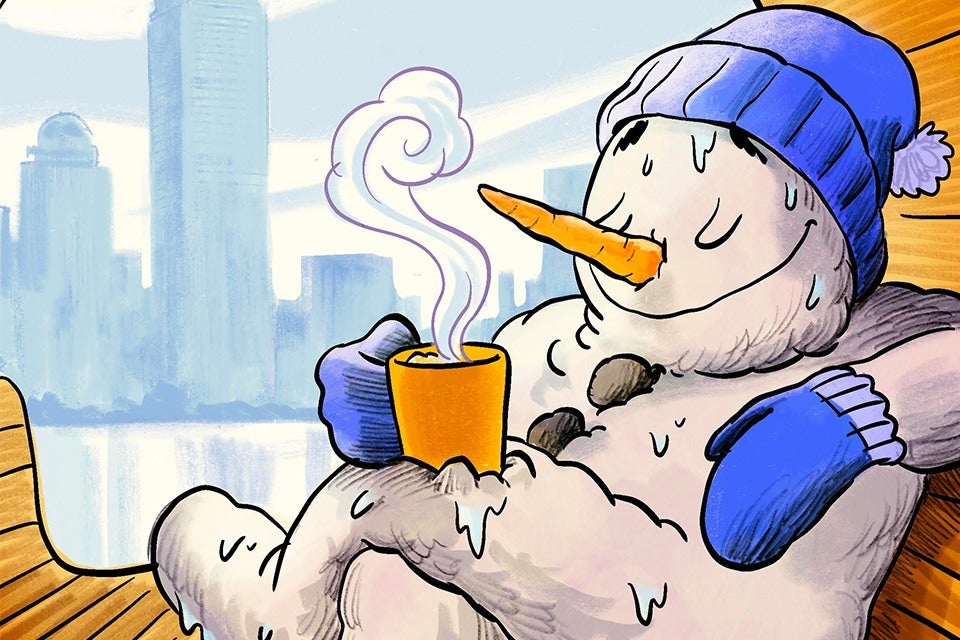
Illustration by Zohar Lazar
“Enjoy winter in Boston.” These are four words you will seldom hear together—unless hollered at a puddle-soaked pedestrian by a malicious driver. As Bostonians, we love to complain—about sports, traffic, politicians. And always about the weather—particularly the dark, soulless days of winter.
It doesn’t have to be this way. And it wasn’t always this way, either. Boston was the original aficionado of urban winter recreation. Our winters once looked like a Christmas card. In the late 1800s, there were at least five toboggan slides in the Boston area, including one in Franklin Park. People ice-skated on practically every frozen body of water, and roasted-chestnut vendors pushed their carts through downtown. Our past winters of fun were also immortalized in song. “These wonderful things are the things we remember all through our lives,” as sung in the Christmas standard “Sleigh Ride,” wasn’t some reference to a far-off, distant land. Its composer, Leroy Anderson, grew up here, and the song is about having a good time during New England winters. Just think: Our winters were so joyful they became the soundtrack of American Christmas.
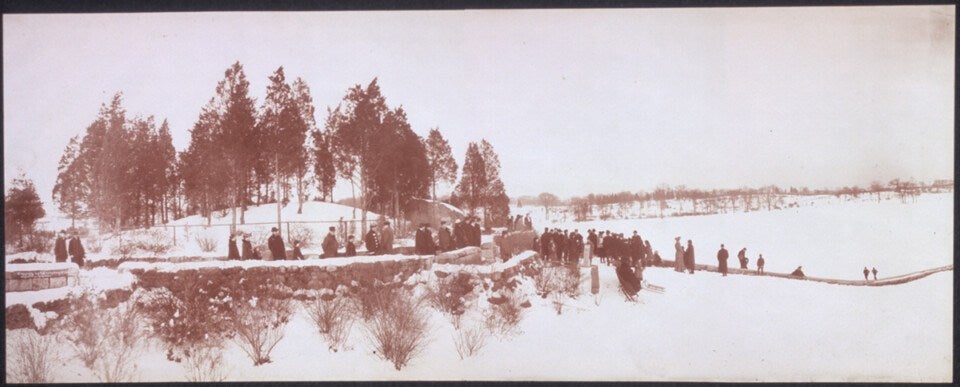
The toboggan line at Boston’s Franklin Park in 1904. / Library of Congress
These days, the irony is stark: The United Kingdom–based hotel chain Premier Inn recently ranked us the most beautiful winter city in America. But looks can be deceiving. When it comes to actually having fun, it seems as though other cities have picked up the winter playbook Boston abandoned decades ago. In New York’s Hudson Yards, with striking skyline views, a hotel offers guests and members access to its barrel saunas and heated pool throughout the winter. In Hokkaido, Japan, competitive snowball leagues were launched in the 1990s to lure tourists during the cold months. Chicago has curling bars. Montreal and Ottawa have epic winter festivals, and Helsinki lights up its buildings every January, bringing hundreds of thousands of people into the city for a month-long fete.
All of these cities are aggressively pursuing what Boston should be chasing—tourist dollars when the temperatures plummet. We desperately need it: Boston’s hotel occupancy in the winter drops by more than 33 percent compared to the summer, even after slashing average nightly rates by more than 40 percent. But perhaps more important, these cities are making themselves more enjoyable for residents instead of surrendering to seasonal misery for half the year. Boston could use that, too. A 2022 national study on seasonal affective disorder (SAD) conducted by mental health service Thriveworks ranked Boston as the 14th-most SAD-afflicted winter city in the country.
Making Boston winters fun again doesn’t require a moonshot. It’s more of a shot put, if anything.
Making Boston winters fun again doesn’t require a moonshot. It’s more of a shot put, if anything. Boston has all the ingredients—history, infrastructure, creativity—but we’re missing the recipe. What was once a tale of two cities—a happy one where we watch the Red Sox win at Fenway Park while runners from the Boston Marathon stream through Copley, and a miserable one where we stay home for months on end and tell the rest of the outside world to piss off—could instead be 12 months of joy.
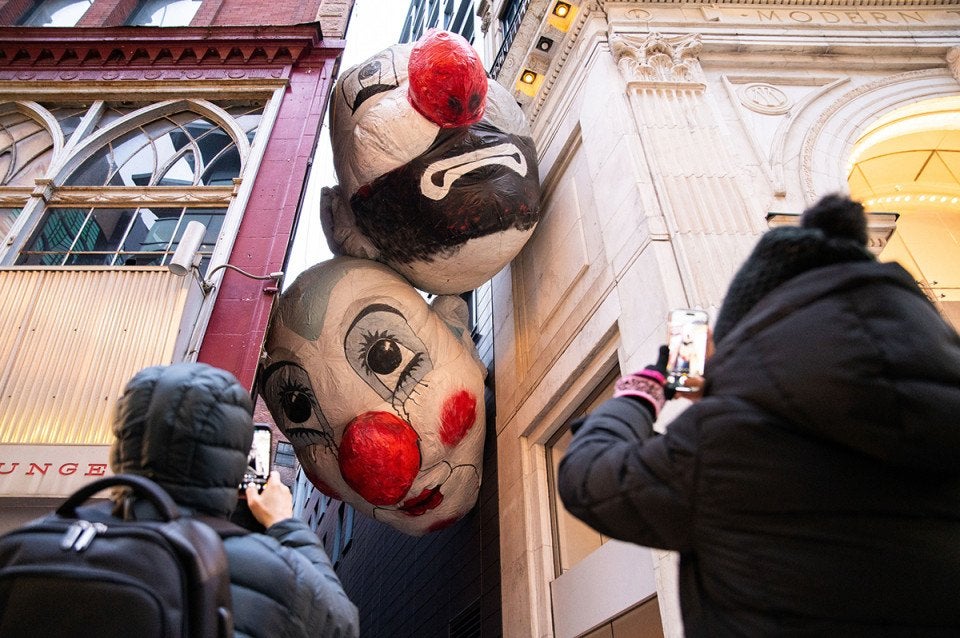
Endgame (Nagg & Nell) by Max Streicher / Photo by Annielly Camargo, courtesy of the Downtown Boston BID
I am not the only one who has this idea. Over the past few years, Boston has added some winter fun, including the opening of holiday markets, a winter festival in Charlestown, and a winter art exhibition downtown. These baby steps have moved Boston forward—from a city that once ignored winter fun to one that is actually looking for it. And this season, the tourism bureau—now called Meet Boston—will partner with large property owners, business development groups, and local government to launch a cohesive winter activation campaign under a unified banner. “[The effort] will take ongoing activations such as Snowport, SoWa Winter Festival, and Winteractive, and fold them into a larger seasonal initiative that will launch in late November and run through February,” according to Meet Boston spokesman Dave O’Donnell, who asked me to imagine outdoor parks and open spaces such as the Boston Common, Rose Kennedy Greenway, and Copley Square bursting with winter activities such as wine tents, fire pits, and “seasonal flair.”
Wine bars and fire pits sound like a fine start. But, let’s be honest, in a city that channels this much intellectual energy into complaining about winter, imagine what we could accomplish if we redirected that same passion toward finding even more fun solutions.
We don’t even need to start from scratch—we’re already missing opportunities right in front of us. Take outdoor dining. Chicago allows it year round, so there’s no point in arguing that it’s too cold here for that. There’s actually already a law on the books—full disclosure, one I passed when I was on the City Council in 2009—requiring sidewalk café licenses to be available year round. But that’s not happening. Instead, outdoor dining is limited to just six months of the year from May 1 to October 31. With year-round outdoor dining, operators could actually afford to invest in heating lamps and cozy throw blankets—the kind of infrastructure that makes winter dining not just possible, but appealing.
Still, year-round cafés alone would not be enough to change Boston’s winter, be it for residents or tourists—Boston will need to dramatically expand its winter offerings. Oslo in Norway is an amazing cold-weather city to visit. With more than a quarter-million visits per year to the more than two-dozen public saunas that blanket the city, its cold-weather bona fides are never in dispute. Before you dismiss this as impossible Nordic magic, consider this reality check: Prior to 2013, there were no public saunas in modern Oslo. Not one.
What began as “one small, anarchist-built floating sauna,” according to Åshild Skadberg, head of communications for the nonprofit Oslo Badstuforening—which works to deploy saunas across the city—quickly turned into the bold infrastructure of today. “The story of the floating saunas in Oslo is also about quick organic growth and a city finding a new, healthy, and easily accessible meeting place close to the elements,” according to Skadberg. The organization only launched what was Oslo’s second floating sauna in 2017, four years after the first one appeared.
Patience and determination made the difference for Oslo, and they could for Boston as well. The city has a unique asset quietly generating cold-weather placemaking ideas: CultureHouse, a nonprofit now in its eighth year. Through founder and executive director Aaron Greiner, the organization has been experimenting in this space. His first winter activation project, “Post-Storm Swarm”—a park takeover featuring sledding equipment and other winter wonderland attractions—was supposed to launch two winters ago, but failed completely. “It didn’t snow that year,” Greiner said.
But Greiner understood something crucial about Boston winters: Even if it doesn’t snow as much, we still have never-ending months of cold weather and gloomy gray days. Last year, CultureHouse ran a free public sauna on City Hall Plaza with 500 bookable slots. The demand was overwhelming: It sold out in three days. A second pop-up sauna company called Moki ran on the Greenway. Performative though it may seem, Greiner assures me he has “no interest in being a sauna company,” but rather he has an earnest desire to make cities “joyous.” What began as a demonstration project has proven the concept.
Imagine, as in Oslo, walking to Boston Harbor and seeing a string of floating saunas, a dozen or so, available to rent by the hour. Next to each, the frigid ocean water serves as the plunge pool for a little of the über-popular contrast therapy. Connecting it all could be a tented clubhouse, or a restaurant, with a wood fire, good music, and warm drinks.
This isn’t just about fun. Catching a public sauna session along the ocean’s edge is more than a joyous way to approach winter—it’s also healthy. Jessica Spissinger, a psychiatric physician assistant and instructor at the MGH Institute of Health Professions who specializes in seasonal affective disorder, explained the benefits. SAD affects people whose mental health suffers in response to seasonal weather patterns. Spissinger, who owns her own sauna, pointed to this Nordic tradition as an essential tool for restoring people’s mood during the dark and cold months of winter. “I think that in the U.S., we are limited in terms of our creativity in how we can make winters more fun,” she said. “There is a correlation between sauna use and reducing depression.” Think of sauna culture as prescriptive urban policy: It’s not just about getting Bostonians warm, but about making us a little less cranky in the winter months.
This becomes much easier once you tap into Boston’s favorite pastime after complaining: beating New York. New York City has glamping on Governors Island, where visitors can roast s’mores in sleeping bags while gazing at the Manhattan skyline just eight minutes away by ferry. Boston has its own island camping option with yurts and campsites on Peddocks Island. Though Boston and New York’s campgrounds both shut down in late October, here’s Boston’s chance to outdo New York: Imagine yurts with wood-burning stoves on the Harbor Islands during winter months. This wouldn’t just draw locals out of their homes—it would attract tourists seeking a unique outdoor-urban adventure.
But why stop at beating New York when we could redefine winter itself? Take January—the hardest, darkest, coldest month, practically designed to crush our spirits with its Dry January mandate—and flip it into the most fun month of all. Think of it as Boston’s ultimate contrarian move. This might require some heavy lifting from the state legislature and governor, but imagine restaurants going tax-free throughout January. Right now, restaurants are so starved for business during this month that some just shut down entirely. Rob Weintraub, who owns Select Oyster Bar in the Back Bay, says his restaurants see revenue drops of 40 to 50 percent compared to his peak summer months. Meanwhile, museums should be encouraged to stay open late into the evening—not just for the occasional First Fridays, but for the entire month.
This also might be a good opportunity for a weekend light show and maybe a shutdown of a downtown street or two. Then we bring on the winter charm: chestnut vendors and roaming servers of hot chocolate and cider, spiked or not. Maybe a roving Dunkin’ server, offering hot—or, let’s be honest, cold—cups of coffee. Sometimes the most audacious ideas work precisely because they’re audacious: When you flip the script on something so profoundly—“January is the best month of the year!”—the notion just might be wild enough to believe.
Building a vision for the colder months will take a lot of work, but it is doable. Heck, if pickleball could arrive pretty much everywhere all at once, winter activation opportunities can as well. The infrastructure for change already exists—we just need to use it. Permitting for these events and activities—from year-round outdoor dining to bonfires in parks—should be made as simple as possible. Supporting the incubators, like Greiner’s CultureHouse and Meet Boston’s latest efforts, is essential. And in this regard, there are no bad ideas. Bless the folks at Harpoon Brewery for the snow-tube slide in their Seaport parking lot.
Boston’s summers full of tourists didn’t happen overnight. It took decades, centuries even, and numerous investments, big and small, to draw the millions of visitors we do year after year. Winter deserves the same commitment and creativity. The four words “Enjoy winter in Boston” should not be a sarcastic taunt, but rather an imminently reachable dream.
Mike Ross is a lawyer at Prince Lobel and a former Boston city councilor.
This article was first published in the print edition of the November 2025 issue with the headline: “Ice Ice Maybe.”