
Welcome to the News Jungle: Why Influencers Matter to Boston
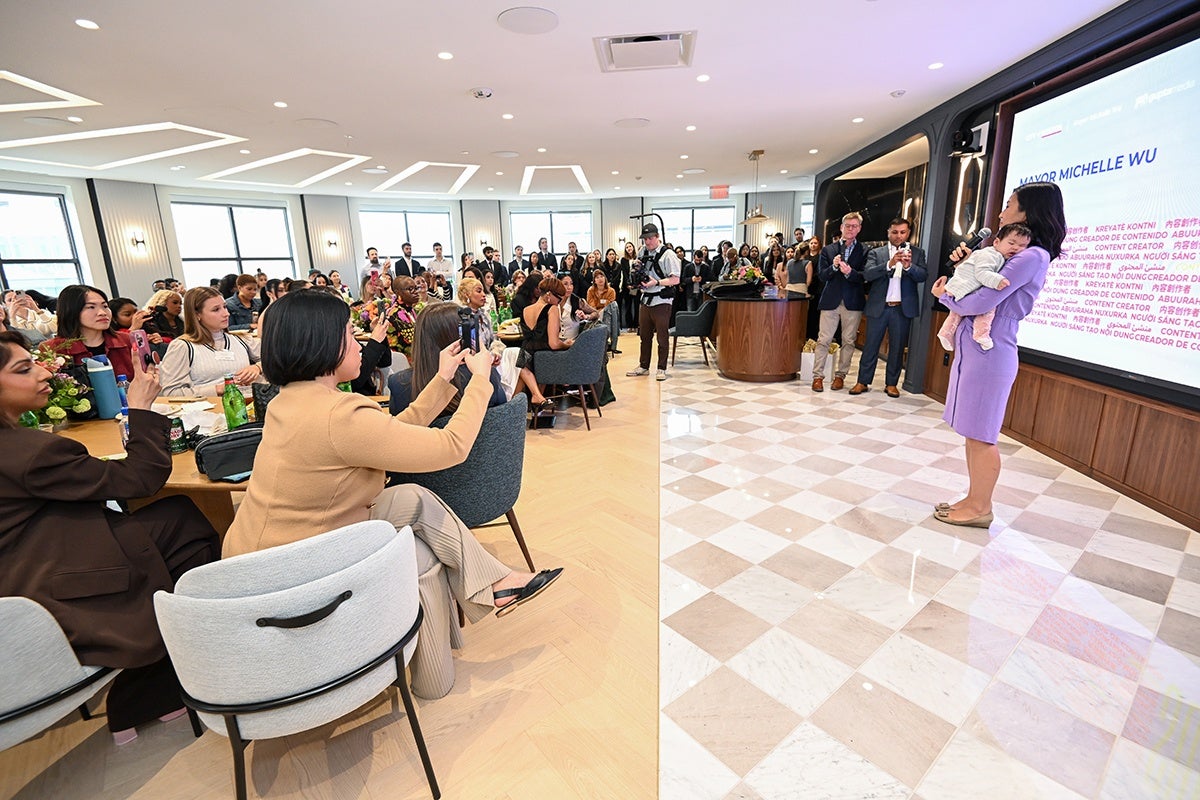
Wu addresses a room of Boston influencers at Boston’s first-ever Content Creator Summit. / Isabel Leon of the Mayor’s Office
In the bright, brand-new lobby of a Back Bay advertising agency, a step-and-repeat bearing the city of Boston’s seal is set up like a Fashion Week photo wall. Mayor Michelle Wu, cradling her infant daughter, leans in for snapshots with a steady stream of visitors: a woman in a crimson corduroy coat, another in a cardigan dotted with three-dimensional flowers. The guest list spans the city’s social media creator ecosystem—from fashion to food, comedy to civic engagement. Many attendees had followed each other for years but never met in person. Everyone smiles broadly, while many instinctively lift their phones for a quick selfie after the official shot.
From a few feet away, the city of Boston’s first-ever Content Creator Summit feels more like a reunion than a municipal initiative. Around long tables, creators swap tips, show one another what’s working on their screens, and angle for better light. The atmosphere is equal parts networking event and dinner party.
The cast includes @bucketlistboston’s Kate Weiser (195,000 followers on Instagram) and Sam Westby (74,000 on Instagram; 51,000 on TikTok), a Ph.D. candidate at Northeastern who moonlights as a bikefluencer. There’s Gia Bueno (@giamiapia_, 44,000 on Instagram), a “brand strategist” and creative, and Koko Dubuisson (@hautekoture, 16,000 on Instagram; 29,000 on TikTok), a “stylist/nurse/creator” and first-generation Haitian American who uses her face time with the mayor to advocate for more space in the city for creatives. You’ll also find Celtics in-game hostess Melissa Valdez (@missmelivaldez, 13,000 on Instagram), baby-faced TikTok comedian Joe Fenti, a.k.a. @fentifriedchicken (415,000 on Instagram; 331,000 on TikTok), and Caught in Southie’s Maureen Dahill (51,000 on Instagram). When the mikes come out, the room quiets. Speakers rise spontaneously and talk frankly about what it takes to build an audience, avoid burnout, and make a living when your job is being a version of yourself.
Later, the mayor takes the floor, still holding her baby, to explain why the city invited 75 social media creators to the airy headquarters of Gupta Media, where I work. To some, influencers still read as frivolous: self-absorbed, unserious, more sparkle than substance. Wu sees something else: a force quietly shaping how the city portrays itself. “What we see, what we consume, and most important, how the people around us in our community think about what they’re capable of,” she says, “that can have a generational impact, day after day after day.”
By the time the group gathers for a final, sprawling photo, the message is clear: Creators aren’t on the margins anymore; they’re at the center of the civic story.
In 2025, the media isn’t the message—the media is your constituency.
For City Hall, this isn’t just a photo op. It’s the beginning of a deliberate strategy to fold creators into Boston’s narrative—and also court them as amplifiers of the mayor’s messaging. A couple of months later, the same group will get an invite to the seasonal launch of Boston’s late-night food trucks. A few weeks after that, the city includes them to help publicize “New Edition Day” in Roxbury. Cynics might see this as the city bypassing traditional TV, radio, and print outlets, but City Hall insists it’s about widening the tent, not shutting anyone out.
View this post on Instagram
One of Wu’s favorite refrains has been to get City Hall out of its Brutalist bunker and into Boston’s daily life. That’s meant leaning into TikTok, where she started posting “Commute with Me” clips that showed the grind of getting to work on the T. When those short videos racked up views and comments, City Hall realized a cell phone could reach people that a press release never would. And in the process, Wu found herself face-to-face with a new generation of creators already telling the city’s story in ways that felt more authentic, representative, and fun than any ad campaign. “One of the most important responsibilities we have in government,” Wu wrote in an Instagram post sharing pics from the Content Creator Summit, “is to meet residents where they are—and today, more and more people get their news online from their favorite creators.”
A light bulb went off: In 2025, the media isn’t the message—the media is your constituency.
Ten years ago, I was editor of this very magazine. These days, I work at one of the city’s fastest-growing advertising agencies. For the past 30 years, I’ve had a front-row seat to watch mainstream media as well as brands and advertisers swing and miss at successive waves of digital innovation—from the Internet’s first wave to the rise of the blogosphere to social media and the infamous pivot-to-video. Hell, I’ve taken quite a few of those swings myself. And while I’d be the first to argue that institutions need to learn from the agility of creators, I also know they’re indispensable: They’re the only ones with the resources, the authority, and the stability to sustain this work over the long haul. So when I see commentators dismissing today’s influencers as a sideshow, I worry that our most important establishments are about to get it wrong all over again—and are missing the forest for the trees.
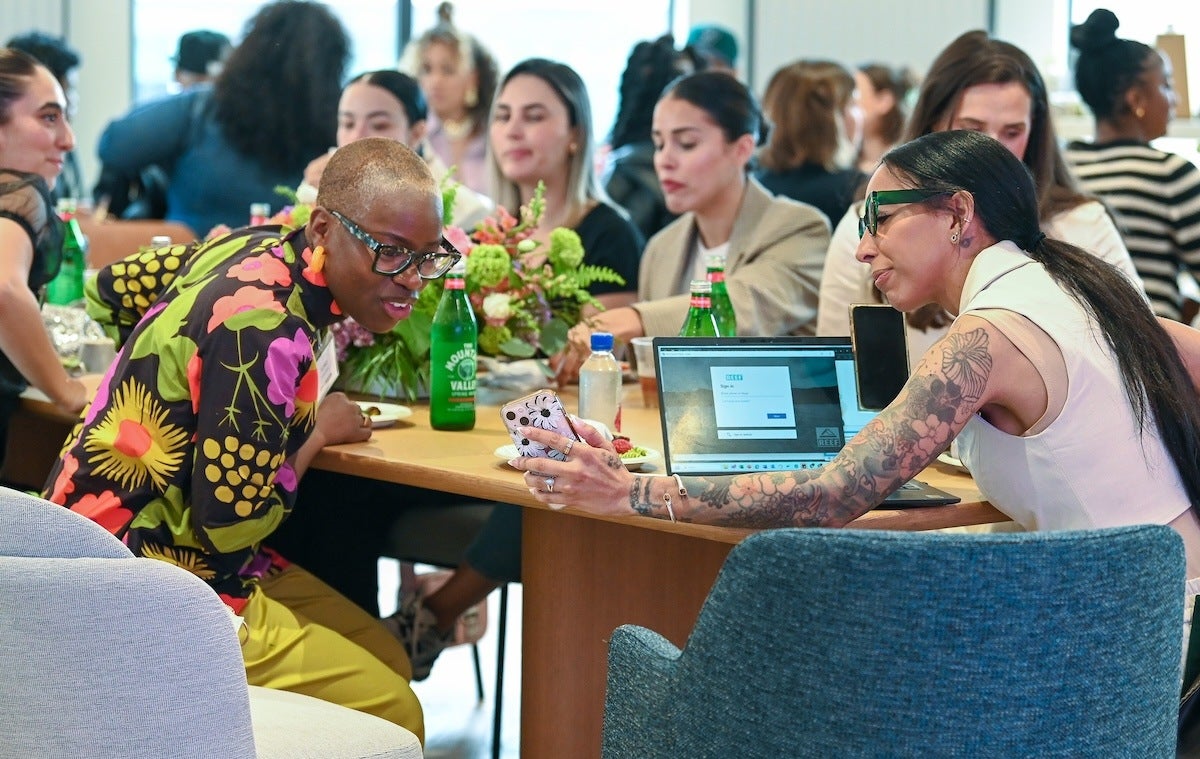
Influencers at Boston’s first-ever Content Creator Summit. / Isabel Leon of the Mayor’s Office
The forest, as it turns out, is bigger than most people realize—and Joseph Zeal-Henry, the City of Boston’s Director of Cultural Planning, has the numbers to prove it. The London transplant, who co-curated the British Pavilion at the 2023 Venice Biennale before studying at Harvard and teaching architecture at Columbia, sees creators as part of Boston’s centuries-old tradition of “applied creativity”—where art has always collided with other disciplines to spark innovation. He points to everything from Amar Bose’s noise-canceling MIT breakthroughs to Arup’s collaborations with artist James Turrell. “If you’re a content creator, you’re also a video filmer, editor, creative director, presenter,” Zeal-Henry says. “We’ve seen this tech-enabled sector grow from basically no one to 10,000 people in 15 years. That’s really exciting.”
He likes to point out that the official stats—he says that there are an estimated 70,000 jobs in Boston’s creative economy, roughly 10 percent of the city’s workforce—don’t even count the multihyphenates (a saxophonist whose day job is in IT, for instance). To Zeal-Henry, today’s side-hustling TikTokers and Instagram storytellers are just the latest chapter in that lineage.
Nationally, the scale of this shift is hard to ignore. Analysts say the broader creator economy—from Instagram sponsorships to Substack newsletters—is worth $250 billion a year, and they expect it to hit nearly half a trillion dollars by 2027. What started as side hustles has become a major economic driver, with brands chasing the eyeballs: U.S. advertisers are projected to spend more than $10 billion on influencers in 2025, and more than half of marketers are expanding their influencer budgets this year. Platforms such as TikTok and Meta are formalizing the process with creator marketplaces and dashboards that make influencer partnerships as routine as buying banner ads—prompting advertising’s big holding companies to fold influencer agencies directly into their operations.
Simply put, Boston’s content-creator wave is part of a generational shift that is transforming everything from politics and media to creativity and commerce. Attention is now infrastructure. And in a city that has long mixed art and industry, the question isn’t whether creators belong. It’s what the rest of us can learn from them—and whether we can pivot quickly enough to survive.
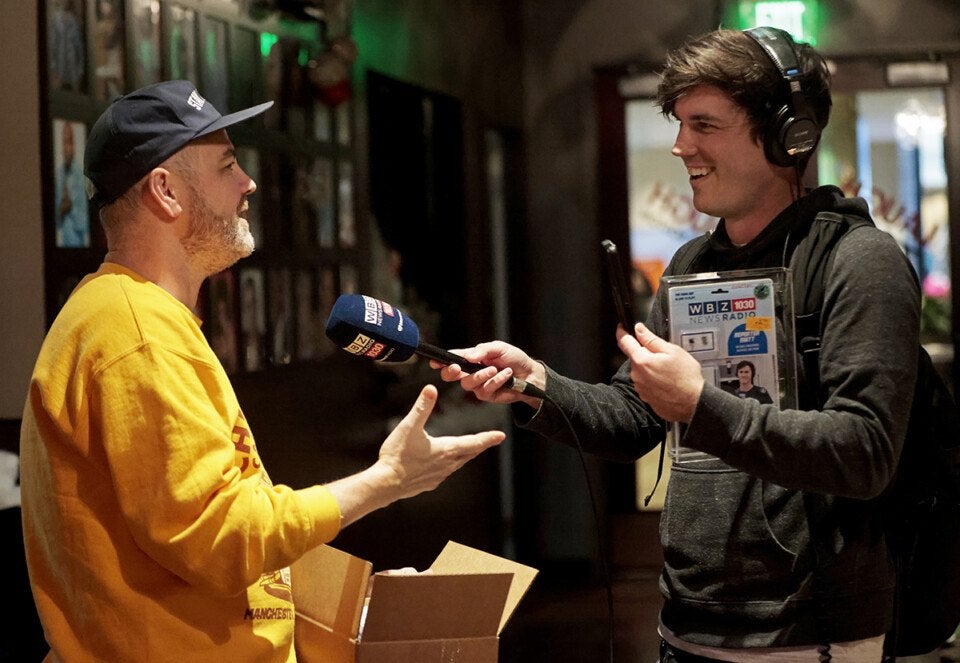
WBZ NewsRadio reporter and “Best of Boston” winner Matt Shearer, right, talks with toymaker Nick Lavallee, at Laugh Boston, where some of the people Shearer’s featured in his social media posts gathered in December 2024. / Photo by Pat Greenhouse/The Boston Globe via Getty Images
Among the faces at the mayor’s summit is Matt Shearer, one of the most interesting people in Boston media today. He’s a creator making vertical video with the personality of an influencer and the journalistic standards—not to mention the financial backing—of a mainstream news reporter. He’s taken one of the oldest, dustiest tools in local news—the man-on-the-street interview—and transformed it into must-watch short-form video, all while operating under the brand of WBZ NewsRadio (which is, among other things, an AM radio station). That incongruity is the point. He’s a one-man experiment in how legacy media can thrive by absorbing the playbook of influencers.
It didn’t start that way. Shearer will tell you he bombed his first attempts at TikTok because he tried to turn his radio scripts into social video. They felt stiff and unnatural, and the audience could smell it. Eventually, he gave up on reverse-engineering and decided to start from scratch: a camera-first approach built for the medium itself. The results—indelible portraits of New England towns and characters, from the MBTA’s biggest fangirl to the suburb that lost its last Dunks—have turned him into a Boston media star, with more reach online than some TV broadcasts in town.
The irony is that Shearer still considers himself a radio guy at heart. He stumbled into the medium as a teenager, skateboarding with friends and playing at broadcasting on his high school radio station. Later, he lived in a chaotic Allston house dubbed Fort Fuck Awesome that doubled as a DIY venue for punk bands, complete with a basement stage and a backyard half-pipe. Those instincts—informal, curious, performance-driven—now shape his journalism. “Something I’ve been preaching for years is that journalism is an art form,” he says. “Journalism is storytelling and storytelling is the oldest form of art. So why do we put ourselves in this state of mind where everything needs to look a certain way and sound a certain way to be considered true journalism? We can rethink the way we talk to our audience, the way we show ourselves to the audience. And we can have a little bit of personality. Think of storytelling as a canvas, not a spreadsheet.”
That canvas is also personal. Shearer’s videos succeed for the same reasons that other creators thrive: the intimacy of direct address, the sense of a friend walking you through something funny, or strange, or worth noticing. The algorithm rewards that style, but so do viewers.
We don’t flip on the evening news like we used to. Instead, we scroll, and information drifts past like mist—everywhere, ephemeral, gone in seconds.
That sense of intimacy—transparent about its point of view, personal, conversational—is the connective tissue linking Shearer’s walk-and-talks to the broader creator economy. The shift is fundamental: Younger audiences increasingly get their information from curated feeds rather than traditional sources. Their general interest content is their inbox and their TikTok feed—personalized, algorithmic, constantly updating. Increasingly, that’s true not just of Gen Z or Gen Alpha, but of all of us. We don’t flip on the evening news like we used to. Instead, we scroll, and information drifts past like mist—everywhere, ephemeral, gone in seconds.
This unfolds against a collapse of trust in institutions, not just media. The next generation of news consumers is eager for information but far less picky about its source. “It doesn’t matter to them anymore whether you’re defined as a journalist or a news source,” says Liz Kelly Nelson, a Vox and Washington Post alum who established the creator-journalism startup Project C. “There’s actually more credibility and trust given to somebody who feels sincere and authentic—they don’t really care about impartiality in the same way that we learned in newsrooms.” When Nelson talks to students, they tell her they want multiple perspectives so they can decide for themselves.
Just over the river at the Neiman Foundation for Journalism at Harvard, Neiman fellows Ben Reininga—who once ran editorial at Snapchat—and Ryan Kellett recently wrote a report that should be required reading for every media exec still rolling their eyes at TikTok. The reflex, they note, is to treat creators as unserious or, worse, dangerous: After all, the algorithms reward outrage, the gatekeepers are gone, and the quality bar is uneven. All true. But focusing only on the risks misses the larger point. This is where audiences are, and creators are already showing us what it takes to meet them there.
What the best creators understand is that personality isn’t a liability but a vehicle for trust—and that this entrepreneurial, experimental approach puts them closer to their audiences than most legacy brands have been in years. According to the Pew Research Center, “almost 4 in 10 U.S. adults under 30 get news from news influencers.” Nelson’s top 50 list of “creator-model journalists” includes Chris Cillizza, Oliver Darcy, Taylor Lorenz, Jessica Valenti, Cleo Abram, and Emily Atkin—reporters and commentators who’ve already gotten the memo.
In Shearer, you can see WBZ’s newsroom adapting to the new attention economy: Here’s a reporter with a mike and a skateboarder’s shit-eating grin, turning local human-interest news into something that’s as personal and addictive as everything else in your feed.
See also: Boston’s Creator Class of 2025
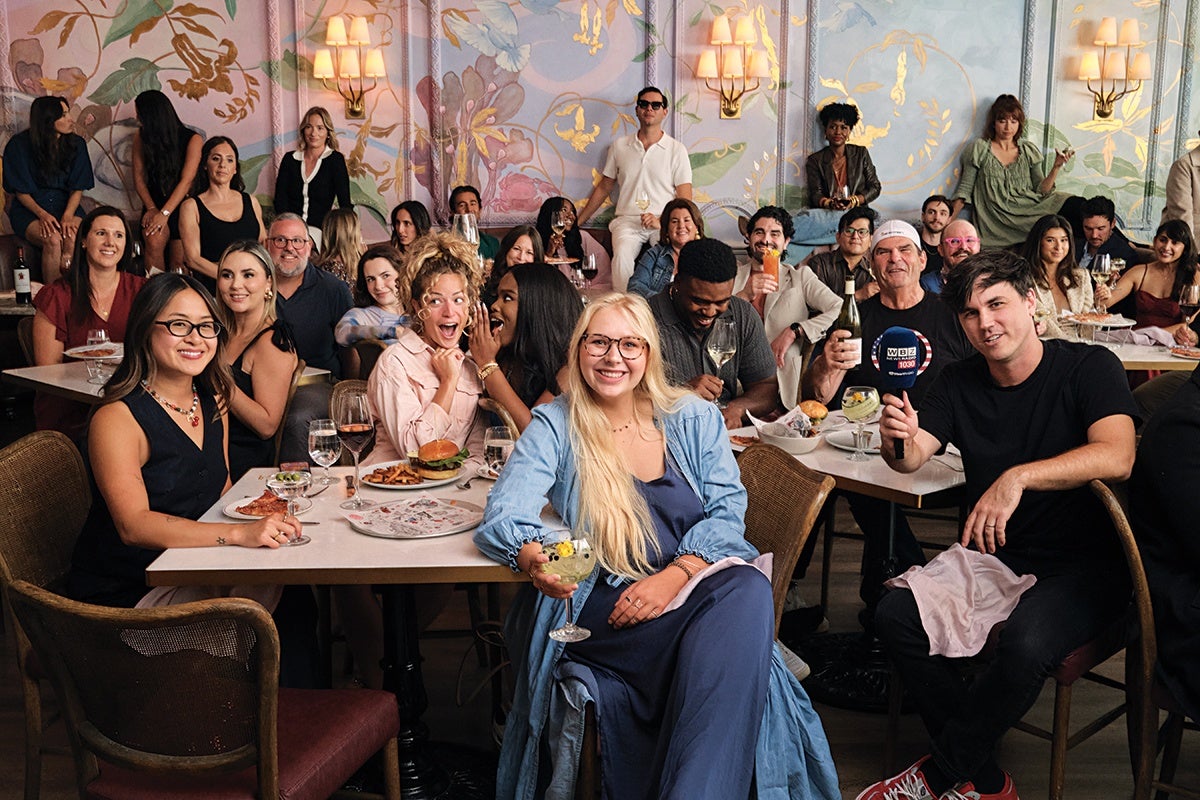
Emi McSwain, center front, with Matt Shearer, right front, alongside 40 other local content creators at Seaport restaurant Coquette. See the full list of your favorite follows here. / Photo by Frankie Alduino / Food styling by Sheila Jarnes
At Coquette on a Wednesday afternoon this fall, the light bounces off marble tabletops and gilded mirrors, catching cocktail glasses and camera lenses alike. The restaurant, with its maximalist French décor and a whiff of decadence, has been transformed into a makeshift Seaport influencer house. This magazine has assembled some 40 of Boston’s creators for a photo shoot—a kind of “Great Day in Boston” for the content class. The point isn’t the spritzes or the sparkle—it’s that, for once, the creators are the story.
Emi McSwain, a songwriter with the blunt candor of someone who has hustled every side of the music business, sits at a table, lightly starstruck in spite of herself. Across from her are faces she’s followed for years, now sipping cocktails within arm’s reach: There’s Kate Weiser from @bucketlistboston again; Madi Beumee (25,000 on Instagram; 77,000 on TikTok), a social media strategist and podcaster whose fun-things-to-do posts rack up tens of thousands of TikTok views each week; and Alaina Pinto (127,000 on Instagram; 34,000 on TikTok), who became a travel blogger after losing her Channel 7 anchor job—one of McSwain’s inspirations to start posting. “It was surreal,” McSwain will say later. She’s been to influencer events before, but those gatherings treated creators like props for someone else’s message. This one was different: The spotlight was theirs.
What sticks with McSwain most isn’t the clatter of glasses or the shimmer of the set—it’s the sense of solidarity. Everywhere she looks are women: leading the chatter, trading collab ideas, pulling each other into selfies. For McSwain, who came up in Boston’s music scene—where green rooms and rosters are still overwhelmingly male—rooms like this feel almost utopian.
Like many in the room, McSwain didn’t set out to be a content creator, attending Berklee to get a degree in songwriting. A detour into band management gave her an early education in the local music scene, as well as the frustrating hierarchies that came with it. A female mentor once dismissed her ideas with a single metric: “Why should I listen to you? You’ve only got 2,700 followers, and this band has 4,000.”
“I thought, fine,” she says. “I’ll do it myself.” In September 2024, she set a challenge: post every single day. It started as a provocation to herself—but also as a matter of survival. “I was so poor,” she says. “There were nights I literally couldn’t afford to buy dinner.” What began as an experiment quickly became her most reliable paycheck.
The math doesn’t lie. A three-hour band gig at Tuscan Kitchen paid $150. A four-hour set at Encore Boston Harbor wasn’t much better. A sponsored reel—requiring roughly the same prep and polish—paid multiples of that. “I’ve never taken a check [for a brand deal] that paid less than any gig I’ve played before,” she says. Not long ago, when she told a West Coast friend what she charges for posts, her friend’s eyes went wide. “You need to be charging so much more.” The market, it turned out, paid more for her posts than her performances.
And that’s the rub: In 2025, every creative hustle eventually ends up in the feed. Even those who swear off sponsorships end up playing to the algorithm—because that’s where the audience is. “A lot of the people I went to Berklee with hate social media,” McSwain says. “They’ll say, ‘I’m not a content creator, I’m a musician.’ But in today’s world, it’s the same thing.” For her, it’s both tragic and liberating: tragic that even the best musicians in Boston can’t sustain themselves on music alone, liberating that social media has cracked open a path that wasn’t there before. Content creation isn’t the add-on anymore. It’s the actual stage.
That reality hits differently when you’ve seen the old economics collapse firsthand. It’s been more than a decade since the Boston Phoenix, where I was its final editor, went under, and not a week goes by that someone doesn’t tell me they miss the ol’ alt weekly. Some mourn the loss of a progressive political voice; more often, they just want to know what’s coming up this weekend. And yet for all the nostalgia, I’ve never once been tempted to start another paper. Why would I? The ad money that once paid for critics and copy desks has been vacuumed straight into the coffers of Google and Meta. The bundle we once called a newspaper has already been pulled apart and—thanks to the algorithm—reassembled in the feed.
That’s why I’ve always bristled at the media term “news desert.” Academics use it to describe places that lose their local newspapers, but it’s the wrong metaphor because when a paper dies, the news doesn’t stop happening; the information doesn’t stop flowing. What you get isn’t a news desert—it’s a news jungle. Messy, unruly, overgrown, teeming with new life. Journalists don’t make the news; they’re the gardeners, trying to clear a path to the truth.
If you look around Boston today, the jungle is alive with species the old guides never accounted for: TikTok explainers, Instagram diarists, Substack gadflies. The area’s two biggest media startups of the 21st century are, arguably, Dave Portnoy’s Barstool Sports and Turtleboy. Ignore them, and you miss where culture and civic life are actually happening. You’ll also miss the enormous challenge for all of us in communicating with one another to make meaning across fragmented feeds, where we no longer share the same front page, let alone the same facts.
There’s a generational gap right now—an artificial one, I’d argue—between what used to be known as the creative class and what is now often dismissed as “content.” This isn’t just semantics: It’s a vision problem. “Content” sounds disposable, but what we’re really talking about is the way stories are told, and communities are knit together.
In a few years, we’ll look back on this divide like we now view early bloggers being dismissed by mainstream press: as missing where culture was headed. The jungle will have grown taller, thicker, and harder to ignore. The only question is whether the institutions that once claimed to map the terrain will find a way to survive in it—or be swallowed whole.
Carly Carioli is Director of Communications at Gupta Media. He is the former editor in chief at Boston magazine and the Boston Phoenix, a former editor at large for Politico Magazine, and a contributor to The New York Times.
This article was first published in the print edition of the November 2025 issue with the headline: “The Relentless, (Sometimes) Lucrative, Surprisingly Wild World of Boston Influencers.”