Inside South Station Tower, Boston’s Big Bet on Downtown Living
At 51 floors, the city's newest skyscraper embodies both the neighborhood's potential and its inequality problem.

Completed renditions of the new South Station Tower. / DBOX for Hines/Pelli Clarke & Partners
A quarter-century in the making, Boston’s South Station Tower is finally here—690 feet of gleaming ambition packed with offices and luxury condos, shooting up from the granite bones of the 125-plus-year-old train station. Above the iconic columns and eagle-crowned clock now rises a shaft of shimmering glass dwarfing the surrounding Financial District.
On a recent tour of the all-but-finished skyscraper, I found myself peering down at the city from a penthouse balcony on the 51st floor, Boston spread out like a detailed map. It is rare to look down on the Financial District, but that was indeed the view: the rooftop HVAC systems of One Boston Place and 75 State Street framing the Tobin Bridge’s green arch toward the North Shore. Moving from unit to unit, past Calacatta gold marble and over silver travertine tiles, I shifted to a southerly vantage that revealed the building’s own private park on the 11th floor—an expansive patch of green where the tower’s Ritz-Carlton residents will mingle with Jones Day lawyers and FM Insurance Executives from the offices below. Beyond that manicured acre lay views of Chinatown, Dorchester, and the Blue Hills. Down on the Southeast Expressway, cars crawled through traffic like toys. Pedestrians on Atlantic Avenue were barely visible dots.
For Kairos Shen, head of Boston’s Planning Department, the new tower represents “the aspiration of having a mixed-use downtown, essentially embodied in one single project.” The surrounding area is following suit, with 21 buildings slated for conversion into homes for some 1,500 people alongside new restaurants and bars that will keep the streets busy long after rush hour. “We’re at our highest level of office-worker return since the pandemic,” says Michael Nichols, head of the Downtown Boston Alliance. But just as important, “We’re at our highest level of foot-traffic return since the pandemic. We’re at our highest number of retail storefronts being occupied since the pandemic. The neighborhood’s going in the right direction.”
South Station Tower is just one part of downtown Boston’s future. There’s also PLAN: Downtown, an ambitious redevelopment manifesto that calls for a “sky” zone east of Downtown Crossing, where developers will be able to build up to 700 feet—roughly the same height as both South Station Tower and Winthrop Center. West of Washington Street, buildings would be capped at 155 feet, except where controversial Planned Development Areas (PDAs) could receive approval to bypass those limits for projects that are mostly residential, cover at least an acre, and preserve a historic landmark.
Yet while this new development unmistakably reflects what’s coming, not everyone is celebrating downtown Boston’s towering future. Some community leaders say they were blindsided by key elements of the proposal, while others worry that the new luxury condos and amenities will do little for lower- and moderate-income residents. “It’s a balancing act,” says Angie Liou from the Asian Community Development Corporation (ACDC). “How can we allow for some growth, some changes in development, while trying not to displace anybody?”
For his part, Shen sees this tension as inevitable. “In every generation,” he says, “there’s a need to rethink and reinvent what the downtown is.” The South Station Tower is ushering in that new era. Boston’s made its bet—now it’s time to see how it pays off.
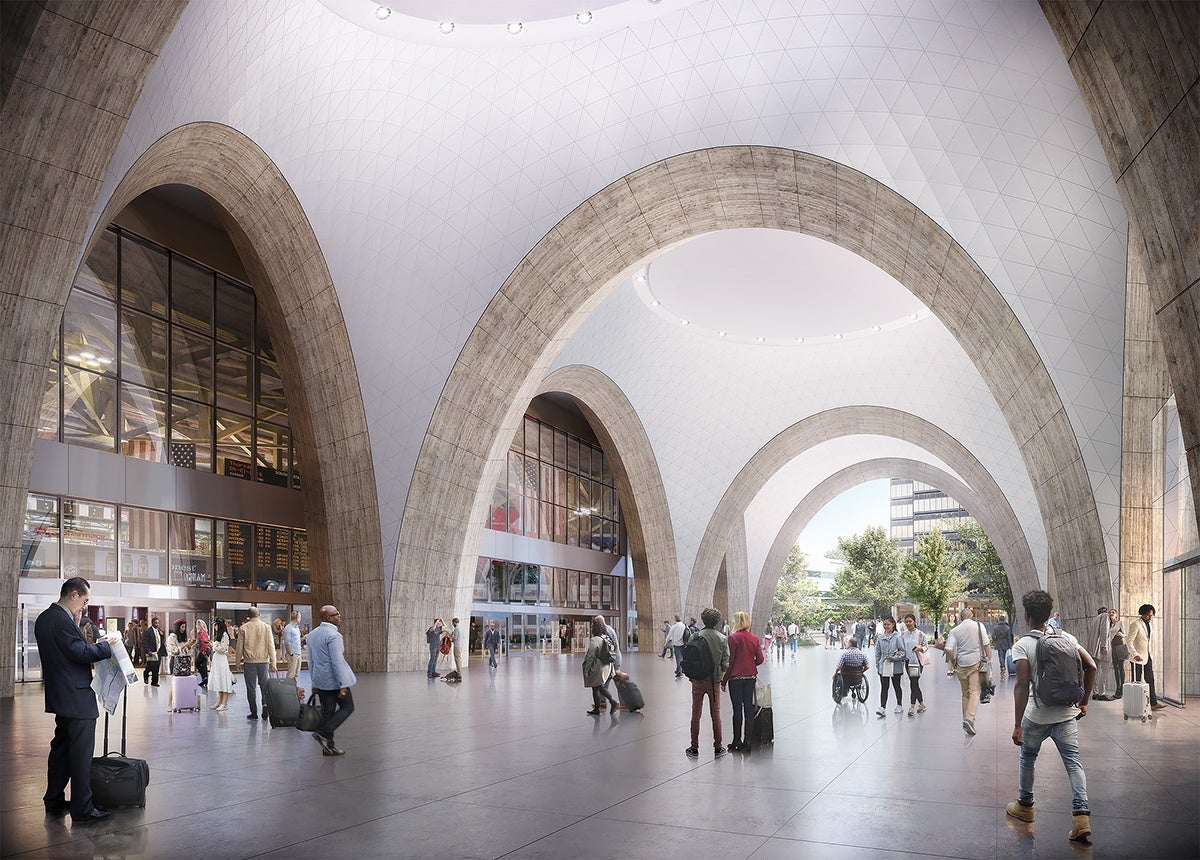
The South Station concourse. / DBOX for Hines/Pelli Clarke & Partners
Let’s be honest: Many Bostonians will never set foot above the ground floor of South Station Tower. But even down at street level, the changes are impossible to miss. Gone are the days when millions of train passengers disembarked onto a drafty industrial platform. Now, monumental vaulted ceilings conjured by Pelli Clarke & Partners guide travelers toward their trains, while construction continues on an escalator that will eventually provide a quick connection to an expanded bus terminal. The grand archways create a far more welcoming entrance to the city. “The integration with everything within the transit hub is a huge part of this project,” says Sarah Hawkins, the head of project developer Hines’s operations in the Northeast. “We have tried to be really careful about striking the right balance, knowing that we have a public responsibility here.” That public access extends to a restaurant on the 9th floor, where the developer is building an airy destination dining room above Atlantic Avenue.
Climb higher and the tower becomes increasingly restricted, since “the reality is that for the occupants of the building, it will be their private home and their private offices,” Hawkins says. In fact, the building’s residents and office workers don’t even need to mingle with commuters—exclusive entrances directly off the surrounding interstates let them drive straight into the building’s garage. Need fresh air? There’s the private green space on the 11th floor.
The tower’s juiciest perks are reserved for condo buyers willing to pay between $1.3 million for a 683-square-foot “junior one-bedroom” and as much as $14 million for a duplex penthouse. The 36th floor marks the transition from offices to residences and serves as the building’s amenity hub. When I visited, workers were still placing tiles around an outdoor pool overlooking the Back Bay, while hard hats and ladders cluttered the VR golf simulator.
Shen sees South Station Tower as more than just another development—it’s a preview of downtown Boston’s future. “This notion of buildings as small cities and communities in themselves is really evolving,” he says. The tower embodies the mixed-use vision his Planning Department has been working toward for years through a rezoning plan that prioritizes density and housing development. Combined with Mayor Michelle Wu’s office-to-residential conversion program, the goal is a more balanced neighborhood with round-the-clock residents instead of empty office buildings after 6 p.m. “The idea is to give the developers and landowners a lot of flexibility in terms of uses,” says Shen, “while as a matter of policy, we’ve continued to emphasize how important residential is.”
That flexibility couldn’t come at a better time. Boston’s office market may be improving, but it’s nowhere near prepandemic levels. Large companies have moved into new buildings such as Winthrop Center and One Congress, yet almost 600,000 square feet of South Station Tower’s office space waits to be leased. Walk down Winter Street—the key pedestrian corridor between the Common and Downtown Crossing—and you’ll see the broader problem: “for lease” signs and papered-over windows everywhere. Hawkins, meanwhile, is unfazed by the tower’s current vacancy rate. “We are in discussions with several very serious and exciting tenants who are looking to expand and solidify their presence in Boston,” she told me. “I am confident we’re going to have some exciting announcements coming.”
Her optimism is palpable, yet it faces some steep odds. Greater Boston’s office vacancy rate hit 17 percent at the start of this year—an all-time high. For Pamela Messenger, president of Friends of Post Office Square, that’s reason enough to take a more cautious view of downtown’s recovery than many of her neighborhood peers. “It feels like more of a plateau to me,” she said, “rather than sort of momentum to jump forward from where we are. That being said, I wouldn’t mind being wrong.”
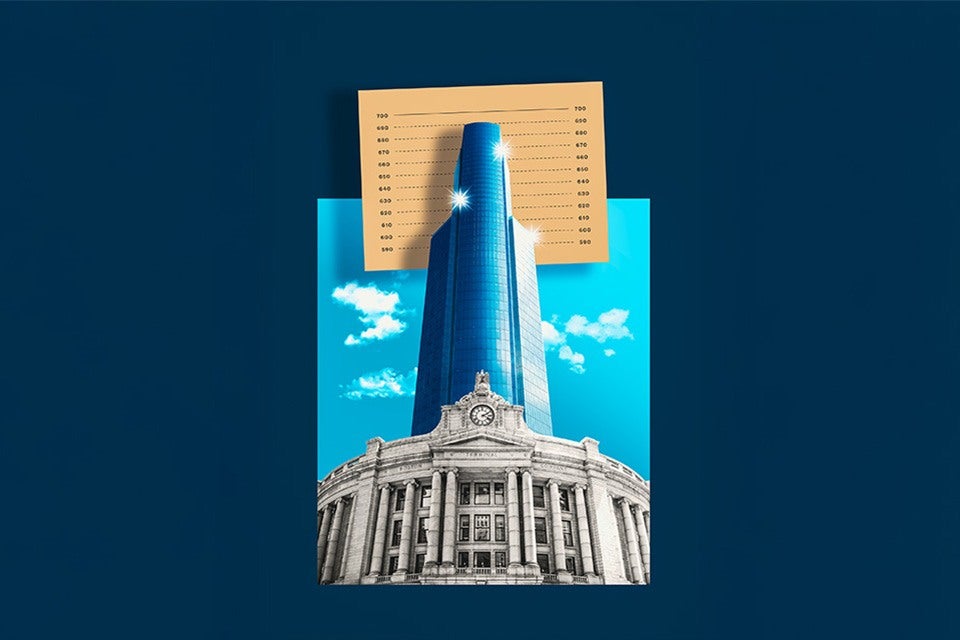
Photo illustration by Benjamen Purvis
When I stepped out of South Station Tower’s lobby, I walked straight into Boston’s tale of two cities. Five minutes later, I was standing in Reggie Wong Memorial Park—a patch of fenced-in basketball courts squeezed between an Interstate 93 on-ramp and a defunct power plant. This cramped space serves as one of Chinatown’s few public gathering spots, where a handful of determined skateboarders were doing battle with the asphalt heat.
The contrast wasn’t lost on Lydia Lowe, executive director of the Chinatown Community Land Trust. She remembers her initial excitement when she learned the tower would include green space. “I was like, ‘Oh my God, they’re going to have a park there!’ But then I read, ‘Oh, it’s only for the residents.’” Beside Reggie Wong Park and Dewey Square—or walking all the way to the Common—she explained, Chinatown residents have few options for outdoor recreation.
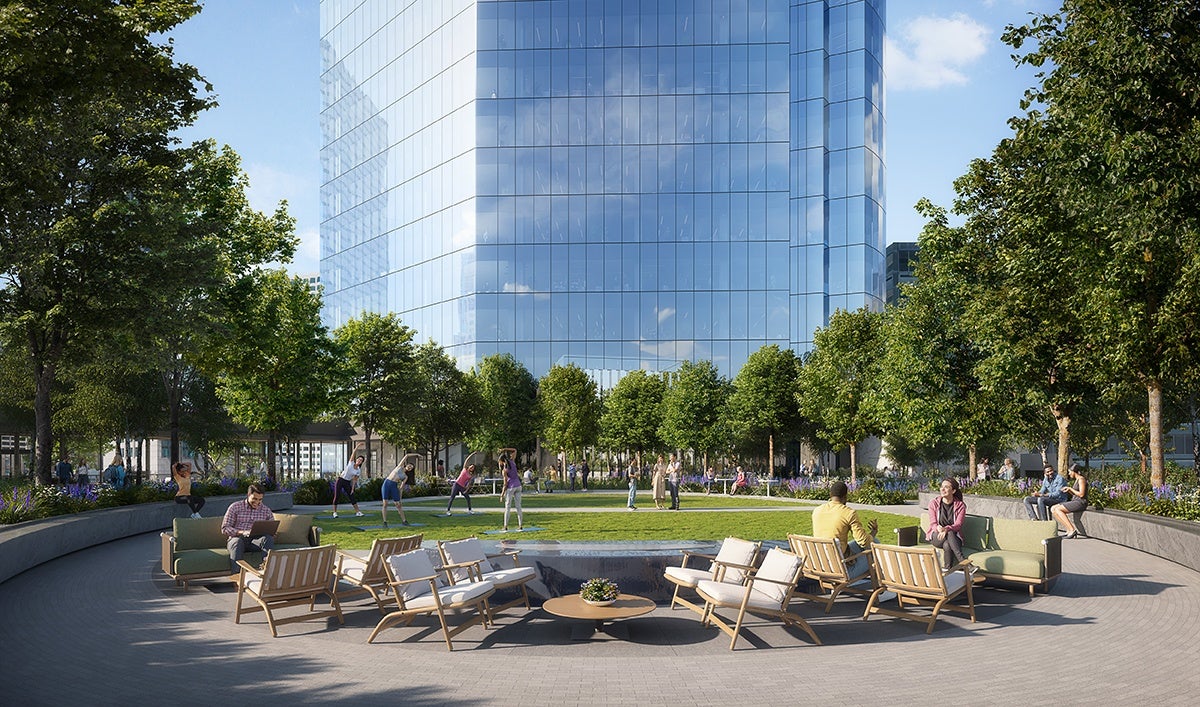
A rendering of South Station Tower’s “Sky Park.” / DBOX for Hines/Pelli Clarke & Partners
Kathryn Friedman, an architect who lives in the neighboring Leather District, shares that frustration. While she’s “thrilled to have more people living in the area,” she worries about the tower’s insular design. The project is “just so internally focused on every level,” she told me. “People can drive right into the garage and go straight up to their units. They can go to their own private park. They can really live their lives there and literally not cross Atlantic Avenue or Summer Street.”
Ford Cavallari of the Alliance of Downtown Civic Organizations sees South Station Tower as a perfect example of the city’s backward priorities. “The idea of having some building and some completion of South Station has always been attractive,” he told me. “But you have to balance that against the continued absurdity of this theory that if you build more and more luxury housing, you’re somehow going to be addressing the affordability crisis in Boston.”
Cavallari’s frustration goes beyond individual projects to the planning process itself. He and other residents were taken aback by the near-final draft of its downtown rezoning scheme the Planning Department released in January—complete with an unexpected corridor of higher-density buildings along Washington Street. Rishi Shukla, one of the leaders of the Downtown Boston Neighborhood Association, was also stunned. “Not a single advisory group member that I’m aware of—and I’ve been in touch with 85 percent of them—not one of them was aware that the city was about to drop a proposal for 500-foot towers along the entirety of Washington Street.”
The Planning Department eventually removed that provision for 500-foot buildings by the Common after public outcry, but kept the allowances for Planned Development Areas that both Shukla and Cavallari see as end-runs around zoning restrictions. But a few months later, the agency released a new version of the plan that still allowed for buildings up to 700 feet tall in some areas of downtown Boston. “Our planning is absolutely broken,” Cavallari says, “and working with bad tools and bad assumptions and more of the same is not going to get us any closer to where we want to go.”
Those frustrations echo throughout Chinatown, where the city is pursuing yet another rezoning plan. Lowe worries that all the talk about density and mixed-use development is just Boston’s long history of unequal development playing out again. “Chinatown has gone through two and a half decades of luxury development,” she says. “This very small-scale, low-income neighborhood has been overwhelmed by high-rises.”
Angie Liou from the ACDC frames the issue more diplomatically: “I think the challenge for the city and for us is, how can we make sure that whatever changes, whatever growth happens in and around Chinatown, that we can make sure that these residents and the small businesses that are already here can stay?” Her ideal scenario involves enforcing the mandate that up to 20 percent of units in future residential buildings be income-restricted, plus linkage fees that support affordable housing projects overseen by the ACDC and the Land Trust.
Still, Michael Nichols from the Downtown Boston Alliance thinks concerns about dramatic change are overblown. “The fear that PLAN: Downtown is going to dramatically reshape the quality and the character of downtown, I think, is overstated,” he says. While the 700-foot building limit sounds imposing, “the practical reality of who owns the real estate on the ground today and the mix of owners, developers, and universities [means] there really aren’t that many sites that are likely to be redeveloped over the next generation.” He estimates only “four to six” spots where another South Station Tower could realistically rise.
The gap between planning and street-level reality feels vast from where I’m standing. Back at Reggie Wong Park, Lowe’s Land Trust is working with the Friends of Reggie Wong Park to raise $3 million for badly needed upgrades—cooling pavement coating, water misters, shade trees, and a children’s playground for Chinatown’s some 7,000 residents. Three million dollars for a neighborhood park, compared to $3 million for a two-bedroom condo in South Station Tower: This is the mind-boggling math of contemporary Boston.
For now, the city’s planning chief remains focused on the long game. When I spoke with Shen, he pointed out that South Station Tower only became possible because of infrastructure investments made in the 1980s. Today’s rezoning efforts are meant to set the stage for the next era—more density, more housing, more public benefits. “This sort of transformation is ongoing,” he says. “This is, I think, the most recent chapter of what a vibrant downtown could be.”
This article was first published in the print edition of the September 2025 issue with the headline: “Rising Ambitions.”