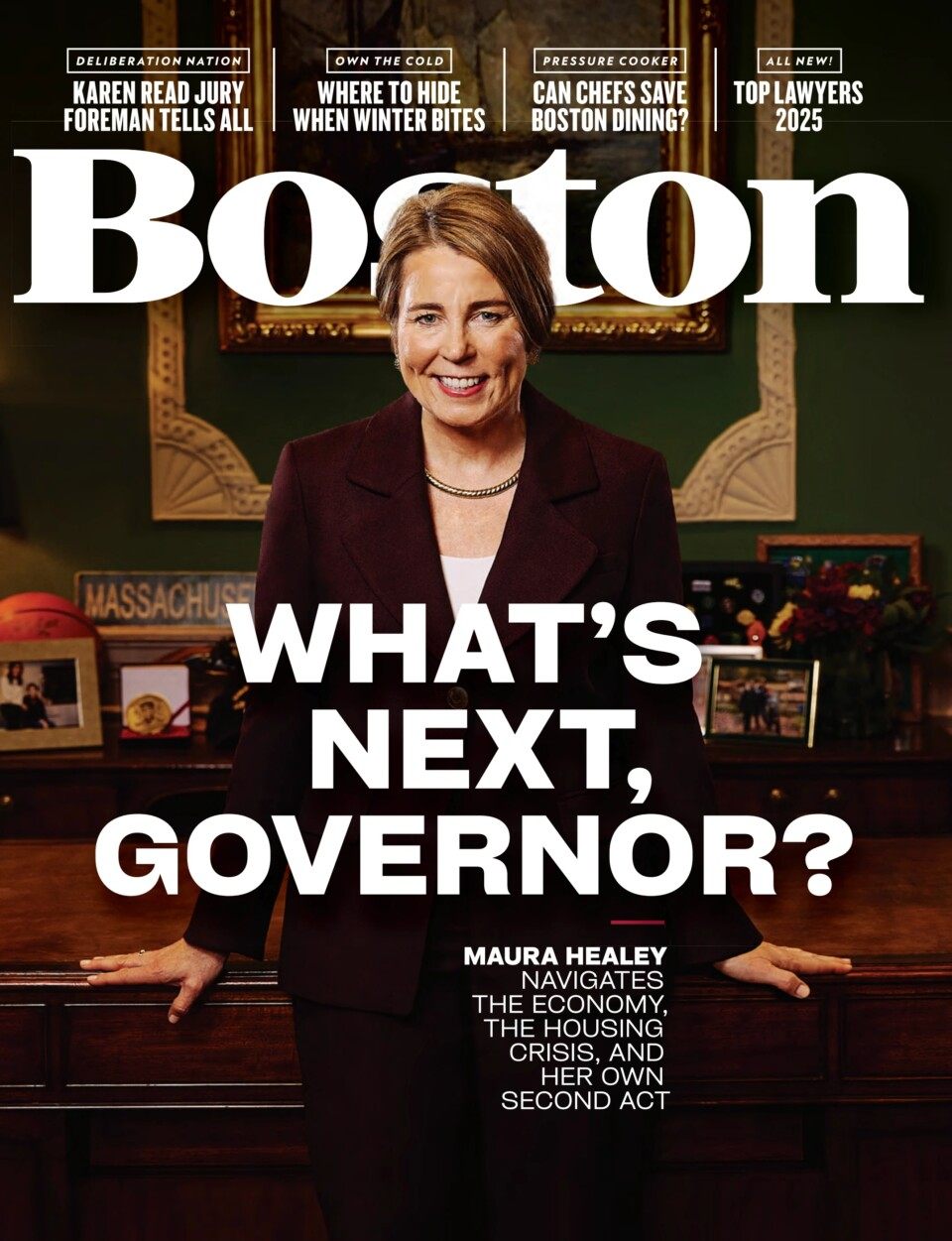
Massachusetts Governor Maura Healey Is Playing to Win
As she gears up for reelection, the governor remains the competitive point guard she’s always been, determined to keep Massachusetts on top. But with businesses bailing and housing costs soaring, she’s facing her toughest challenge yet.
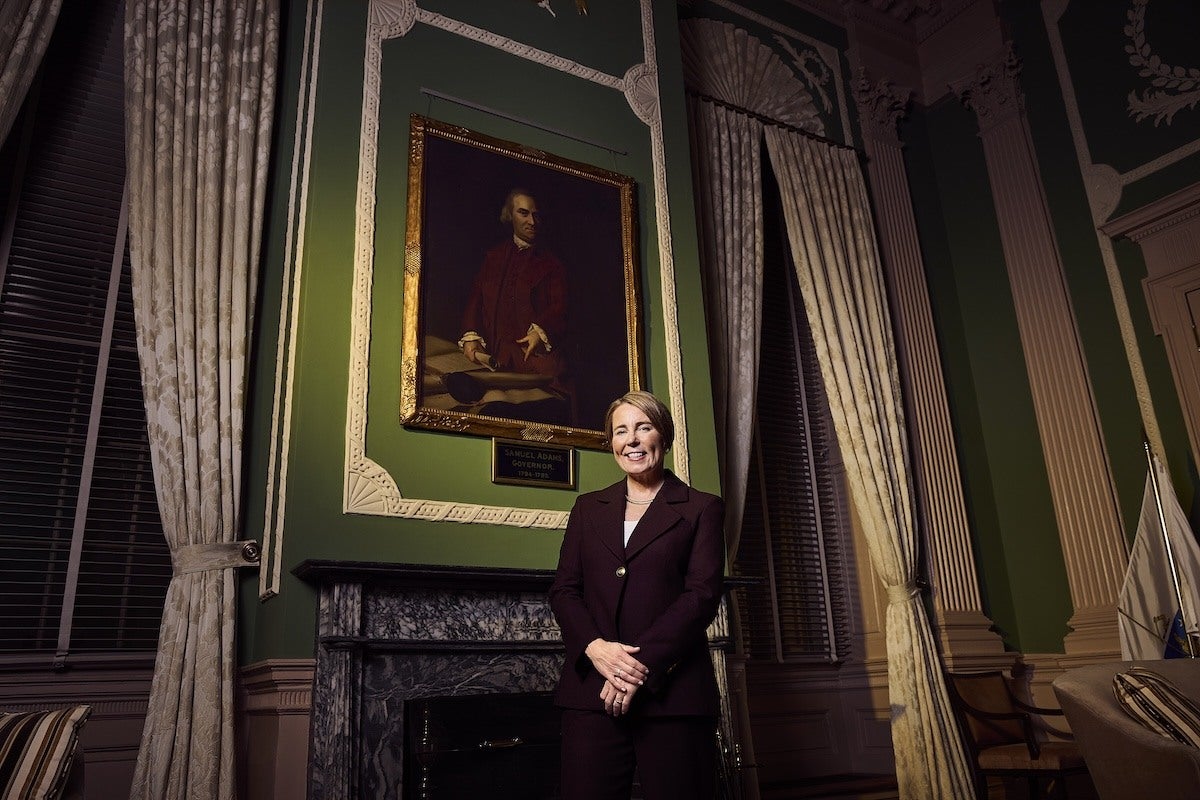
Healey in the governor’s ceremonial State House office. / Photo by Steph Larsen / Hair and makeup by Nicole Baglione
The interview is coming to an end, but Maura Healey is not quite finished delivering her message. And that message is clear: Massachusetts is winning.
It’s a pleasant afternoon in Boston, and Healey has come to Bloomberg’s Boston bureau, in the Financial District, for a 30-minute conversation about the economic issues facing the city. There are a few dozen people in the room, many of them journalists like me, but the governor knows the real audience is the business-minded viewers catching this interview on Bloomberg TV or streaming it at Bloomberg.com. To put it in basketball terms (as one does when writing about Healey, a former standout Harvard point guard): It’s a wide-open shot to sell Massachusetts—and she’s going to take it.
The interviewer, Bloomberg’s Caroline Gage, has asked Healey an array of questions, but the governor has focused most of her answers on a single point—how terrific Massachusetts is. “I want to be clear: As the governor of this great state of Massachusetts, we’re open to the world for business,” Healey says in response to a query about how the Trump administration’s cuts to federal research funding might affect the commonwealth’s innovation-based economy. She mentions her administration’s new DRIVE Initiative, a proposed $400 million fund intended to offset those cuts—a solution, an answer, and reassurance that Massachusetts has this handled.
“I’m a very competitive person,” she says. “I want Massachusetts soaring. And I want America soaring.”
The interview moves forward, hopscotching across various topics, from energy policy to ICE raids to the potential for the Trump administration to send the National Guard into Boston. After a couple of questions from the audience, Gage signals that it’s time to wrap things up. But Healey wants one more opportunity to leave this audience feeling good about Massachusetts.
“I just want people to know,” she says, leaning forward in her chair, “rankings came out; we’re number one in education, innovation, healthcare. We are ranked the best state to have a baby, the best state to raise a family, the best state if you’re a woman. We have the safest drinking water. A lot of good things going for us. I gotta work on driving down costs—housing, healthcare, energy. We’re working together to do that every single day. But, as you might imagine, my money’s on Massachusetts. Thank you.”
There’s pleasant applause as the interview comes to an end.
Part of the job of being governor, Healey will tell me later, is being “cheerleader-in-chief,” but watching her work a room—any room—you start to see something else at play. She wants people to feel good. About Massachusetts, yes, but also about the conversation they just had, and about themselves. In the events I saw her at over the period of a couple of weeks, Healey got the metaphorical pompoms out almost every single time—including reciting that list of Massachusetts bests and firsts more than once.
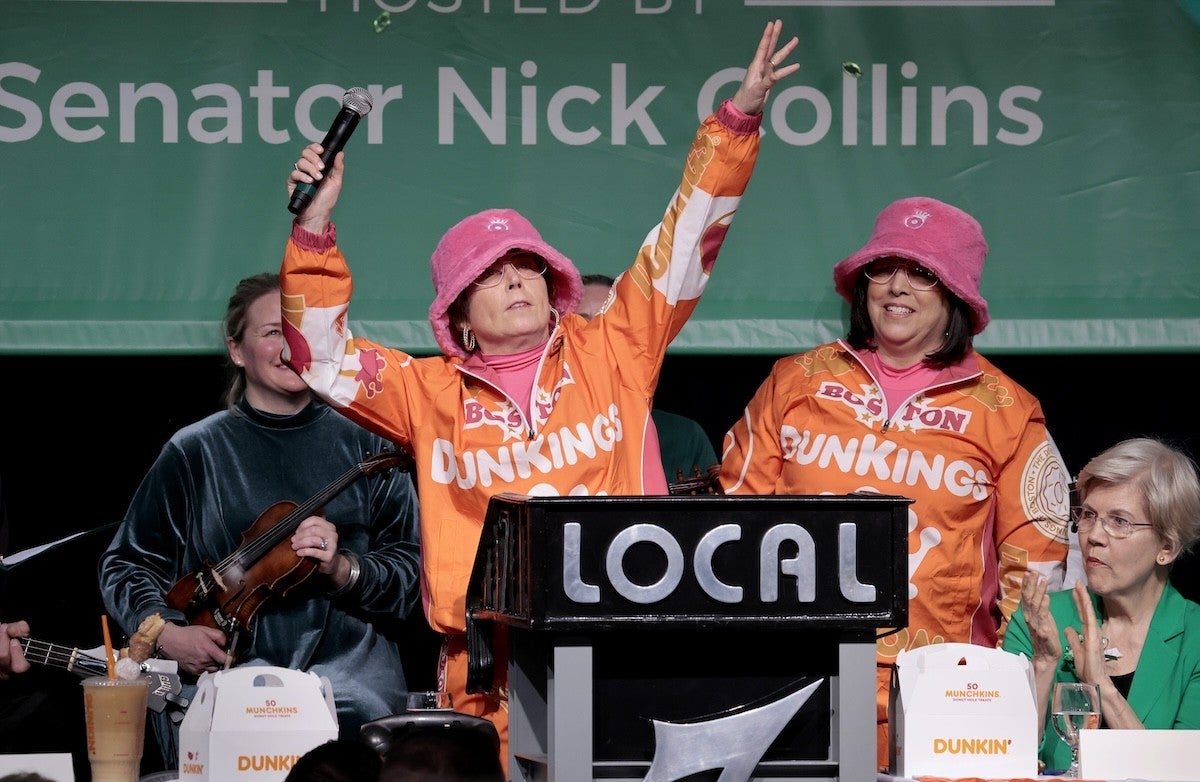
Healey and Lieutenant Governor Kim Driscoll as the self-styled “DunQueens” at last year’s St. Patrick’s Day Breakfast. / Photo by Pat Greenhouse / The Boston Globe
Of course, as she gears up her 2026 reelection campaign, the real question might be: How much are Massachusetts voters cheering for Healey? Polls taken over the past year have been solid but not quite spectacular for the governor. An August survey sponsored by CommonWealth Beacon had her approval rating at 55 percent, while a May poll from University of New Hampshire had her at 49 percent. A February snapshot from UMass Amherst fell in between—52 percent. The numbers are hardly a disaster, but they’re a ways off from the 60 percent-plus ratings former Governor Charlie Baker often received during his two terms in office, not to mention the 63 percent share of statewide votes Healey herself garnered in trouncing Republican Geoff Diehl in the 2022 governor’s race.
So why is Healey not—let me borrow her word—soaring? At the top of the list is the state of the state’s economy. After three decades of mostly firing on all cylinders, Massachusetts’ economic engine has sputtered in recent years. Housing, as we all know, is ridiculously expensive, which has caused plenty of residents to move away in search of cheaper pastures. Businesses are also feeling the effects of high costs, driving some of them to less expensive, lower-tax states while dampening overall activity for others. (Since 2020, Massachusetts has seen a net loss of 37,000 jobs, and ranks below average nationally when it comes to job growth.) Healey wasn’t in office for the birth of these problems, but as CEO of the state, she now owns them. She’s also had to govern during a period of federal chaos—first Biden’s border crisis, then Trump’s unpredictable policies and funding cuts. Few governors would have an easy time navigating this landscape.
But Healey’s middling numbers also reflect, to an extent, her style of governing. On a podcast last year with comedian Samantha Bee, the governor described herself as a “natural-born sort of pleaser,” a trait she suggested came from her parents splitting up when she was 10. “My mom’s a single mom, so I didn’t want to see acrimony or fighting,” she told Bee. “That’s my personality, for better or worse.”
It’s the same instinct on display at the Bloomberg interview—the desire to make people feel good, to smooth over tension. This particular trait—not only wanting others to feel good but jumping in to make everything all right—has served Healey extraordinarily well in the various roles she’s taken on through the years, from co-captain of Harvard’s basketball team to corporate attorney to two terms as Massachusetts’ attorney general. But as governor, the job demands making choices that inevitably leave someone unhappy.
Politically, Healey has ties to three different constituencies: working-class voters (with whom she feels a bond in part because of her own up-from-the-bootstraps background); progressives (who’ve long been drawn to Healey, thanks in part to her identity as a gay woman); and the business community (whose role in building the economy Healey understands). In her nearly three years as governor, Healey has given something to each of those groups, but has hardly gone all-in with any of them. Which perhaps explains why, when I asked a wide range of insiders how they think she’s doing, I often heard words like “pretty good,” “okay,” and “fine.” I believe the math equivalent of those phrases is…52 percent.
Healey is not, we should be clear, quite the same person she was when she burst on the state’s political scene 12 years ago. Her role has changed. Her status has changed. Her personal life has changed. But one thing about her hasn’t changed: She remains, as she told that Bloomberg audience, a very competitive person, someone who still sees herself, as she often puts it, as a point guard determined to engineer a victory. “The vigor that she brings to the job is reminiscent of who she’s always been,” says political consultant Sean Curran, who’s known Healey for years and played a role in her campaigns. “Very few people are as driven as she is.”
All of that is another way of saying: Healey will be damned if Massachusetts goes backward on her watch. Her challenge? The game she’s playing now isn’t quite like any she’s ever played before.
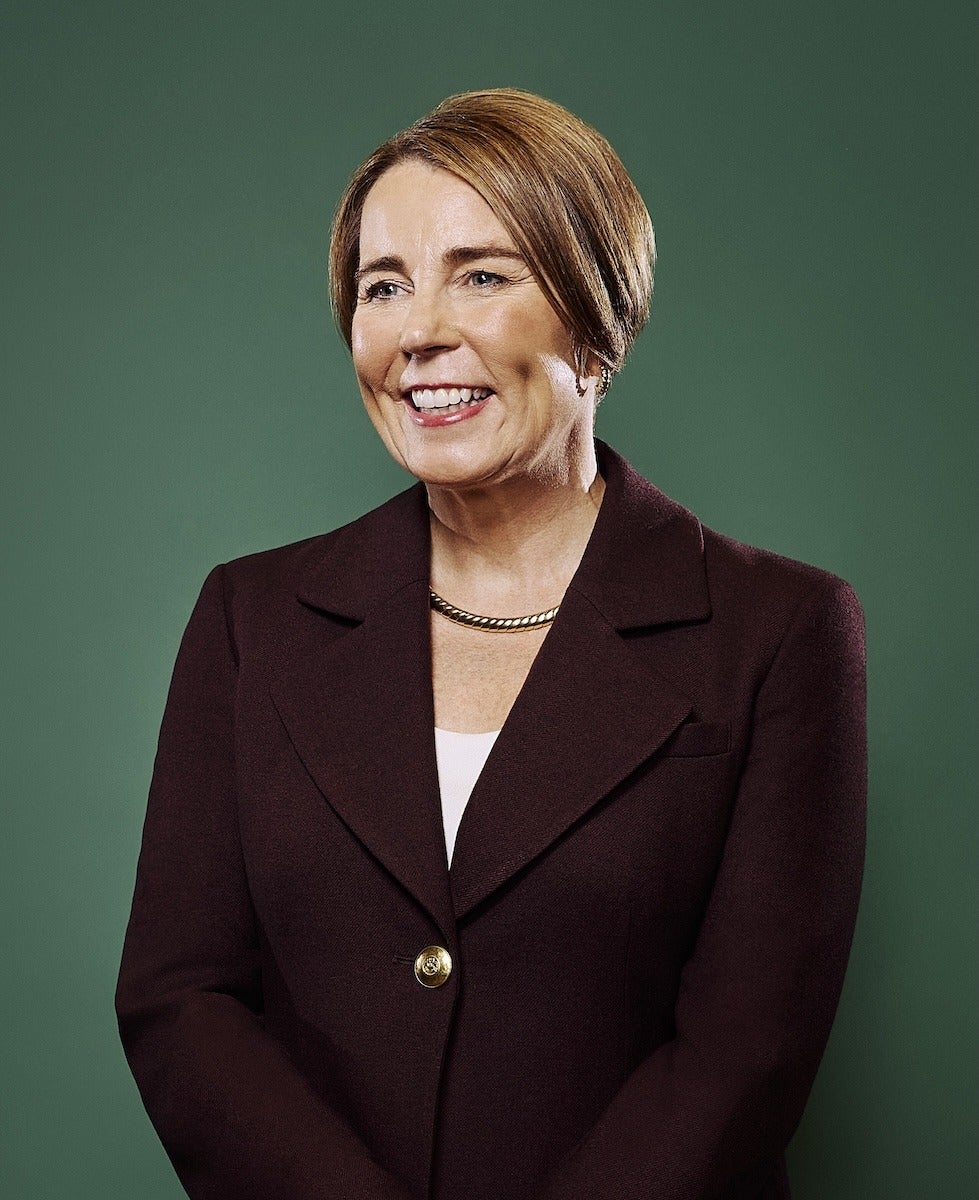
Photo by Steph Larsen / Hair and makeup by Nicole Baglione
“Especially now, states matter. State leadership matters.”
A couple of weeks after the Bloomberg event, Healey is sitting on a love seat in her ornate, high-ceilinged State House office, telling me that, yes, she really does like being governor.
“I love my job. I love leading the state,” she says brightly. “And I’ll tell you why: Especially now, states matter. State leadership matters.”
The subject of Healey’s job satisfaction has come up, in part, because there have been whispers in power circles that Healey isn’t particularly happy as governor; in fact, the whisperers will tell you, if Kamala Harris had won last November, Healey would have pushed hard to be her attorney general. So I ask the governor: Was she interested in that? Were there any discussions about it?
“Unequivocally no,” she says firmly. “You know, people make stuff up all the time, right? They’re trying to advance their own agenda. I love my job.”
Healey does allow that her current role is intense. She and her partner, Joanna Lydgate, with whom she lives in Arlington, are up before 7 a.m., getting two kids (Lydgate has a teen and tween with her ex-husband) off to school. Healey kicks off her own workday with a morning team call; then it’s on to whatever her jammed calendar calls for—speeches, signings, photo ops, calls, meetings. Activities often don’t wrap until 8 or 9 in the evening, but even then, Healey isn’t off the clock. There are binders of material to review and prep to be done for the next day. “She works really long hours, and even more than that, she has a job that always comes home with her,” Lydgate says. (The pair met as attorneys in the AG’s office but say they didn’t become a couple until a few months after Lydgate left the office in late 2020.)
Along with being intense, Healey also acknowledges that the job of being governor is decidedly different from the role she played as attorney general from 2015 through 2022. As AG, your job is to advocate for a particular side. As governor, your job is to listen to all sides—then decide. “I think anybody in [this position], if you’re doing your job, you are sitting at the intersection of competing interests, or at least you should put yourself at the intersection of competing interests,” she says. Another difference: While attorneys general more or less set their own agendas, deciding which cases to pursue on behalf of the public, governors have no such luxury—they deal with what’s in front of them, whether the issues are appealing or not.
Indeed, if Healey had a magic wand to set her own agenda as governor, it’s hard to imagine that said agenda would have included the issue that’s most dogged her during her first three years running the state: the migrant shelter crisis.
The problem began during Baker’s last year in office, the byproduct of millions of immigrants flowing over America’s southern border—thousands of them ending up here—and the state’s more than four-decade-old law requiring that any families with children residing in Massachusetts be provided shelter. Healey knew that was an equation for trouble, but the situation quickly grew more dire than she imagined, with migrants living at Logan and crammed into hotels, all at taxpayers’ expense. (The crisis would eventually cost the state a billion dollars per year.) A low point came this past January, when an undocumented migrant was arrested in a Revere motel, which was being used as a migrant shelter, and charged with possessing an assault rifle and 10 pounds of fentanyl. Healey said she’d ordered criminal background checks that should have stopped such a person from being given shelter, but state officials at the time acknowledged those checks were not being implemented.
The crisis has since faded: Healey and the legislature took steps to limit emergency shelter stays, and the Trump administration’s crackdown on the border has all but stopped the flow of migrants. But to Healey’s critics, the entire situation remains an example of mismanagement. Earlier this year, state auditor Diana DiZoglio, a fellow Democrat, issued a harsh audit from her office accusing the Healey administration of unlawfully giving out no-bid contracts to food and transportation vendors helping to manage the crisis.
I bring the shelter issue up with Healey, and she makes two points. One is that the system she inherited from the Baker administration for housing migrants was essentially a hot mess. The other is that the root cause of the crisis—a loose federal border—was out of her hands. In fact, she’s more openly critical of Biden than I can recall her previously being. “I remember telling President Biden and his team multiple times that they needed to take action on the border, and, unfortunately, they didn’t,” she says. “My frustration as governor—you’re dealing with problems that are made outside of your jurisdiction. There are geopolitical forces in Latin and South America at play. You’ve got failed leadership on the part of the presidential administration, on the part of Congress.”
It’s a reasonable defense—she inherited a chaotic situation, and the federal government failed to act. But it’s also a reminder of the bind Healey is in: When things go wrong, governors own the outcome, fair or not.
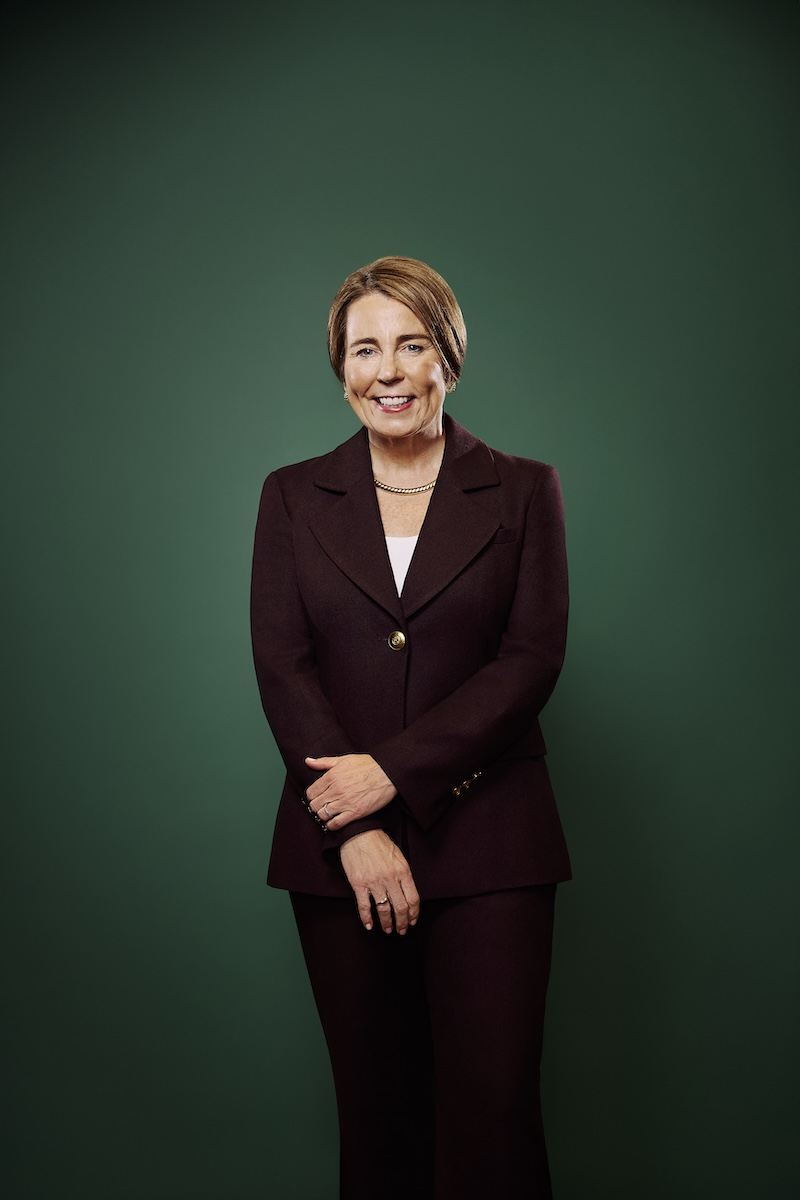
Photo by Steph Larsen
On the issue that may matter most to voters—Massachusetts’ struggling economy—Healey has taken a distinctly collaborative approach, one that reflects both her management style and the political realities of governing a diverse state.
To oversimplify (a bit): Massachusetts built a remarkable economic engine over the past several decades—world-class universities fed innovation, creating companies that generated tax revenue, which funded excellent schools and attracted more talent. At the same time, healthcare became an ever-larger part of our economy. But around a decade ago, success bred its own problems. Housing costs exploded. People left. In 2022, the state passed a millionaires’ tax. Business leaders felt overtaxed and underappreciated. By the time Healey took office, the virtuous circle had become a vicious cycle of competing grievances.
Healey has tried to attack the problem in multiple ways. On the “competitiveness” front—basically, making Massachusetts more friendly to business—she shepherded through the first tax cut in roughly 20 years (and I’m a Democrat, Healey likes to say). The bill had a range of provisions, including increasing child- and dependent-care tax credits as well as reductions in inheritance and capital gains taxes. She also signed an economic development bill boosting AI, climate-tech, and life-sciences industries, and developed the DRIVE Initiative to ease the blow of Trump’s research cuts.
To try and make housing more affordable, Healey has focused on increasing supply, speeding up the environmental review process while signing a $5 billion package intended to make it easier to build in the state. When Healey took office, she asked for an audit of how many housing units Massachusetts needed to balance supply and demand. The answer was 220,000. On her watch, she tells me, at least 100,000 new units have been built or broken ground.
Finally, there’s the T, whose financial and operational problems were arguably making all the other economic issues worse. Healey hired transit veteran Philip Eng, who’s gotten nearly unanimous praise for turning around a system that was not just figuratively, but sometimes literally, on fire.
All of these, it should be noted, are real accomplishments. And yet they’re solutions that come with problems of their own. The first: Making Massachusetts more affordable and competitive is not something that can happen in weeks or months; if it happens, it will happen over the course of many years. And people—a.k.a. voters—might not have that much patience. (In the UNH poll showing Healey’s approval rating at 49 percent, she was underwater with less-educated Massachusetts residents, who cited housing as the number one issue.) Healey acknowledges some things can’t be solved immediately, but says there’s nothing to do but get moving. Those 220,000 housing units the state needs, for instance? “Those can’t be built overnight, right?” she tells me. “So what do you do? You just get to work. And my approach was, you know, I’m still that point guard.”
Healey keeps returning to this metaphor—the player who distributes the ball, keeps everyone involved, and tries to make the whole team happy. But it illustrates the second problem she faces: In trying to solve the state’s problems, she’s given various constituencies some of what they wanted, but she’s also disappointed each of them. Progressives, for instance, were hardly stoked about the parts of Healey’s tax bill that benefited wealthier Bay Staters. They’re further frustrated that she won’t get behind efforts to allow rent control to happen in Massachusetts. The business class, meanwhile, wants taxes cut even more, including a reduction in or complete elimination of the millionaires’ tax. Healey has given a political answer—let’s study it—but she surely knows that pushing to deep-six the tax will only alienate already-not-so-thrilled progressive and working-class voters.
Healey is hardly the first elected official to deal with these kinds of problems; in many ways, this is what politics is. But her management style has her biggest critics wondering how well she’s mastered becoming a decisive executive. In reporting this piece, I was told a story about a member of the business community who met with Healey and presented her with a number of economic development ideas. Healey purportedly listened intently and nodded her head in agreement—and then never followed up.
On the flip side, others see her willingness to at least listen as a virtue. Chrissy Lynch, head of the Massachusetts AFL-CIO, makes clear she’s not always thrilled that the business community has such a large seat at Healey’s table, but she gives the governor credit for bringing stakeholders together. “She doesn’t have an ego in this stuff,” Lynch says. “She is so solutions-driven.” Jim Rooney, head of the Greater Boston Chamber of Commerce, likewise praises Healey’s willingness to listen, which he says is in contrast to the Baker administration. “That administration was much more top-down and confident that they had all the answers to all the public policy issues,” he says. “This is a much more collaborative approach.”
That said, Rooney believes there’s a time for listening and a time for action. “I’d like to see a bigger sense of urgency on some of these issues of competitiveness,” he says. “Otherwise, we’ll look back in 10 years and say, what happened?”
The governor acknowledges feeling the push and pull from various groups. But she believes she’s doing this job the right way. “I’m a pro-growth, pro-business Democrat,” she says. “I’ve worked incredibly well with the business community. It’s also the case that I have an excellent relationship with our labor unions. I don’t think these things are mutually exclusive. And actually, if you get people in the room together, you can figure out that there’s often a way to compromise. There’s often something that works for everyone.”
It’s a reminder of how different this particular game is from those Healey has played before. On the basketball court, in the courtroom, you win or you lose. Period. Governing offers no such clarity.

Healey played point guard for Harvard, 1988-1992. / Courtesy Healey Family
Healey has been around Massachusetts politics long enough that by now, many people know the basic outlines of her bio: Grew up on a farm near the New Hampshire Seacoast, the oldest of five kids whose dad left when Healey was just 10. “That was a shock to my mom, a shock to our household,” she tells me. “I think a little bit from that experience, you kind of live moment to moment. I threw myself into school. I threw myself into sports. You try to work hard and put yourself in a position where you have some options.”
Out of that feeling of insecurity, a powerful inner drive emerged. She helped her single mom by working multiple part-time jobs—including, eventually, cocktail waitressing at Hampton Beach Casino—while also becoming the best basketball player Winnacunnet High School had ever seen. It was a masterclass in juggling competing demands—and making sure nobody felt let down. After graduating from Harvard—where she had a work-study job in the fieldhouse, which turned her into a whiz at folding laundry—she allowed herself to explore a bit, playing two years of pro basketball in Austria (it was during this period she came out as gay). But then it was back home and back to serious stuff: law school, followed by a decade as a business litigator, followed by a fascinating turn into public service as divison chief in the AG’s office.
Healey says there was no grand strategy in any of this; it was all moment to moment—just use your wits and listen to your gut about what comes next. “None of it was planned, you know? I mean, honestly, that’s been the story of my life.”
But there was a pattern: Work harder than everyone else. Don’t complain. Make people around you feel supported. Win.
It’s an approach that served her brilliantly when she ran for attorney general in 2014. Given the role Healey has played in Massachusetts politics for more than a decade, it’s hard to remember what a long shot she was back then. She’d never been involved in politics before and was almost completely unknown. Turns out it didn’t matter. Her natural political skills—and her story—clicked with voters. She pummeled endorsed Democrat Warren Tolman by 24 points in the primary, then crushed Republican John Miller by nearly the same margin in the general election.
As AG, Healey leaned into the role of protector of the underdog, the person who jumps in to try to make everything all right. She famously sued Donald Trump nearly 100 times during his first term, while also challenging other powerful interests, including winning a $4.3 billion settlement from the opioid-pushing Sackler family and Purdue Pharma. She was both fierce and beloved simultaneously.
By 2022, after Charlie Baker announced he wouldn’t run for a third term, Healey was such a rising star that she cleared the Democratic gubernatorial field. She seemed to be the right candidate in the right place at the right time: a tenacious progressive prosecutor who’d be the first woman and openly gay person ever elected governor in Massachusetts.
Yet Healey’s smooth path to victory in that race may have also contained a downside. “She didn’t have much of a race, because no one was going to beat her, and that’s a tribute to her,” says one Democratic insider. “But she was so clearly the frontrunner in that race that she was never forced to articulate a strong vision for what she was going to do as governor.”
The vision thing continues to hound Healey three years later. The vision she does articulate—the litany of bests and firsts she rattles off—isn’t so much about transformation as preservation, maintaining Massachusetts’ position at the top. In some ways, she’s like the coach who took over a championship team: Sure, that team might have more problems than people realized, but the goal is still to stay on top, not reinvent the game.
I don’t think Healey spends much time thinking about her role in these terms. Her approach—as it’s been since she was 10—is just to throw herself into the task at hand so that people don’t have to worry so much. “Every night I go home and I think about, you know, there are upward of 7 million people out there in this state who are depending on me,” she says. “You feel that responsibility.”
It’s the same instinct that made her successful on that New Hampshire farm, in that Harvard fieldhouse, and in the AG’s office. Whether it will be enough to continue governing a state facing challenges that require difficult trade-offs—not just hard work—is the test of her governorship itself.
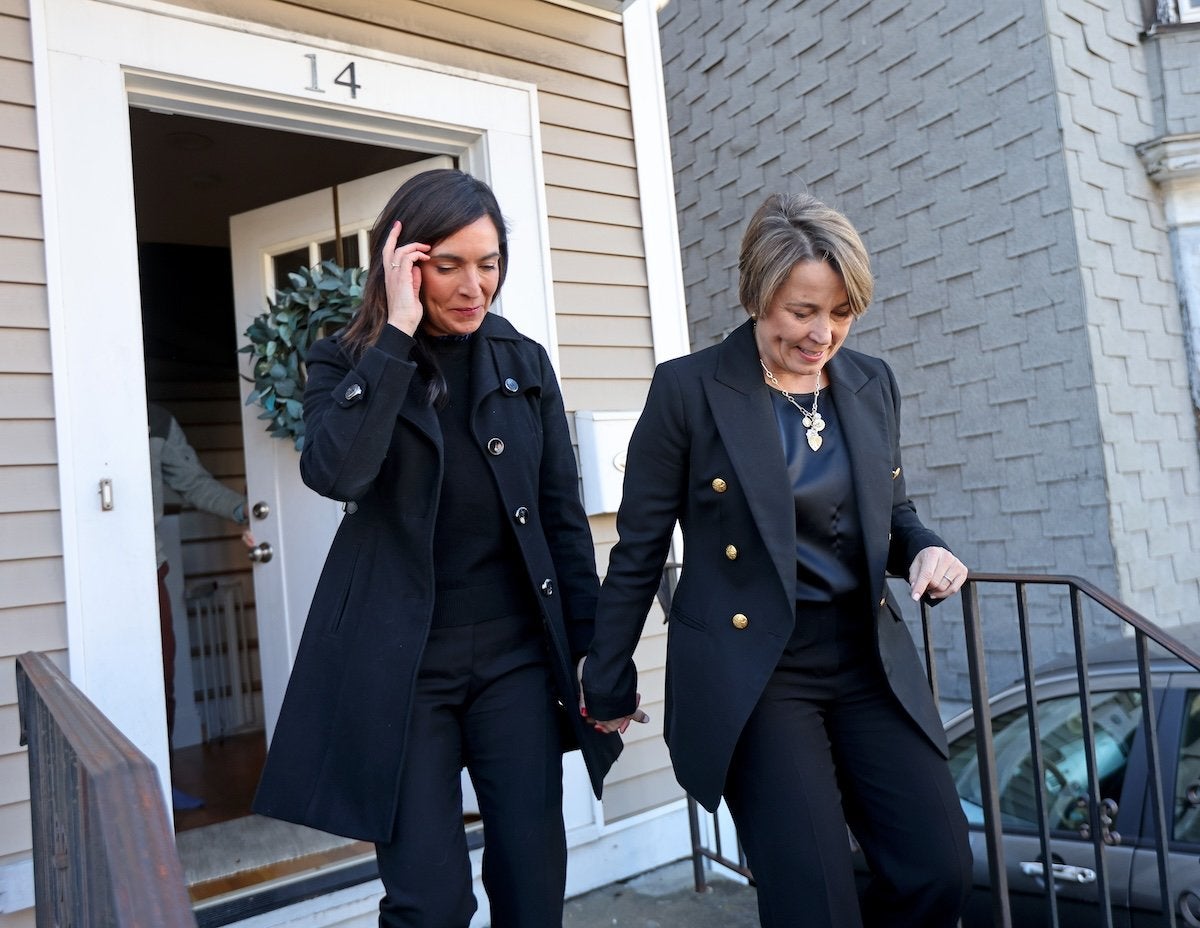
The governor with First Partner Joanna Lydgate. / Photo by Matt Stone / MediaNews Group / Boston Herald via Getty Images
In January 2023, a few days after her inauguration as governor, Healey did something somewhat uncharacteristic: She let the public in. Boston Globe columnist Yvonne Abraham wrote a piece introducing readers to the state’s new First Partner, Joanna Lydgate. Healey and Lydgate had mostly kept their relationship out of public view until then, in part to protect the privacy of Lydgate’s kids and ex-husband. “This is a person I love very much, and I have great respect and admiration for,” Healey told Abraham. That summer, Healey’s office announced the governor was moving in with Lydgate and her kids. (Healey had previously been in a long-term relationship with Gabrielle Wolohojian, whom she nominated—to some public outcry—to the state Supreme Judicial Court in 2024.)
Ask ChatGPT for a list of major life stressors, and you’ll find starting a new job, moving, and becoming a stepparent—all three of which Healey essentially did in fairly rapid succession in 2023. When we talk one morning, Lydgate acknowledges that she and Healey have navigated a lot of change, and that their lives—she now runs the nonpartisan elections organization States United Democracy Center—are busy. When I ask how much work-life balance the couple has, she chuckles. “What work-life balance? She has her job, which is a very big job. And I have to travel a lot for work,” she says. “We have a teenager and a soon-to-be teenager at home. But I think it’s honestly not so different from so many families that are trying for a balance.”
Lydgate tells me that she and Healey strive for as much normalcy as possible: Working out together when they can. Watching a TV show when time allows. Taking their dog, a female golden retriever named Charlie, for a walk. On the more mundane side, Healey—harking back to her work-study days at Harvard—handles washer-and-dryer duty. “My son likes to joke that the governor does his laundry,” Lydgate says with a laugh.
I ask if there are elements of Healey’s personality that the public might not fully appreciate, and Lydgate talks about how grounded her partner is. “She’s very good at putting furniture together,” she says. “She grew up on a farm, and I think that’s a really deep part of who she is. Not just because she loves to be outside, but she has a really strong work ethic.” (Speaking of farm life, Lydgate mentions that Healey was initially thrown by the fact that Charlie is allowed on the couch. “She grew up with dogs who lived outside on the farm. Like, who is this princess dog that you are treating like a fifth member of the household?”)
Lydgate also talks about how much Healey thrives on interacting with people. She says the couple once took an online quiz measuring introversion versus extroversion. “She was, like, 100 out of 100 on the extrovert scale,” Lydgate says. “She would be so happy to spend all of her time talking to people.”
It’s a revealing detail. Healey doesn’t just tolerate the endless meetings and glad-handing that come with being governor—she genuinely likes it. For her, listening to all sides isn’t a chore—it’s central to how she leads. There is one area, though, where Healey has been willing to take clear stands and risk making people unhappy: Donald Trump.
It’s in dealing with Trump that Healey most resembles the protector figure from her days as attorney general—the person who jumps in to make things right. She’s spoken out repeatedly about various Trump decisions and policies, and in certain cases has taken steps to counteract those moves with measures of her own. The DRIVE Initiative is one example. Her announcement this summer that Massachusetts would protect vaccine access was another. Healey has also engaged in political theater—hosting a high-profile meeting with Canadian premiers to discuss Trump’s tariffs and tourism issues, and later welcoming Democratic legislators from Texas who hightailed it out of their state to stop GOP-led redistricting.
But as with many things Healey has done, not everyone is thrilled with her version of the resistance. Especially in the early months of Trump’s current presidency, progressives complained she wasn’t speaking out often or forcefully enough. Meanwhile, some in the business community complain that every time she criticizes Trump, Massachusetts gets whacked in terms of slashed funding. (The Trump administration clawed back $600 million in Congressionally approved money to replace two Cape Cod bridges, and in September slashed nearly $7 million in federal safety funding for Massachusetts. And this on top of research grant reductions and ongoing funding threats aimed at Harvard.)
Healey scoffs at the idea that clamming up would make anything better. “I don’t think it matters,” she says. “He’s been attacking us and other states since the beginning of his administration. He’s a guy who, if you think you’re making a deal with him, he just moves the goal posts.”
All of this is bigger than politics or dealmaking anyway, she believes. “I’m not going to stand by when this president decides to give away intellectual assets to China,” she tells me. “I try to talk about the facts. I try to say ‘Yes, it’s a criticism, Mr. President, that you are deferring research and medical innovation in our state and in our country and then allowing China and other countries to scoop up our scientists, researchers, engineers.’”
If only governing Massachusetts were this straightforward.
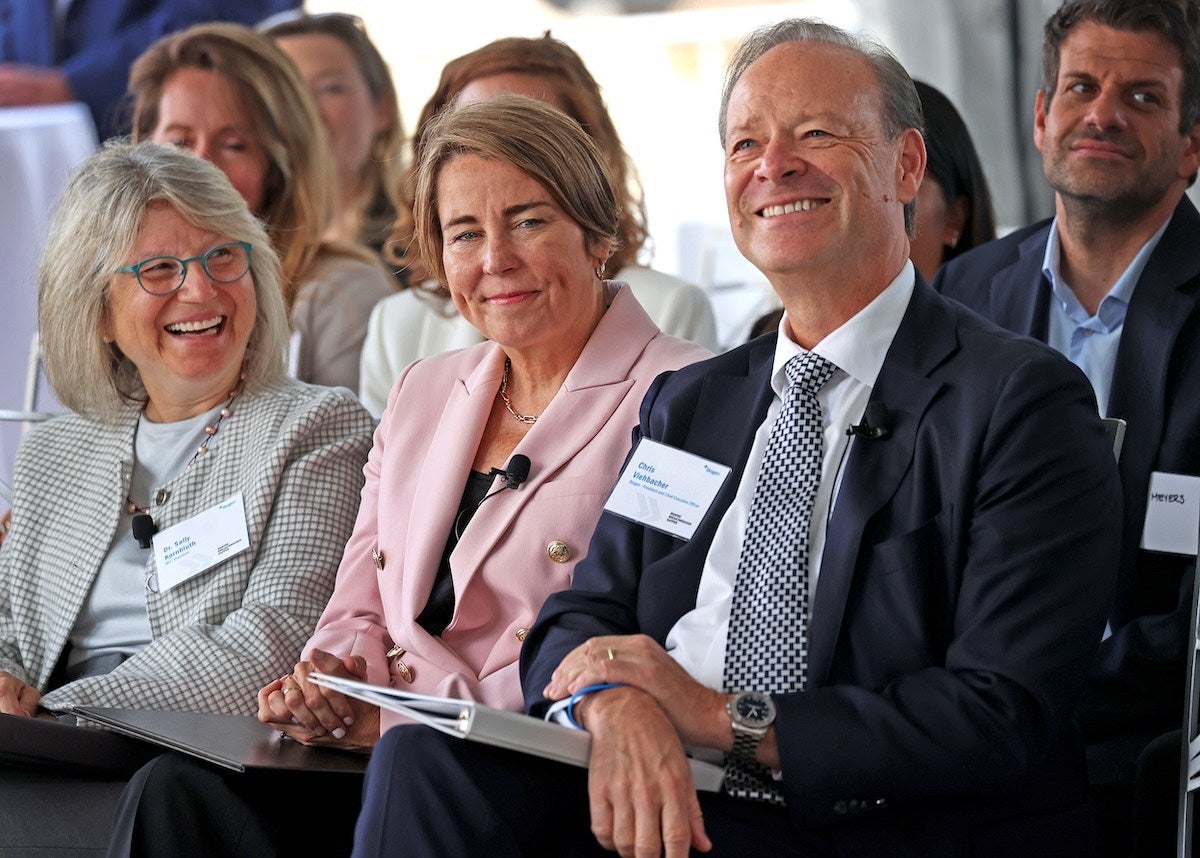
At the Biogen headquarters groundbreaking in September. / Photo by David L. Ryan / The Boston Globe
A few hours before I sat down with Healey in her office, she appeared at a groundbreaking ceremony in Kendall Square for Biogen’s new headquarters. The event had the air of history about it, not just because of the size of the project—the facility, built in conjunction with MIT, will be 580,000 square feet—but because Biogen was one of the companies that helped establish Massachusetts as an innovation hub back in the ’80s, kicking off a new economy—a new era, really—in the Bay State.
At the event, held in a giant tent near the building site, the crowd of nearly 300 people got on their feet for a standing ovation. But it wasn’t for the governor. It was for Biogen cofounders Phillip Sharp, now age 81, and Wally Gilbert, now age 93. When Healey was introduced, she got a pleasant reception. She went to the podium and talked about how the new complex was exactly the kind of commitment Massachusetts needs if it’s going to continue to lead the world in innovation, if it’s going to continue to have a robust economy. Then she went into full cheerleader-in-chief mode.
“I say this to the world: If you’re a researcher, scientist, entrepreneur, soon-to-be-founder, come to Massachusetts. There is no better place. This is why we’ve been number one in education, innovation, healthcare. We’ve been rated the best state for working moms and dads, the best state to have a baby and raise a family….”
It’s the same pitch she’s been making since she took office—Massachusetts as champion, herself as cheerleader-in-chief. And it might be enough to win her reelection.
The dynamics of next year’s governor’s race appear, at least right now, to be in Healey’s favor. She’s unlikely to have an opponent in the primary, while on the Republican side, three contenders will likely battle it out. Two of them—Mike Kennealy and Brian Shortsleeve—are moderates who served in the Baker administration. The third—Mike Minogue—is a military veteran and biotech executive who gave substantial money to Trump and other GOP candidates in 2024. No matter which one of them wins, Healey will undoubtedly try to tie them to Trump and make the election about the president. Meanwhile, it’s important to remember: Healey has not only won every election she’s ever had, but she’s also won each one of them by 20 points or more.
That said, Healey’s reelection is not a sure thing. In a UMass poll taken in late October, 43 percent of respondents said the state is on the wrong track, versus only 40 percent who said it’s on the right track. Meanwhile, it’s not hard to imagine the three Republican candidates—all men—going after Healey as not decisive enough, not moving quickly enough, not cut out for this game. The one who let the vaunted Massachusetts economy really slip.
Several people I talked to for this story pointed out that, contrary to many expectations, Healey has largely followed the template Bill Weld established 30 years ago for successful Massachusetts governors: conservative on business issues, more liberal on social ones. It’s been pretty damn effective from a governing standpoint, but it’s fair to wonder if the model is starting to show its age politically. We live in an era, after all, when the politicians who generate the most energy (and social media visibility and money) are the ones on the edges—Trump and his MAGA acolytes on the right, figures like Zohran Mamdani (and Michelle Wu) on the left. It’s not just that the positions they stake out are bolder; it’s that none, at least politically, would be described as pleasers. Our new norm isn’t avoiding acrimony and fear; it’s cultivating it.
Healey, true to who she is, is betting that in Massachusetts, at least, there’s still room for someone who wants everyone to leave the room feeling good. As always, she’s in it—“it” meaning fixing the state’s economy, or standing up to Trump’s excesses, or winning reelection, or whatever she turns her attention toward—to win. Still, it’s unclear whether the victory she’s chasing—keeping all her constituencies satisfied while moving the state forward—is actually achievable. Perhaps Healey’s approach requires more time to bear fruit than a single term allows, or perhaps her governing approach is past its prime. The next year will help answer which of these is true.
When I talked to Lydgate about her partner, she mentioned the governor’s stint as a Hampton Beach cocktail server a couple of times. “I honestly think she liked that job almost as much as she likes being governor,” Lydgate said. “She loves being around people, meeting people, hearing people’s stories.”
But, of course, a cocktail-server gig was never going to be enough. The point guard was too driven for that, too competitive, too determined to do more than just make people happy—she wanted to win. Whether she’s figured out how to do both as governor remains to be seen.
This article was first published in the print edition of the December 2025/January 2026 issue with the headline: “Maura Healey is Playing to Win.”