Why Don’t Many Apple Cider Doughnuts Taste Like Cider?
Buying one at a bakery or farmstand might up the odds of finding something cider-forward, but pastry experts still recommend an orchard.
Welcome to “The Salty Cod,” a monthly column in which humorist Steve Calechman grapples with uniquely New England dilemmas.
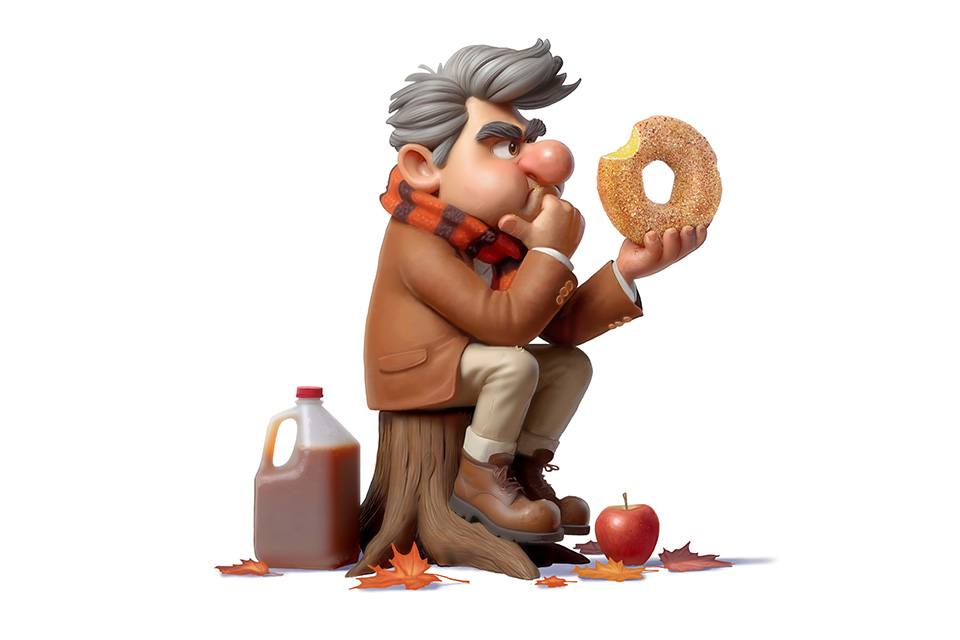
Illustration by Dale Stephanos
Dear Salty Cod: Why do so many apple cider doughnuts not taste like apple cider?
Another autumn, another attempt to visit an orchard and not over-pick. As you fail spectacularly once again, the thing that makes it all better is the promise of that doughnut at the end. Yet after waiting in that long line, when you finally take a bite…well…it’s not really that apple cidery.
To address this seasonal betrayal, the Cod reached out to two experts: Nathan Kibarian, owner of Desserts by Nathan, and Marissa Rossi, pastry chef at Northern Spy. The culprit, they say, is that the cider likely hasn’t been reduced. On its own, it’s watery and thin. The former can prevent the dough from frying well; the latter makes it too weak to compete with the spices, sugar, and oil. As a result, the cider flavor gets buried, relegated to backup vocals, handclaps at best.
Buying one at a bakery or farmstand might up the odds of finding something cider-forward, but Kibarian and Rossi would still go with an orchard. And of course, that’s where you’re going anyway, because it’s not merely about buying a doughnut. It’s about doing the walking, picking, and mild sweating to justify putting down one, two, probably three-plus doughnuts. The cider is also most likely made in-house, and you have the best shot at getting a hot doughnut, and a hot doughnut makes most problems go away.
If you think you can tell cider concentration just by looking, well, you’re a fool. You certainly could ask, “Hey, do you reduce?” but only if you want to get mocked by the teenage employees as soon as you walk away. There are, however, some signs you’re getting a good doughnut. It should be fluffy and the size of, you know, an actual doughnut—a four-biter, as Rossi says. Anything smaller is a letdown; anything larger has to take a longer oil bath.
You also don’t want to see any greasy shine, Kibarian says, and Rossi will look to see if any sugar remains on the outside. The sweet stuff is hygroscopic, a fancy way of saying it’ll draw out moisture, then dissolve. No sugar means dryness, so your next move is to stare at the menu board, make your best “can’t decide” face, and let people go ahead of you, because you will wait for the next batch to come out.
Got a question for the Salty Cod? Send it to [email protected].
See also: Where to Find the Top Cider Doughnuts at Greater Boston Farms and Orchards
Previously: What’s the Deal with Foliage Drives?
A version of this story appeared in the print edition of the October 2025 issue.