Stranded in New Hampshire: A Rescue Mission at Franconia Ridge
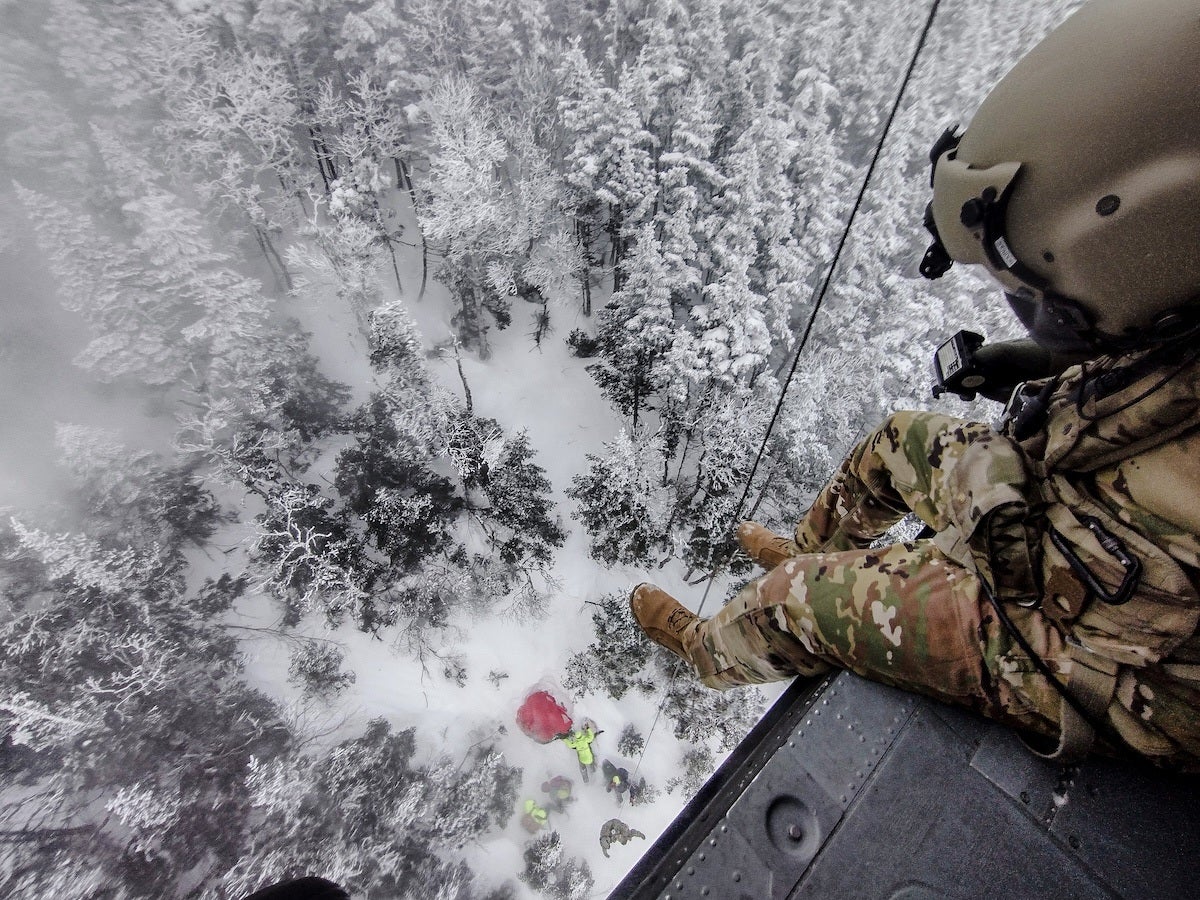
Fish and Game calls in the Army National Guard for helicopter evacuation only in life-or-death emergencies. Patrick Bittman’s situation required one. / New Hampshire Army National Guard
A single beam of light bobbed in the darkness as Patrick Bittman, cold and winded from hours of hiking, hauled himself up the last stretch to the summit of Little Haystack. Hours earlier, he’d set out alone on a nighttime winter hike in New Hampshire’s White Mountains to climb the three peaks of the Franconia Ridge loop and watch the sun rise from the final summit. He had left the trailhead at 12:15 a.m. under a light snow, shortly after scribbling down his first journal entry: “Maybe this is foolish.”
Three hours later, as he scanned the first peak with his headlamp, he felt as though he’d stumbled into a Norse hellscape. The summit of Little Haystack, at nearly 5,000 feet above sea level, was far colder, windier, and buried under much more snow than the trailhead. Off the sides of the ridge, stunted trees—gnarled and bent by years of pounding wind—were caked in thick layers of frozen snow. Icicles jutted out at improbable angles from the black rocks. Then there was the sound—that unnerving, haunting sound. He took off his gloves, exposing his hands to the cold, to pull his journal out of his pack. “The wind is primordial, not a roar, but a deep, unceasing, guttural back-of-the-throat growl,” the 28-year-old wrote. Still, he pressed on.
On his way up Little Haystack, the trees on either side of the trail had kept him on course. Now, above the tree line, the path vanished under fresh snow. Every few steps he strayed from the invisible, rocky spine of the mountain and sank up to his waist in drifts. Each time, it took him 10 minutes to fight his way out, leaving him colder, wetter, and more exhausted than before. A distance that would have taken 15 minutes in normal conditions took him two hours. He was badly behind schedule. But he didn’t turn back—he just adjusted his goal. Instead of sunrise from Lafayette, he’d catch it from Lincoln, the middle peak.
As he slowly advanced, Bittman kept stripping off his gloves, exposing his hands, to consult his GPS or write in his journal, yet decided against eating food or drinking hot coffee from his thermos because he was worried about the cold. After a while, the words he wrote weren’t making much sense either.
Finally, a realization cut through his mental fog—unless he made strategic decisions right away, he would freeze to death on this mountain. He thought of his friends and family, how he’d be letting them down if he never made it home. None of them even knew where he was out hiking.
But when he finally decided to turn back, it was too late—he couldn’t find the trail. Instead, he started frantically down a steep, treeless gully, thick with snow, moving faster and faster. He figured he’d eventually intersect the trail and, even if he couldn’t go any further, a hiker would find him in the morning. Sliding 10 feet at a time in the deep snow, then getting back on his feet and sprinting again, he was animalistic, his body buzzing with adrenaline, his heart thundering beneath his layers.
He ran on in a panic, littering the mountainside with his belongings—his hat, his gloves, his walking stick, his headlamp. His mind was locked in flight mode.
After about a third of a mile, his mad dash came to a sudden halt as he sank waist-deep into the snow. He could no longer move his body, nor did he even want to. His adrenaline drained away, and his heartbeat slowed. Peace settled over him. He closed his eyes and waited for death.
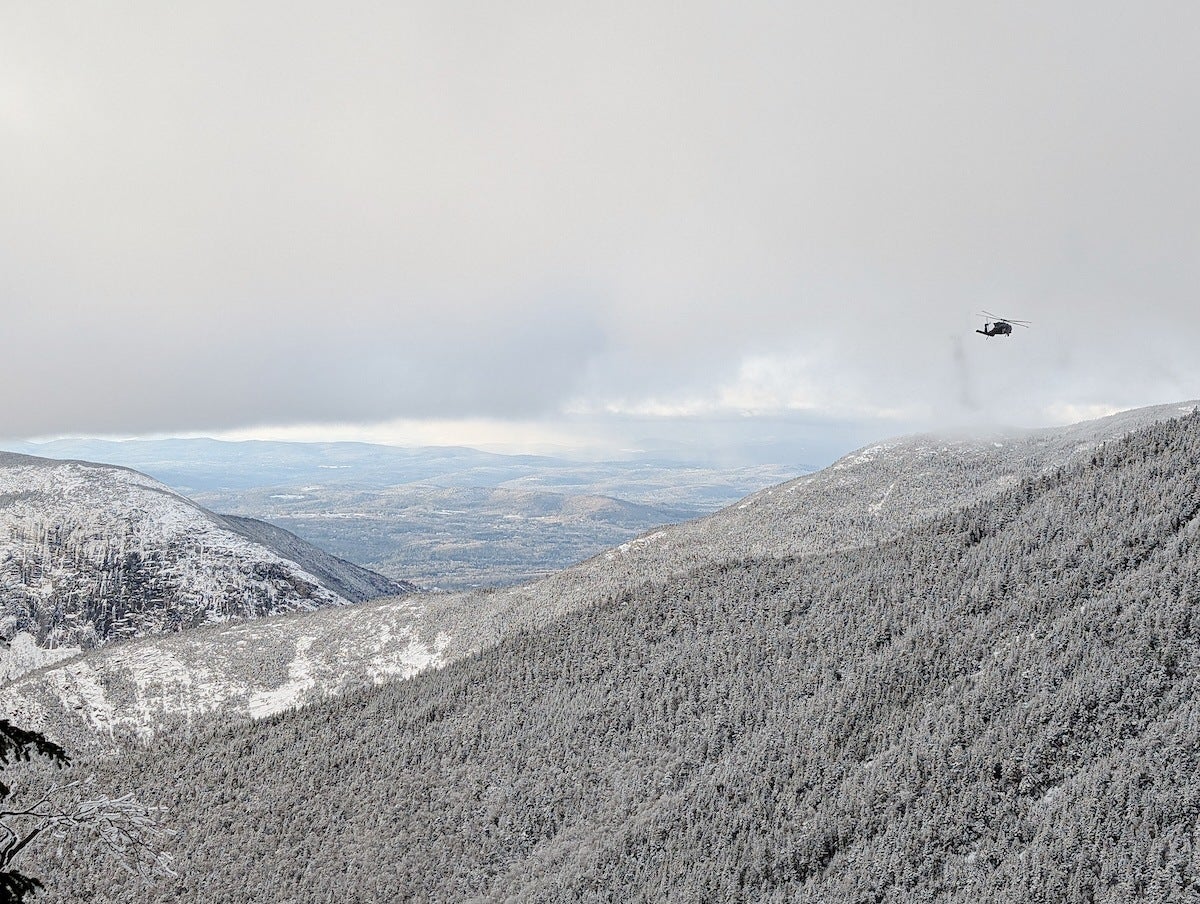
The Franconia Ridge loop in the White Mountains—New Hampshire’s most frequent rescue site. / Courtesy photo
Just before 8 a.m. on December 19, 2024, New Hampshire Fish and Game Department Lieutenant James Kneeland drove north through Franconia Notch on Route 93 to a meeting in Lancaster. It was wild in the notch that morning, the mercury at 25 degrees, with 40-mile-an-hour winds blowing snow everywhere. As always when driving north, he decided to check out the scene at the trailhead to the Franconia Ridge Loop, which lies just steps off the highway, to see how busy things were. The loop is one of the most popular hikes in the Northeast—and the single most frequent site for rescues in New Hamsphire.
He pulled his Chevy Silverado into the snow-covered lot where a single car sat parked. Who the eff would be up there in this goddam weather? he wondered. Still, with so few cars in the lot, he felt confident he wouldn’t get an emergency call that day.
Minutes later, more than 3,000 feet above that parking lot, Bittman opened his eyes, surprised he was still alive. One lucid thought surfaced: Maybe he had cell reception. He fished his phone out of his jacket and dialed 9-1-1. To his disbelief, a dispatcher answered. He told her he needed help.
Kneeland had only made it 20 minutes up Route 93 when State Police texted him at 8:13 a.m. about a hypothermic hiker on Little Haystack. He pulled over, took out his laptop, fired up his GPS mapping software, and entered the coordinates. Bittman’s location appeared as a red dot in the Dry Brook drainage, a gully he knew all too well. Two years earlier, on Christmas Eve, he had sent a team of rescuers up there to find a lost hiker. They returned on Christmas Day carrying his lifeless body.
Kneeland called Bittman and asked if he could move, explaining he could guide Bittman back to the trail over the phone. But Bittman was too cold and his limbs were frozen. Kneeland knew a helicopter was his best chance, and he asked how far Bittman could see. When Bittman replied that he was in the clouds and could only see about 50 feet, Kneeland knew a chopper wouldn’t be able to safely fly through the clouds to get there. He would have to send rescuers up on foot. “I’m going to get a team together and send them up to you. It’s going to be several hours till they’re there, though,” he told Bittman, adding that he would call every 30 minutes to check on him.
“I know it’ll take you as long as it took me to get here,” Bittman replied.
Kneeland hung up and started calling members of his team. It was time to save Bittman.
Fish and Game Lieutenant Bob Mancini was sitting on the exam table at the doctor’s office getting his blood pressure taken when his phone lit up with a message from Kneeland about Bittman. He read it and turned to the doctor. “You might want to give me a minute,” he said. “My blood pressure could be a little high.” He called Kneeland to accept the mission, then hustled out to his truck.
Fish and Game Conservation Officer Christopher McKee was at home when he got the call. He opened his pantry, snagged two cans of Campbell’s Chicken and Stars soup from his kids’ lunch cache, boiled them up, and poured it into his thermos before grabbing his coat and jumping in his truck, where his rescue gear was already packed and ready to go. Conservation Officer Jim Cyrs was on his way to pick up a potentially rabid bat for testing when he received the call. He rerouted his GPS and headed for the notch. Conservation Officer Joseph Canfield also responded.
Kneeland knew he was going to need more rescuers for a carry-out—it would take a minimum of 18, in shifts of at least six, to carry Bittman down the mountain in a litter. He called Allan Clark, founder and then-president of the Pemigewasset Valley Search & Rescue Team (Pemi SAR), an all-volunteer group that covers this stretch of the White Mountains, and gave him the details.
Dan Allegretti, a semi-retired private equity guy and Pemi SAR volunteer, was walking his poodle with his wife when an alert hit his phone: We have a male off trail below the ridge; he is currently alive. We will be going up Falling Waters Trail to Shining Rock and then bushwhacking north to his coordinates. Staging will be at the normal trailhead. This will likely be a carry-out. Fish and Game is bringing the litter. This is for winter crew only. Temperature is dropping currently 15 degrees, wind 25 mph. Need traction and likely snowshoes.
Allegretti walked home, filled a thermos with hot black coffee, wrapped up a piece of his wife’s homemade banana bread, and gathered some electrolytes and additional food for the mission. Then he grabbed his snowshoes, pack, and fluorescent yellow Pemi SAR jacket, and headed for his car.
When Rusty Talbot, a local climbing-gym owner and mountain guide, saw the alert, his mind flashed back to nearly two decades earlier, when he and some friends had gotten caught in a snowstorm after ice climbing. When they tried to get down the mountain, they got lost for a couple of hours in deep snow in the very gully where Bittman was located. He knew exactly how disorienting that terrain could be.
Talbot quickly checked his calendar. That night was his son’s last concert of his elementary school career. He crossed his fingers that he’d be back by then and accepted the mission. Six other winter-qualified members also responded.
Kneeland knew the cloud cover was too low for a helicopter medevac mission, but he also knew that weather moves fast on Franconia Ridge. He put in the call to the New Hampshire Army National Guard base in Concord, just in case.
National Guard Chief Warrant Officer Luke Koladish was in the flight operations room that Thursday morning when the call came in. He knew from the sense of urgency on the line, and the time it would take a ground crew to reach the hiker, that the Guard’s medevac team was Bittman’s best shot at survival. He agreed to take the mission as pilot-in-command, asking Chief Warrant Officer Jeremy Gray to serve as pilot and Sergeant First Class Aaron DeAngelis to build out the rest of the crew. DeAngelis recruited Sergeant Daniel Bourque to operate the hoist and Staff Sergeant Ethan Major to serve as medic. It was a solid team; they all had extensive experience, including some who had rescued wounded soldiers from battlefields in Iraq and Afghanistan, often under fire.
After their commanding officer signed off on the mission, Koladish headed to the Black Hawk on the tarmac, where the crew had already prepared their gear for the mission. He and Gray climbed into the cockpit, pulled on their headsets, and ran through their lengthy preflight checklist. The engine whined, and after a while, their seats began to shudder as the rotors came to life overhead. The rest of the crew climbed in. As the Black Hawk began to slowly rise into the air and head north, Gray radioed base: “We are off of Concord, en route to Franconia Notch.”
Fish and Game calls in the Army National Guard for helicopter evacuation only in life-or-death emergencies, as with Bittman’s rescue. / New Hampshire Army National Guard
At about 9:15 a.m., Conservation Officer McKee swung his truck into the snowy parking-lot staging area where Kneeland was waiting. Kneeland briefed him on the plan as McKee pulled on his outer layers, grabbed his radio, and hauled his 60-pound pack from the back of his truck. Inside it were warm clothing, a chemical warming blanket, sleeping bags, and a bothy bag—a pole-less survival shelter used for keeping warm. McKee waited for Canfield to arrive on the scene, and by 10 a.m., they were heading up the trail.
Allegretti and fellow Pemi SAR volunteers Corey Swartz and Mark Casale pulled into the lot shortly after, checked in with Kneeland, and started up the mountain. Then Mancini arrived from the doctor’s office, stripped out of his dark-green Fish and Game uniform right there in the parking lot, and started pulling base layers and outer layers from the drawers in the back of his Chevy Tahoe before grabbing his spikes, snowshoes, and 50-pound pack. Kneeland handed him the litter, and Mancini began up the trail, dragging it behind him. Soon after, Talbot and three other volunteers checked in and set out with Jim Cyrs from Fish and Game.
Eventually, Allegretti and the other two Pemi SAR volunteers caught up to McKee and Canfield. Since the volunteers were carrying much smaller packs than the Fish and Game officers, they decided the volunteers should push ahead as the hasty team to reach Bittman first and start warming him. McKee handed over some of his warming gear, including the bothy bag and chemical blanket. The volunteers stuffed them in their packs and took off, moving at as fast a pace as they thought they could reasonably sustain.
Meanwhile, far overhead, the Black Hawk closed in on Franconia Ridge. In the back, medic Ethan Major was readying his rescue gear. If the clouds were high enough to get to Bittman’s location, they were going to have to move fast. They would need a long enough break in the weather to lower Major down to Bittman, hoist both back up, and safely get out of there. DeAngelis monitored visibility out the left-side window, down toward the notch. “We have an escape route down to the left, toward 93,” he said over the chopper’s intercom.
As they neared their target, their rotors whipped up fresh snow from trees and created a rotor cloud from the moisture—both limiting visibility. But the most dangerous obstacle by far was the low cloud ceiling. Koladish and Gray inched the Black Hawk slowly up the mountain to avoid punching into the clouds if they suddenly shifted. When that happens, pilots lose all visibility in an instant and with it, often, their sense of orientation. It’s an extreme emergency—and often fatal.
Over the chopper’s intercom, Koladish announced their emergency plan: If they went into the clouds, they would immediately turn left and climb to 7,500 feet—far above the range’s peaks. The pilots would fly to the edge of what was possible, but they couldn’t risk five lives onboard to save one on the mountain.
The chopper got within a half mile, then a quarter mile to where the needle on their grid indicated Bittman should be. But as they inched higher, they reached 3,900 feet—as high as they could safely fly in the clouds. Bittman’s coordinates were at 4,300.
Just then, DeAngelis piped up: “93 is starting to fade.” They were losing visibility, and their escape route was disappearing. The pilots backed off, turned left, and prepared to retreat down toward the notch.
Still, there was one last possibility: Maybe Bittman was just above the top of the clouds. The chopper climbed over the band of clouds and tried to descend to him from above, but no luck. Bittman was unreachable.
The National Guard team radioed Kneeland and told him that they would land at the Cannon Mountain Ski Area, just north across the highway, to conserve fuel and wait for a possible break in the weather. “Granite ops this is ABLE 12,” Koladish radioed to the base in Concord. “We’re unable to get to the patient. We’re going to land at the Cannon Mountain parking lot to stage.” Down in the parking lot, Kneeland sat alone in his pickup, following it all on the Guard’s radio channel. “Goddammit,” he said aloud.
The pilots lowered the chopper onto the snowy surface and powered it down. Then they strode into the ski lodge in their camo flight gear, where ski-school kids buzzed around the lodge. Around that time, Kneeland called Bittman to check in. “Could you hear the helicopter overhead?” he asked. Bittman said he could not.
Kneeland felt a pit in his stomach. Either it was far windier up the mountain than he thought—putting Bittman in even more danger—or his coordinates were off, meaning the rescuers might need to conduct a search before they could even get to him.
At about noon, the hasty team reached the turnoff to Shining Rock, just below the summit of Little Haystack. They checked their GPS maps. Bittman was at that same elevation, but about 1,000 feet off the trail. They decided to climb a bit higher, figuring they’d naturally drift downhill as they traversed toward the little red dot marking Bittman’s location.
The trail they’d climbed was hard-packed snow. Now they faced 3 feet of undisturbed powder. They pulled the spikes off their boots, unhooked their snowshoes from their packs, strapped them on, and ventured off trail.
Swartz took point, using his GPS to guide the trio through the spruce-fir forest’s nasty, matted low-lying branches. They pushed tree limbs aside with their arms and clomped over them with their snowshoes. It had taken them nearly two hours to climb the 3 miles to where they left the hiking trail. After 20 minutes of bushwhacking through the forest, they’d only made it about 500 feet.
Meanwhile, the four Fish and Game officers, Talbot, and the other Pemi SAR volunteers had made it to the point where they too would leave the trail to move toward Bittman’s location. Their mission was different: to secure Bittman’s exit. That meant blazing a trail through the trees wide enough for the litter and the rescuers carrying it, and as level as possible to avoid jostling him. Sharp or rough movements can send a hypothermic patient into immediate cardiac arrest.
They got out their hatchets and saws—Cyrs pulling his recently sharpened two-handed axe—and started hacking. Early on, McKee hit a steep drop-off. He knew they would never get a litter back up it, and they backtracked to cut a new path. They did this again and again, backtracking, rerouting, and searching for a way through.
While the ground crew made their way toward Bittman, Kneeland sat in his truck at the trailhead, calling Bittman every 30 minutes. On an earlier call, he asked again if Bittman felt strong enough to try to reach the trail. Bittman said he could not. Kneeland reassured him that help was on the way and gave him a warning: “Whatever you do, if you do move, do not go downhill.” On another call, Kneeland asked if Bittman could build a snow shelter. The answer was no.
Kneeland kept calling to check in, but by late morning, Bittman could only respond with moans. He was fading.
At noon, Kneeland called him again. The phone rang and rang. No one answered. He dialed once more. No answer. “Fuck,” he said, banging his fist on the steering wheel. He thought the worst. If Bittman’s battery had died, the call would have gone straight to voicemail. Calls were going through but Bittman was no longer answering.
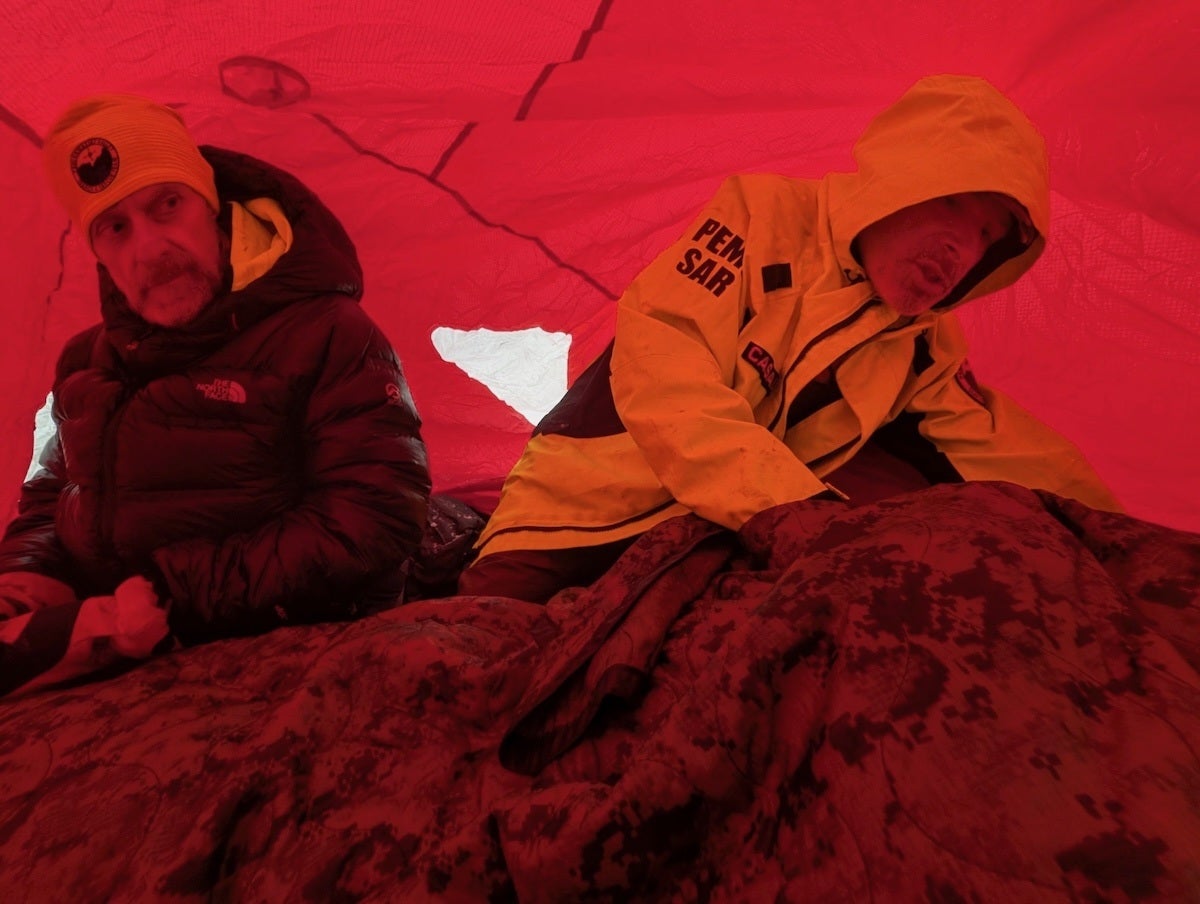
All volunteer rescuers from the Pemigewasset Valley Search & Rescue Team reached Bittman first, working to warm him. / Courtesy photo
Kneeland knew his team was moving as fast as they could, yet he needed them to understand how dire the situation was getting. He picked up his radio and reported that Bittman was no longer responding to calls.
At 1 p.m., about 45 minutes after the hasty team had left the trail, they were closing in on the red dot. Swartz was out front, whacking through what his map showed was the final stretch. Then a clearing came into view, and he emerged from the forest into the open gully.
There, precisely where the map said he’d be, was Bittman. A few feet away lay his phone, dropped from his frozen hands.
Down in the parking lot, Kneeland picked up his cell phone again. One more try to see if he would answer. He dialed Bittman. It rang. Then he heard a voice on the other end.
“This is Corey.”
“Oh, Corey. Sorry. I must have dialed the wrong number,” Kneeland said.
Before Kneeland could hang up, Swartz explained that he had just gotten to Bittman and picked up his phone.
“Is he alive?” Kneeland asked.
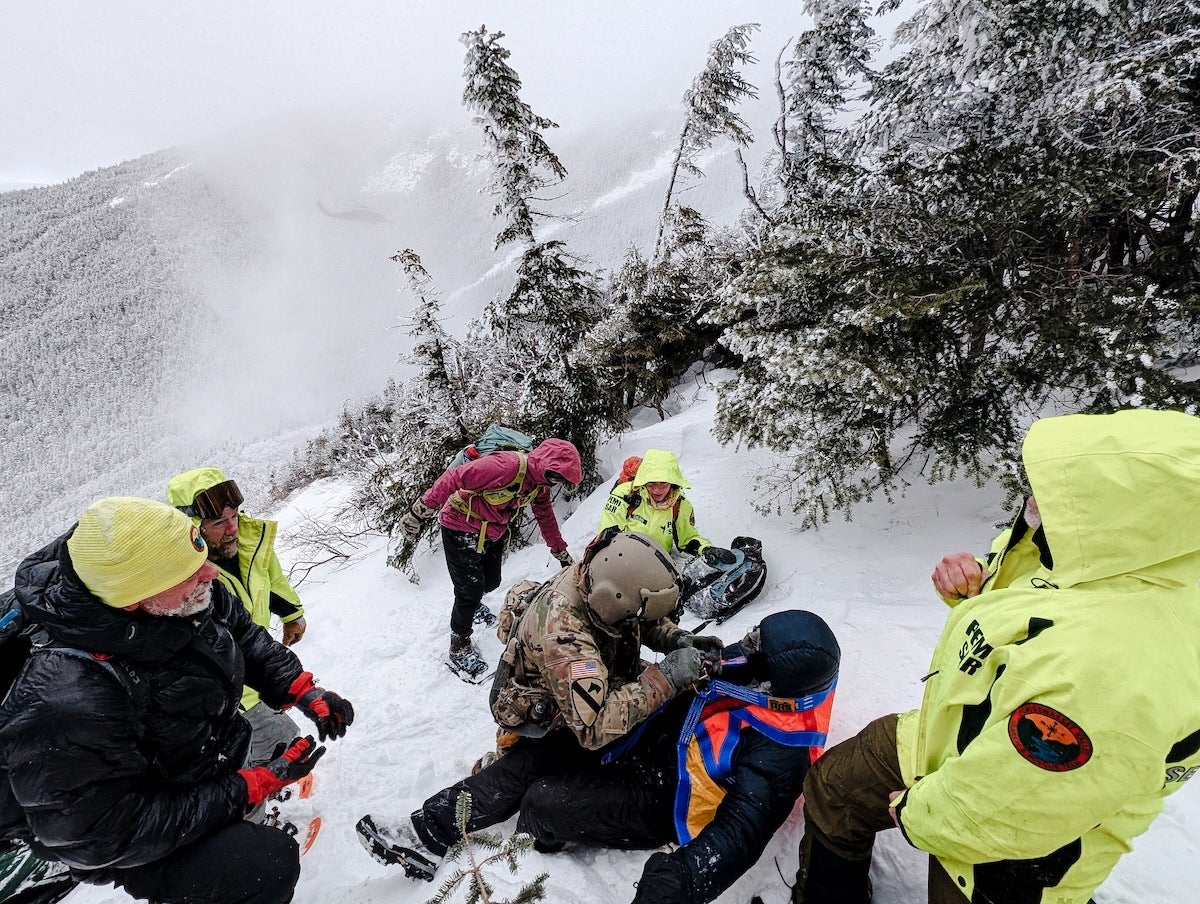
Pemi SAR volunteers reached Bittman first, warming him until the helicopter arrived. / Courtesy photo
Swartz said he was, and the team was already working on warming him. Kneeland felt a wave of relief. “Update me when you can,” he said before hanging up.
Bittman was in bad shape, sitting dazed in the snow. When Swartz told him they were from search-and-rescue, he seemed to understand, but he had a vacant look in his eyes, like he wasn’t even there.
The three volunteers got busy constructing a makeshift platform out of their snowshoes and packs to get Bittman off the ice. Then they opened the red bothy bag and climbed inside. Under the warm glow of the shelter, they started pulling layers and blankets out of their packs.
Allegretti pulled out the chemical blanket McKee had given him and tried to activate it. Nothing. It was a dud. “Okay, what else do we have?” he asked. They rifled through their packs—a Thinsulate blanket, an extra jacket, a hat, and gloves—and started dressing Bittman. Then Swartz and the other volunteer opened their bright yellow Pemi SAR coats and sat on either side of Bittman, sandwiching him between them, using their own body heat to warm him. Allegretti pulled out his thermos. “I’m sorry, all I have is some black coffee,” he said. “Will you drink that?”
“I’m a barista,” Bittman replied with a smile.
Allegretti was relieved to see a sliver of the person who was still in there. They got him to eat some of Allegretti’s wife’s banana bread. He seemed to be coming back.
Still, Bittman was confused. He gazed at the strangers around him offering sips of hot coffee, a puzzled look on his face. After a while, he asked Allegretti if he could lie down. “So long as you keep talking to us,” Allegretti said. They didn’t want him to drift off.
Allegretti checked in with Kneeland, relaying that Bittman’s condition was inconsistent and unstable. He looked at the time—they’d been with Bittman for more than an hour now. Where was the litter?
Just a few hundred feet away, the rest of the ground crew was hacking through the forest, searching for the best route. They were moving as fast as they could without sweating through their layers, which would chill them and turn them from rescuers into liabilities. They looked skyward. Still socked in. This would be a carry-out, no question about it. That meant the hardest part of the day was still ahead of them. The carry-out would require great care, potentially ropes to maneuver the litter down hairy sections, and as many as 10 hours. What was less clear was whether, somewhere along the way, this rescue would become a body-recovery mission.
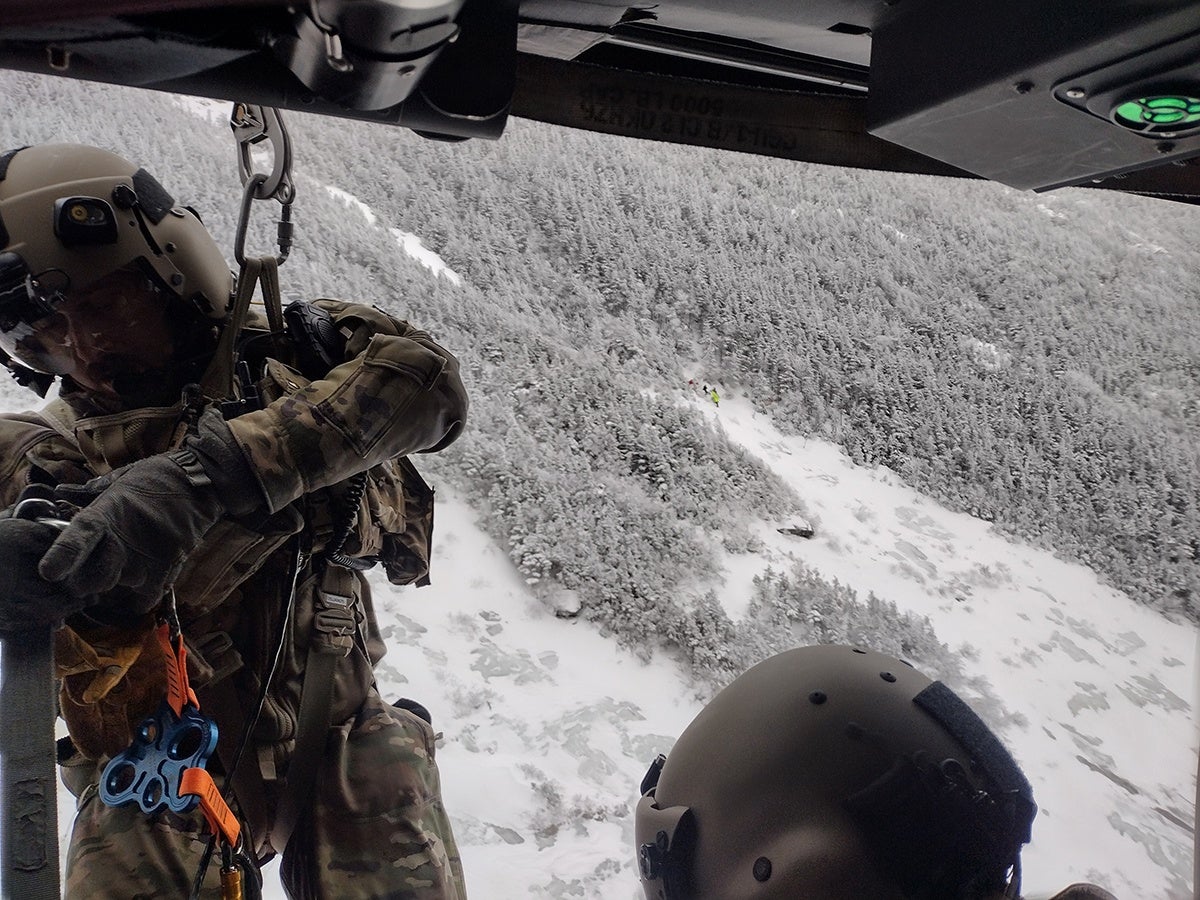
The view from the air during the mission to find Bittman. / New Hampshire Army National Guard
Down the mountain, time was running out. In the basement of the Cannon Mountain ski lodge, the National Guard members gathered around their radio, tracking the slow progress of the ground rescue and monitoring the weather. Mount Washington’s weather station predicted a break in the clouds at 6 p.m.—four hours away.
It was two days shy of the winter solstice, with sunset at 4:13 p.m. Outside, daylight was draining from the sky. Just before 2:45 p.m., they radioed Kneeland that they had run out of time—they couldn’t carry out the mission after dark without night-vision goggles and would have to head back to the base in Concord. The news rippled across the forested hillside and into the gully where the Pemi volunteers were huddled under the red bothy bag, trying to keep Bittman alive.
If Koladish had worked expeditiously through the lengthy preflight checklist on the way out here, he was now slow-walking his safety check outside the chopper, hoping for a break in the clouds before they left. He climbed into the Black Hawk, grabbed the checklist off the hook behind his seat, and methodically ran through it with Gray, one item at a time.
Up on the mountain, the trail crew knew they were almost there and had sent Talbot ahead with the litter. In the bothy bag, Allegretti kept Bittman talking. Then Allegretti heard rustling outside and stuck his head out to see Talbot emerging through the trees. He climbed out to meet him and discuss the plan for getting Bittman into the litter.
Down in the parking lot, Kneeland looked skyward and saw a break in the clouds. He radioed Talbot and Allegretti, who confirmed they were seeing it, too, as did McKee. For the first time all day, he and the other Fish and Game officers could see the entire mountainside, meaning that they—and Bittman—were about 100 feet below the cloud ceiling. “Send the helicopter,” McKee said. “It’s now or never.”
At 2:55 p.m., the pilots and crew were already in the Black Hawk, ready to fly home, when they heard the chatter on the Fish and Game channel. The three crew members in the back looked at one another and knew the mission was back on. By the time they heard one of the Fish and Game officers asking Kneeland if the Guard was up on the channel yet, Koladish had already thrown the throttles into fly.
The pilots still had Bittman’s location on their grid and headed up the mountain, this time with urgency. In back, Major was already out of his seat, preparing to rappel out of the chopper. DeAngelis monitored their escape route on the left, while Bourque scoured the mountainside through the right-side window, looking for their target. The chopper made a pass over Bittman but didn’t see him. McKee came on the radio: They were one ridge off and needed to come back.
Then Bourque spotted them—the bright yellow Pemi jackets against the fresh white snow. “I’ve got him at 4 o’clock, a half a mile or so,” he said. He opened the side door. Cold air rushed into the cabin. The pilots slid the chopper sideways toward the mountain.
By now, Major was hooked into the hoist, bringing along a bright orange stuff sack containing an air rescue vest. He leaned backward on the edge of the chopper door, his harness tightening around his pelvis, and fist-bumped Bourque before stepping off into the abyss. Bourque began lowering him, calling out directions for the pilots. “Five, continue right, four, continue right, three, two, one, and hold,” Bourque said. They were on target, with Major hanging just feet from the ground.
On the snow below, the Pemi SAR volunteers stood sideways and leaned into the slope, bracing against the downdraft that threatened to blow them off the mountain. Bourque lowered Major the rest of the way. When Major’s boots finally touched snow, he unhooked from the cable and gave the signal. The pilots retreated to hover off to the side to spare them the hurricane-force winds—but not too far in case the weather changed and they needed to get out fast.
Major made his way over to Bittman, who was still inside the bothy bag, raised his visor, and looked him in the eyes. “My name is Ethan. I’m a medic, and I’m here to help you.” He quickly assessed Bittman’s condition and asked him his name. Bittman answered. Good—he was alert enough to follow directions. They removed Bittman from the bothy bag and Major laid the triangular-shaped rescue vest on the snow and told Bittman to roll onto it. Together, they got his arms through the armholes. Then Major clipped it across Bittman’s chest and between his legs, before clipping himself to Bittman.
From the chopper, Bourque was monitoring everything on the ground. When he saw Major and Bittman were clipped in, he guided the pilots back until they were hovering right overhead, then lowered the hoist. The hook swung in the downdraft, and Allegretti reached up, grabbed it, and immediately handed it to Major. He clipped in and they were hoisted into the air.
In an instant the chopper was in motion again, banking left toward the notch, with Bittman and Major dangling beneath. Bourque hauled them up, and as soon as they were inside and he’d shut the door, the pilots blasted the heat. Major immediately knelt beside Bittman, wrapping him in the litter on the chopper floor, defibrillator pads close by in case his heart stopped. “We have the patient and are en route to Littleton Hospital,” Koladish said over the radio.
An instant later, the pilots and crew heard the sounds exploding from the radio channel—cheering, whooping, and several top-of-the-lungs “fuck yeahs” from the gully where the Pemi SAR volunteers had kept Bittman alive; the mountainside where the Fish and Game officers and Talbot had hacked through the forest; and the parking lot where Kneeland had coordinated it all. They smiled as they heard the radio channel. After all, they’d all had rescues that didn’t end the way they wanted. This one did. The mountains didn’t take this one, Cyrs thought to himself as he watched the chopper fly off toward Littleton. They’d made it just in time. Five minutes after the helicopter disappeared from view, the cloud ceiling came down again. The window had closed.
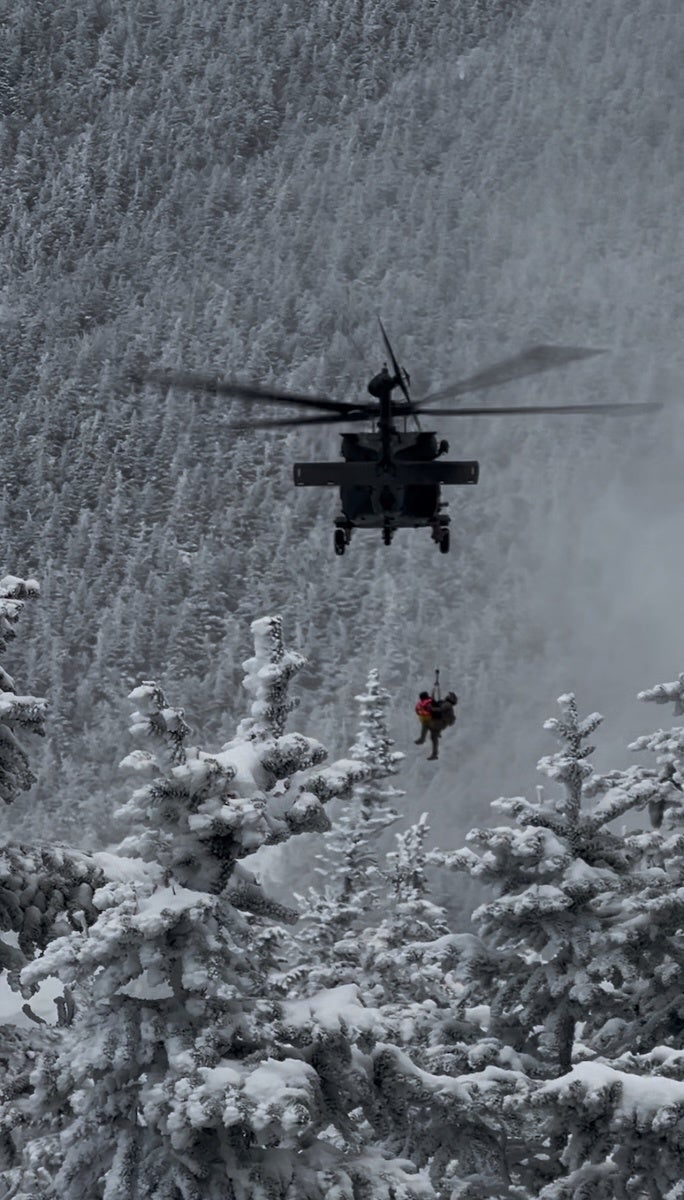
Staff Sergeant Ethan Major hoisted Bittman into the Black Hawk for evacuation to Littleton Hospital. / New Hampshire Fish and Game
Ten minutes later, the Black Hawk set down on the hospital helipad, where medical staff were waiting just inside the building. Major orchestrated the handoff, hustling alongside the gurney into the hospital before jumping back in the chopper to head back to Concord. The doctors went to work on Bittman. His body temperature was in the 70s, at the edge of death.
At the gully, the rescuers gathered their gear, strapped on their snowshoes, and met up with the trail crew on the path they’d hacked through the forest. As they approached, Cyrs put his fist in the air and shouted, “Pemi SAR”—a salute to the volunteers who had been on the frontline all afternoon. McKee opened his thermos of Chicken and Stars, and they passed it around, sipping from the cup. Cyrs broke out his gummy bears for everyone to share. Then they headed down the mountain together, the empty litter dragging behind them.
At the parking lot, Kneeland waited for every one of them to come off the mountain and sign out before heading to a McDonald’s on the way home. He hadn’t eaten all day and ordered three cheeseburgers and fries from the drive-through.
Talbot knew that if he hurried, he could make it to his son’s winter concert. Mancini could, too—it was his kindergartener’s very first one. They both hustled toward their vehicles and drove to the school. Still in their wet mountaineering gear, they raced into the building, took their seats, and watched their children perform.
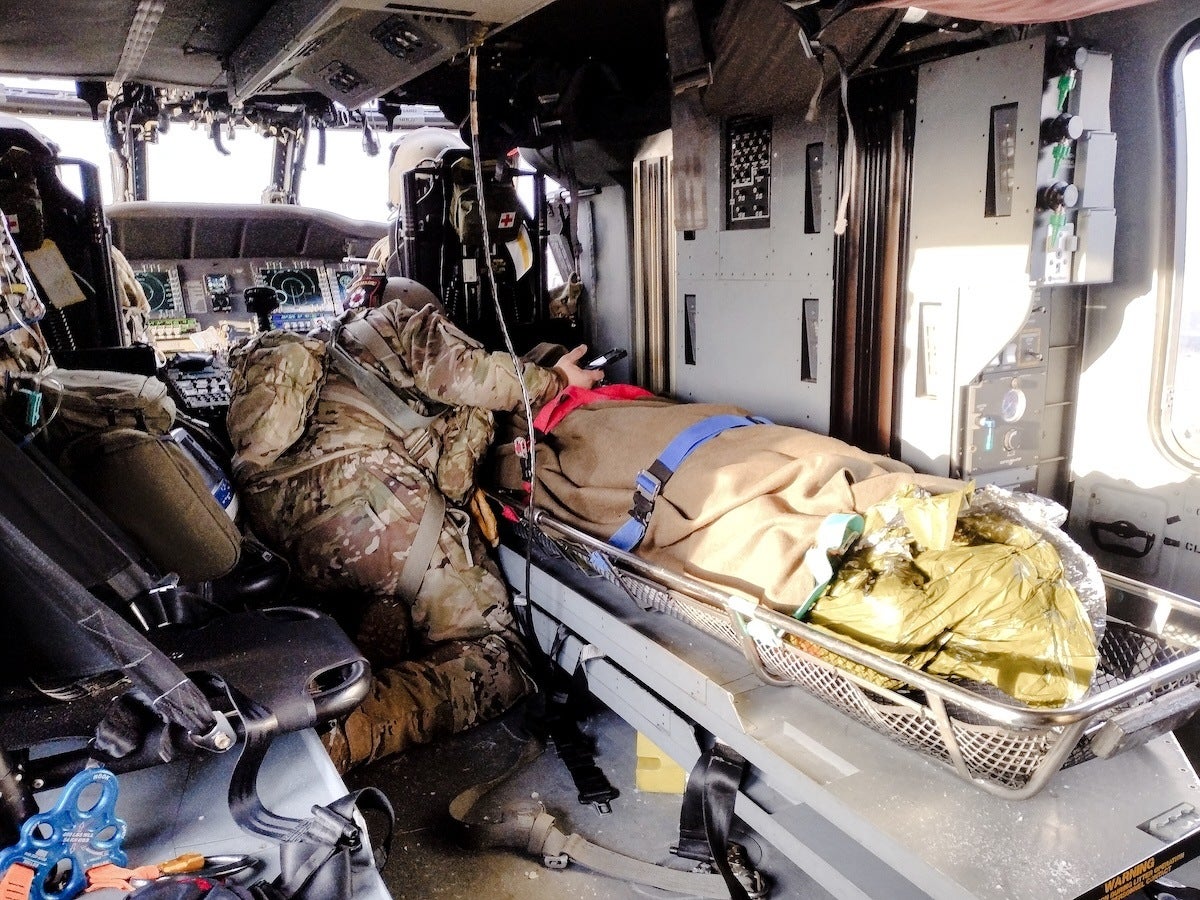
Bittman in the Black Hawk. / New Hampshire Army National Guard
When Cyrs went home, the first thing he did was lay out his gear on the floor to dry. If a call came in the next morning, or even that very night, he’d have to be ready to head back out.
The first thing Bittman remembers from the hospital was doctors moving around the room talking about his organ function. He was lying there, his hands and feet extending off the table, warm water streaming over them, as the doctors tried to save his fingers and toes from amputation.
The next morning, Allegretti woke up unable to shake Bittman from his mind. He called Kneeland to ask if it would be okay to visit Bittman in the hospital. Kneeland said it would.
When he walked into the hospital room, Allegretti didn’t recognize Bittman—he was like a different person. “Do you remember who I am?” Allegretti asked. Bittman said he did. He was grateful for the mission that was orchestrated across two government agencies and a volunteer group, but to him, it had felt very personal. Strangers had fed him coffee and homemade banana bread. When Bittman’s mother walked into the room and he introduced Allegretti, she threw her arms around him.
As Bittman improved, his nurse joked with him about defying natural selection. Bittman thought of all the people—volunteers, Fish and Game officers, National Guard officers and crew members—who’d dropped what they were doing that day to save his life, risking themselves in the process. Maybe it isn’t survival of the fittest that matters most, he thought. Maybe the strongest force in natural selection is community.
A Fish and Game officer also showed up at the hospital—to collect information for their report, which would cite cotton layers, insufficient preparation, and poor judgment. Bittman hadn’t purchased the state’s $25 Hike Safe Card, meaning he could be charged for the rescue. But Bittman knew no amount of money could repay the strangers who had risked their lives for his. (In the end, he was not charged.)
Months later, Allegretti saw a message pop up on his phone. It was a video of Bittman, healthy and happy, back at his café job in Portland, Maine. In the video, he waved, then lifted a pitcher of foamed milk over a cup of espresso and poured a perfect tulip, topping it with a heart.
This article was first published in the print edition of the February 2026 issue with the headline: “Stranded.”