Dreamy Peruvian Restaurant Rosa y Marigold Opens in Back Bay
The Boston sibling to Celeste and La Royal has Peruvian sandwiches, live music, and a lot of heart.
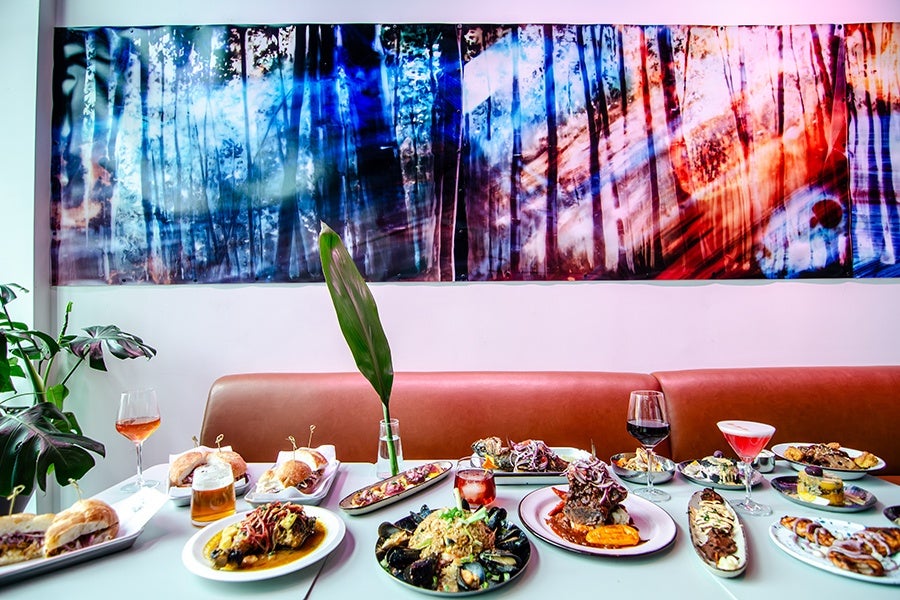
A spread of food at Rosa y Marigold in front of a photographic print by Cambridge-based Matt Saunders. / Photo by Rachel Leah Blumenthal
It’s been 13 years since JuanMa Calderón and Maria Rondeau started hosting dinner parties in their Cambridge home. Since then, the couple—a Peruvian filmmaker and a Guatemalan architect, respectively—have opened three Peruvian restaurants: the tiny Celeste in Somerville’s Union Square, the big-city-swanky La Royal in Cambridge, and the experimental Esmeralda in Vermont. Now, their biggest venture yet: Rosa y Marigold, a 100-seat restaurant on the ground floor at Back Bay’s Lyrik development. “We are more confident,” says Calderón, who’s the group’s executive chef. “At Rosa y Marigold, we’re being braver.” That means bolder dishes like anticuchos de corazón (beef heart skewers) and a packed schedule of weekday lunch, weekend brunch, and daily dinner service. Lots of live music, too. “With a new restaurant, it’s time to arrive,” says Calderón as the acclaimed team finally makes its Boston proper debut. It’s big and it’s ambitious, but Rosa y Marigold feels firmly moored to the joyous, community-building ethos of its elder siblings.
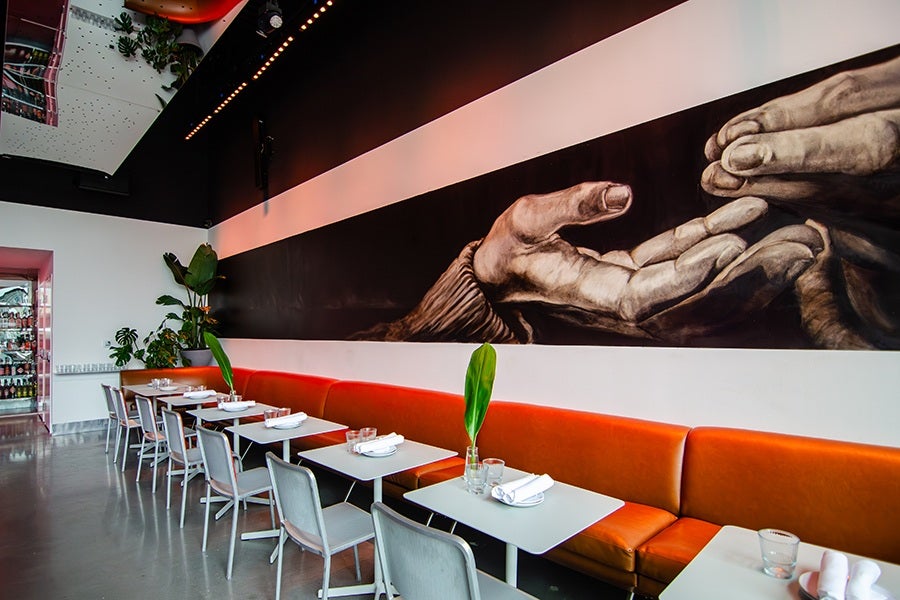
Rosa y Marigold features a mural by Wellesley-based artist Daniela Rivera. / Photo by Rachel Leah Blumenthal
The new restaurant’s concept is rooted in duality, like the book for which it’s named. Rosa y Marigold is inspired by Marigold and Rose, a novel by the late Nobel Laureate poet Louise Glück, “who was a very dear friend of ours,” says Rondeau (the restaurant’s designer and general manager). “She was a very big supporter of Celeste and always encouraged us to move forward.” The book reads like a fable, says Rondeau, describing two infant twin girls “who don’t have the gift of speech yet, but do have the gift of imagination, and they project. One is very creative and interested in the world as a visual; the other is more interested in the concepts behind things. So, [the book explores] how these two live as one—they’re separate, yet they’re together.”
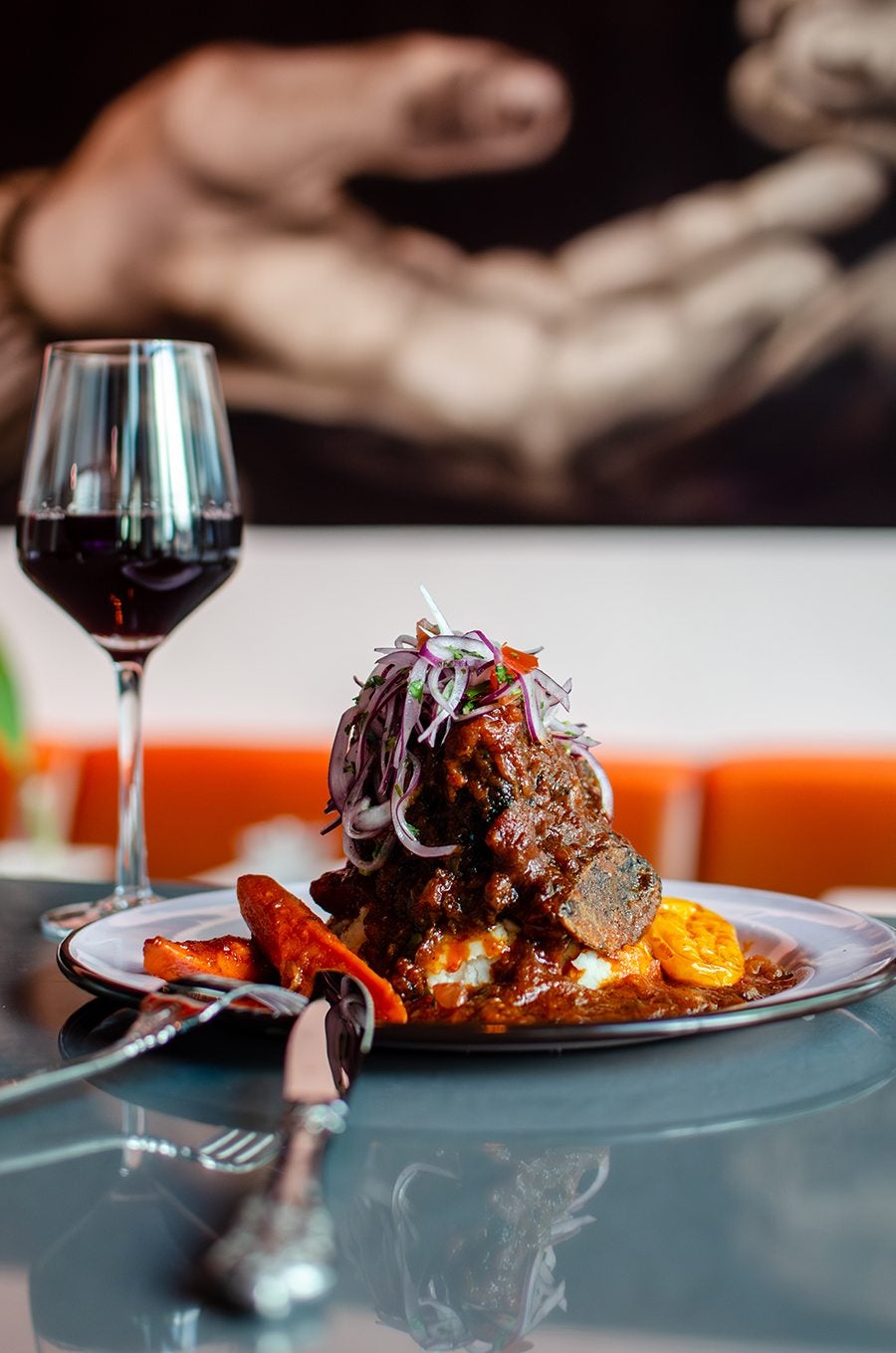
Rosa y Marigold’s asado de costilla con pure de papas—braised short rib in panca, mole, and red wine reduction, with potato puree. “It’s based on a very traditional Peruvian dish called asado, which is made with roast beef,” says Rondeau, “but we wanted to portion it differently and give it a richer flavor, so we made it with braised short rib. It’s a little bit of a spin on ossobuco, also.” / Photo by Rachel Leah Blumenthal
Duality manifests in various ways. For one, Rosa y Marigold is equally suited to day and night; Rondeau and Calderón are excited to finally be in a neighborhood with enough mid-day bustle to support weekday lunch service, when they’ll highlight sánguches, Peruvian sandwiches. Plus, the menu is a balance between tradition and modernity, from classic ceviche and street-food anticuchos to contemporary spins on steak frites (with huacatay butter and fried yuca) and the homey Peruvian dish asado (made here with artfully plated short rib instead of roast beef). “When I go to Peru to explore and research, I always go looking for the very traditional things,” says Calderón, “but in Lima, a lot of things are happening in cuisine. So, I always come back with the two parts: whatever I was looking for from my memories, and all the new things happening there.” And Lyrik itself embodies duality, too, perched at the intersection of neighborhoods and the crossroads of locals and tourists.
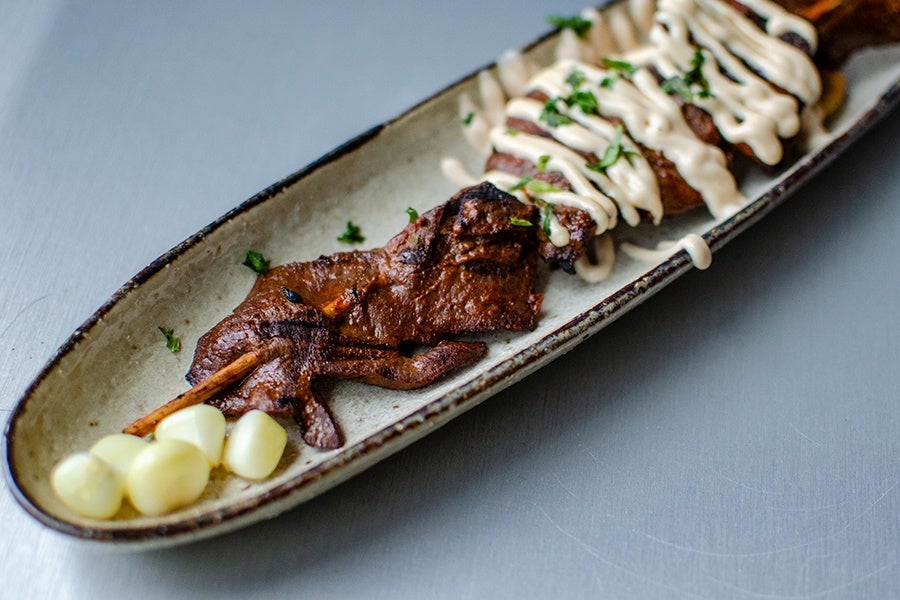
Rosa y Marigold’s anticucho de corazón, a beef heart skewer made with aji panca marinade. The restaurant also offers shrimp and pineapple anticuchos and vegan portobello anticuchos. / Photo by Rachel Leah Blumenthal
Compared to the menus at Celeste and La Royal, the anticuchos de corazón are one of the most notable new dishes at Rosa y Marigold. “Every neighborhood [in Lima] has a lady on the corner serving this every night,” he says of the ubiquitous street food. “It’s very old, coming from the slaves’ time, when the only meat they could eat was [offal].”
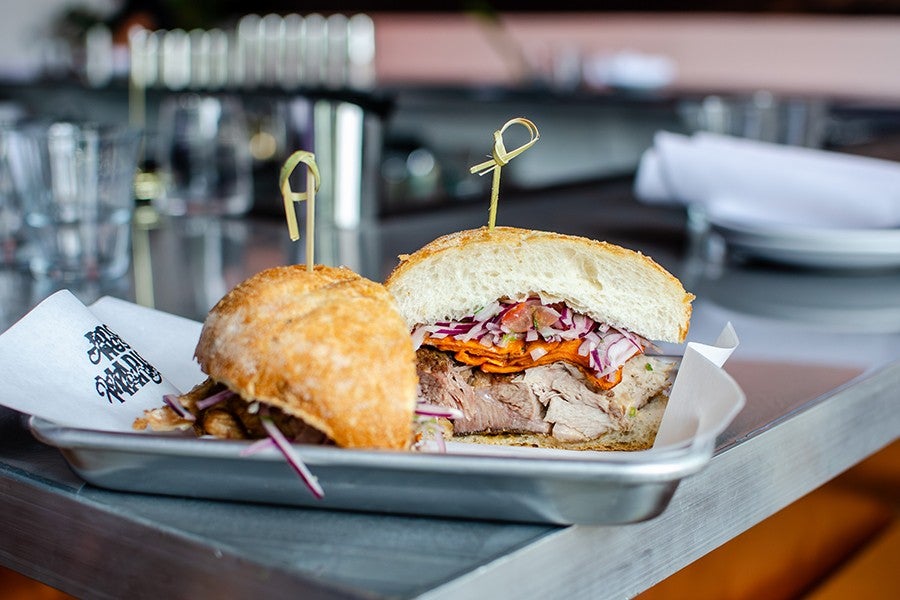
Rosa y Marigold features seven sánguches, Peruvian sandwiches, on its lunch menu. This is pan con chicharrón, deep-fried pork with sweet potato and salsa criolla, traditionally enjoyed on Sundays but always available here. / Photo by Rachel Leah Blumenthal
The sánguches are also new, and they’ve been on Rondeau and Calderón’s minds for ages, but lunch just didn’t work for the Celeste and La Royal locations, which don’t have as much midday foot traffic. (“In Peru, [sánguches are] pretty much what you eat in bars when you’re drinking beers,” says Calderón, and they’re also often a breakfast food. In Boston, they feel like a perfect fit for lunch.) Try the pan con chicharrón first, deep-fried pork with sweet potato—it’s a classic sandwich recently declared the best breakfast in the world in an internet contest (but equally tasty at any time of day). Traditionally it’s eaten on Sundays; Sundays are “the reason for a reunion, and people arrive to have a big breakfast,” says Calderón. Rosa y Marigold will thankfully serve it every day, though.
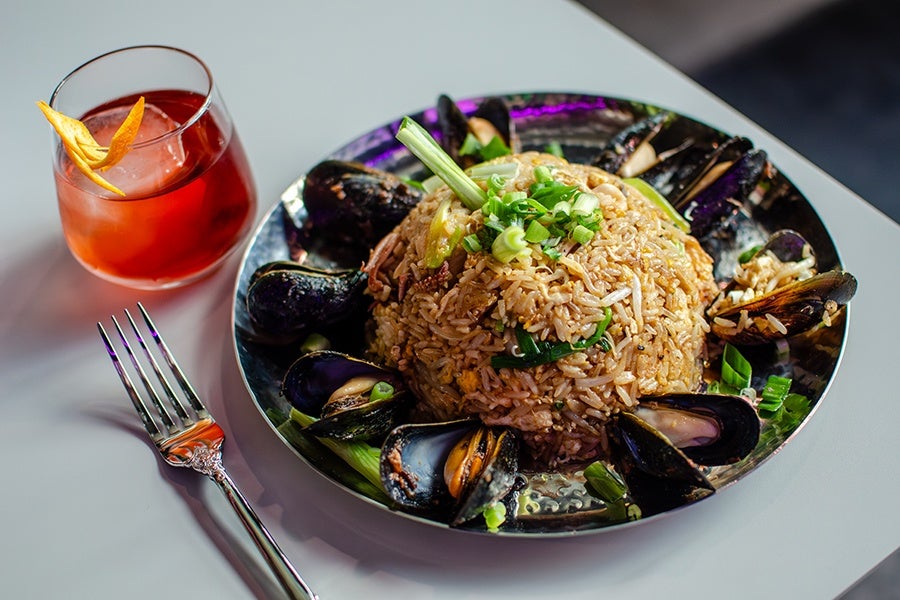
Rosa y Marigold. / Photo by Rachel Leah Blumenthal
There are plenty of familiar threads, too, among Rosa y Marigold and its siblings. To drink, for example? “Always a lot of pisco sours and versions thereof,” says Rondeau. Here, one version is spicy thanks to the South American Rocoto pepper; another, the Newbury Sour, incorporates chicha morada (a purple corn-based drink) and black currant cassis, its color mirroring the dreamlike purple lighting in parts of the restaurant. Calderón’s emphasis on chifa (Peruvian-Chinese dishes) continues here as well, with dishes such as chaufa de mariscos, stir-fried rice with seafood, and wonton de camaron, fried shrimp dumplings with a sweet-and-sour tamarind sauce. “[Making the wontons] one by one helped me a lot during all these days [of opening the restaurant],” says Calderón.
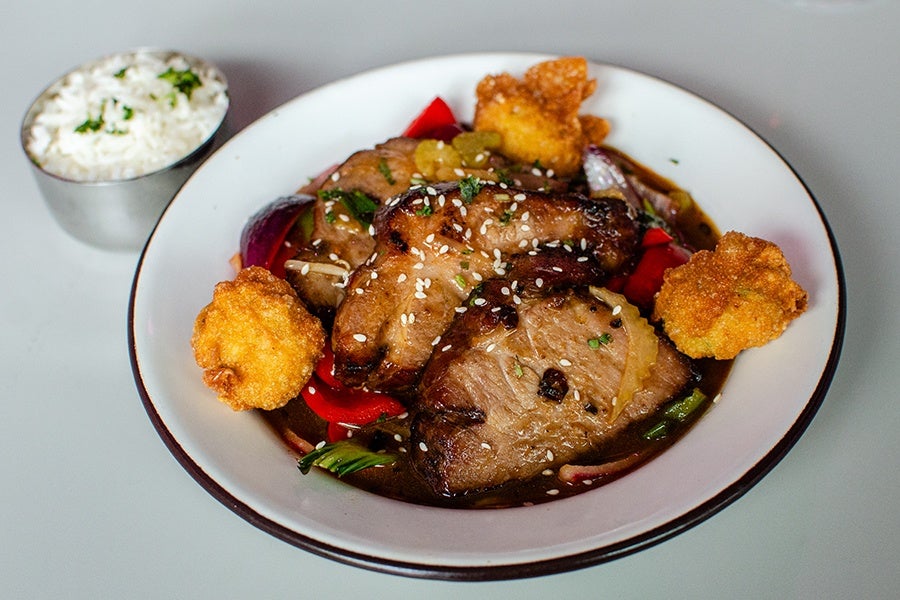
Rosa y Marigold’s chanchito asado—Chinese-Peruvian roasted pork, hoisin sauce, and sautéed vegetables—pictured here with wonton de camaron, fried shrimp wontons. / Photo by Rachel Leah Blumenthal
Adds Rondeau: “It’s therapeutic; he meditates when he makes them.” And those dinner-party roots have not been forgotten. At each of the group’s restaurants, “the design revolves around the open kitchen,” says Rondeau. “That’s really what we’re all about: kind of sharing, kind of performance.”
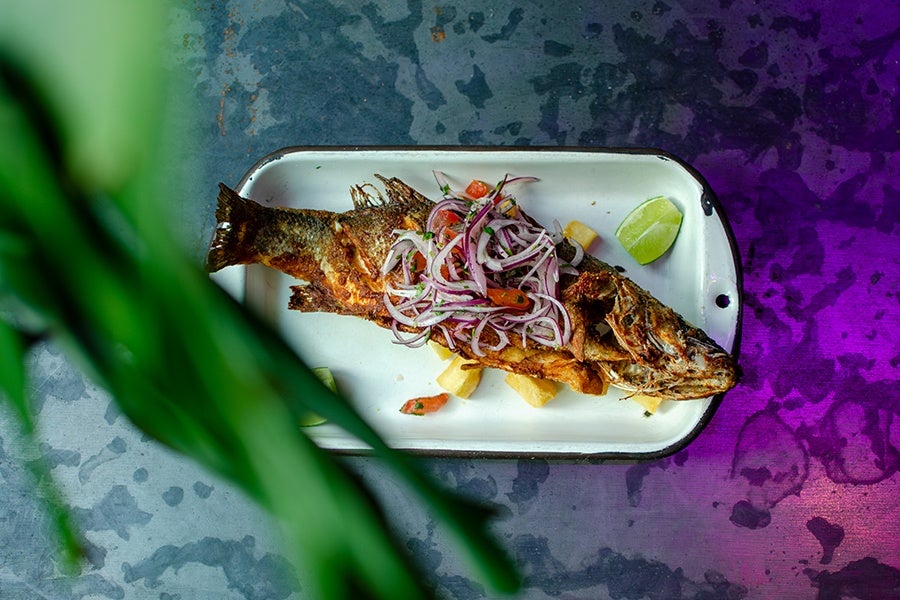
Rosa y Marigold’s frito pescadito con papa dorada y salsa criolla, deep-fried whole branzino with potatoes and salsa criolla (tomato and onion). / Photo by Rachel Leah Blumenthal
Of the group’s locations, this is the least neighborhood-y on its surface—the plentiful tourists and students come and go—but Rondeau and Calderón are confident that they can cultivate a community here. “When we came to this location,” says Rondeau, “we had this idea of food and bringing people together,” a lifeblood that courses through all their projects. With long hours, from lunch to late-night, and live music collaborations from Berklee and other local institutions and groups, it seems like the right pieces are in place to achieve that goal. “There’s a huge demographic here completely different from what we see [at our other locations]. We have tourism, because we’re at the hub of Boston, and we have students, and we have the neighborhoods: the Back Bay, Fenway, the South End. We see it as an opportunity to grow.”
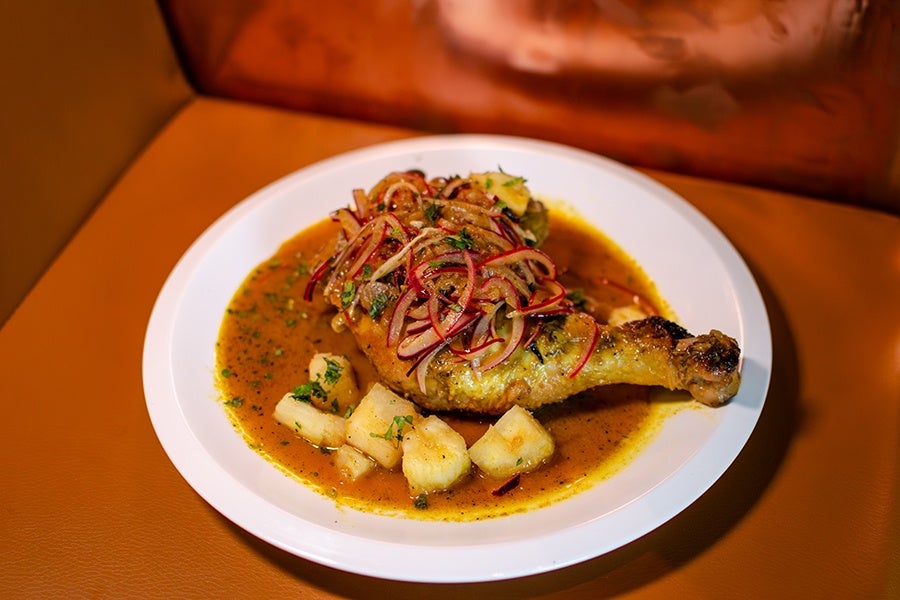
Rosa y Marigold’s pollo al limón: braised chicken, aji amarillo, lime, red onions, and rice. This is “a classic from JuanMa’s mom’s kitchen,” says Rondeau. (It’s traditionally called ceviche de pollo, which leads some English speakers to mistake it for a raw chicken dish. The name actually refers to the flavors of ceviche, not the preparation.) / Photo by Rachel Leah Blumenthal
Community within the restaurant group itself is essential to Rondeau and Calderón as well, and key to the decision to open this fourth venue. “One of the really important things for us is growing from within our team,” says Rondeau. Celeste’s first employee, Jose Saravia, who started as a dishwasher, is a partner in Rosa y Marigold, as is Lauren Harder, who is La Royal’s landlord and general contractor. “Our restaurants are really about us as a family,” says Rondeau, and that chosen family keeps growing.
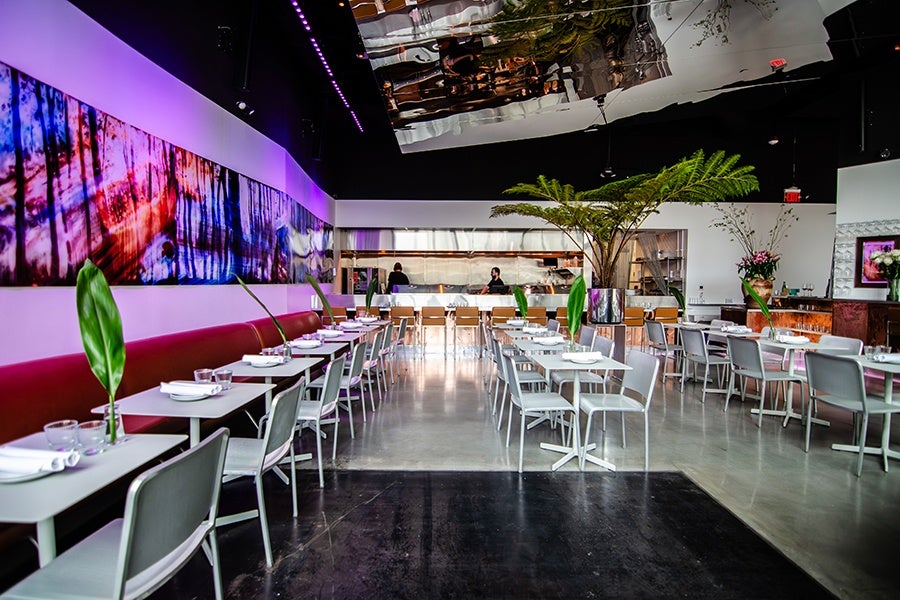
Rosa y Marigold. / Photo by Rachel Leah Blumenthal
Since Rondeau designs each of the group’s restaurants, Rosa y Marigold feels like a seamless continuation of its older sisters. Grander in scale, sure, but intimate and lovely just the same. Of note are large mirrors on the ceiling, meant to “augment the space and give the idea that you’re looking beyond,” says Rondeau. “They let you observe, taking it all in, [feeling] that you’re part of something.” One wall is covered by a striking mural of “hands describing food you love,” as Rondeau explains it; it’s by Chilean-born, Wellesley-based artist Daniela Rivera, who also did pieces for Celeste and La Royal. Another wall features an almost otherworldly forest-like landscape, a photographic print by Cambridge-based Matt Saunders.
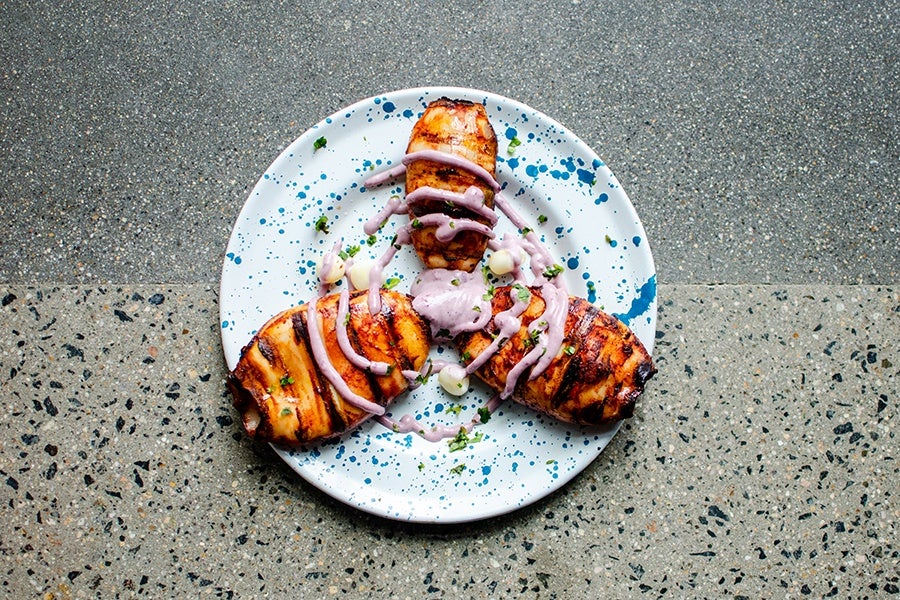
Rosa y Marigold’s squid al olivo, grilled squid with black olive mayonnaise. It’s one Rondeau’s favorite dishes on the menu. / Photo by Rachel Leah Blumenthal
With duality at its core, Rosa y Marigold is equal parts an evolution for the group and recommitment to its siblings’ foundation, from Calderón’s expressions of Peruvian cuisine to Rondeau’s artistic design that balances homey and trendy. “A new restaurant is an opportunity to keep creating, keep playing, and keep experimenting,” says Calderón. “We’re ready to say, ‘This is who we are, and this is what we have.’ We can keep exploring Peruvian culture.”
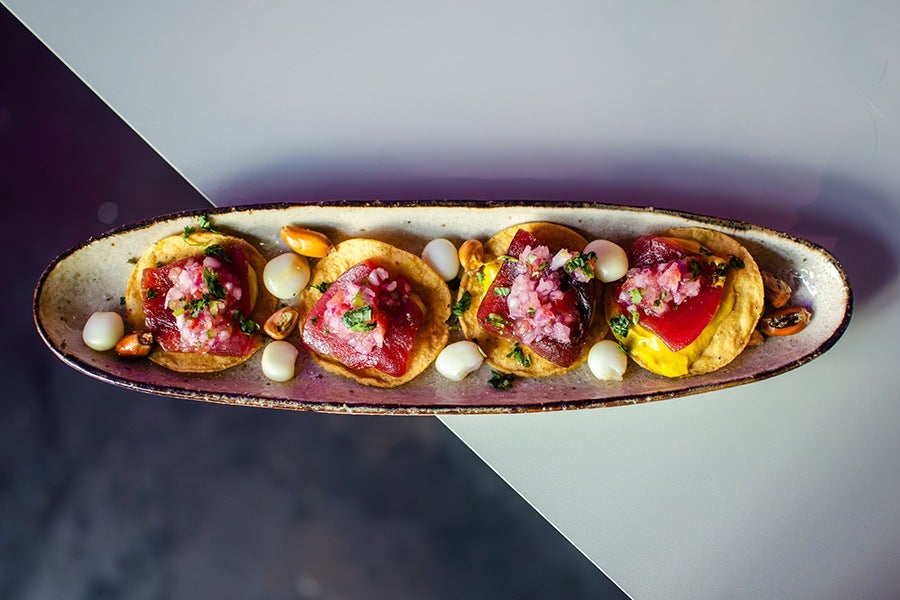
Rosa y Marigold’s tostaditas de atún: cured salmon and avocado salsa madre. / Photo by Rachel Leah Blumenthal
Rosa y Marigold opens in mid-April, serving daily dinner, weekday lunch, and weekend brunch; reservations available via Opentable. Watch for live jazz on Wednesday nights and Sundays during brunch, with an expanded live music and schedule coming soon, spanning various genres. 400 Newbury St. (Lyrik Back Bay), Back Bay, Boston, rosaymarigold.com.
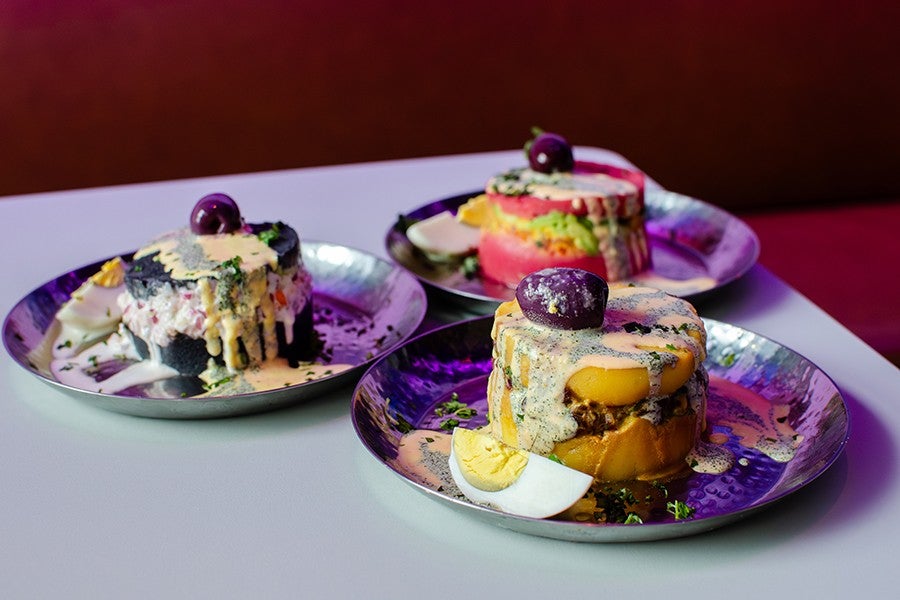
Rosa y Marigold’s causas—riced potato with lime, aji amarillo, and olive oil, served cold. The yellow one features tuna tartare; red—beet, tomato, and avocado; black—squid ink and shrimp. / Photo by Rachel Leah Blumenthal