
Ask Little Miss AI: Should I Trust LLMs with My Medical Data?

Illustration via Getty Images
Little Miss AI is a recurring advice column. Have a question? Email us!
If I generate insights about my medical condition using ChatGPT, should I share the output with my doctor? Should I upload it to my healthcare portal?
Also: Is there a way to enter my whole medical record into ChatGPT and have it come up with tests I should take? If I do that, is my medical information not protected enough?
— Russ A., Marblehead
Dear Russ A.,
These are outstanding questions, and you are clearly a proactive “patient.” The medical arena offers some of the most promising and beneficial ways artificial intelligence can help us humans. But there are still loaded mines to navigate, mainly for confidentiality and accuracy (not nothing!). I will gladly offer my personal opinion here, but have sourced two experts who deal with these questions every day: Waichi Wong, of Boston Medical Consulting, and Emilia Javorsky, director of the Futures Program at the Future of Life Institute.

Image generated in Perplexity by Lisa Pierpont.
Both agree that AI is an excellent tool that democratizes medical information and enables folks to learn more about their medical needs. But as Javorsky—who describes herself as an AI advocate and ethicist—puts it, “ChatGPT is not a doctor, and general purpose LLMs [large language models] like ChatGPT have not been cleared by the FDA as medical devices for diagnosis.” In other words, there is zero guarantee that what ChatGPT shares with you is accurate. Still, AI is a good way to translate complicated medical jargon into words that anyone can understand. So, sure, ask ChatGPT (or Perplexity, Claude, Gemini, etc.) for medical insights, but make certain that you use that material as a conversation starter with your human doctor.
As for uploading that AI-generated data into your healthcare portal…hey ho, not so fast. The issue with artificial intelligence is that it can be Just. Plain. Wrong. If you upload your AI findings to your portal, future providers could get confused and misguided by erroneous information. That’s a big deal! Now, if you feel there is low risk of a fiasco like that, Wong advises uploading a brief summary with a short list of questions. “Practically,” she says, “many portals have message length limits, and clinicians may not have time to read a long attachment.”
Regarding entering your entire medical history into ChatGPT for guidance on tests and diagnosis; how cool would that be? The short answer is yes, someday that will be the case and AI is tracking toward that by the nanosecond. But today? AI has some hurdles. First, there’s a possibility that it will recommend tests that are not necessary. “Lab interpretation is context-dependent—reference ranges differ by laboratory, and small deviations can be clinically meaningless,” Wong says. “Physicians interpret results in the setting of the whole clinical picture and decide whether a borderline abnormality is truly important.” Additionally, while cost can be, of course, a factor in deciding what tests a patient receives, so is the risk of false positives. “Such findings then require follow up testing and procedures that are often not risk free, meaning patients take on risks without benefit,” Javorsky says.
Finally, on your question of whether your medical information is protected if you share it with ChatGPT: In most cases, it’s a big fat no. Doctors are bound by HIPAA, a U.S. federal law that prevents a patient’s medical information from unauthorized disclosure. Your records are confidential, and you have legal rights if HIPAA is not honored. Big tech companies abide by no such law. In fact, your shared medical record and personal identifiers could be used to train future AI models. No problem with that? Go for it.
Previously: How Can AI Help My Senior Mom Communicate Better?
Glamorous Greek-Inspired Seafood Chain Avra Estiatorio Arrives in Boston
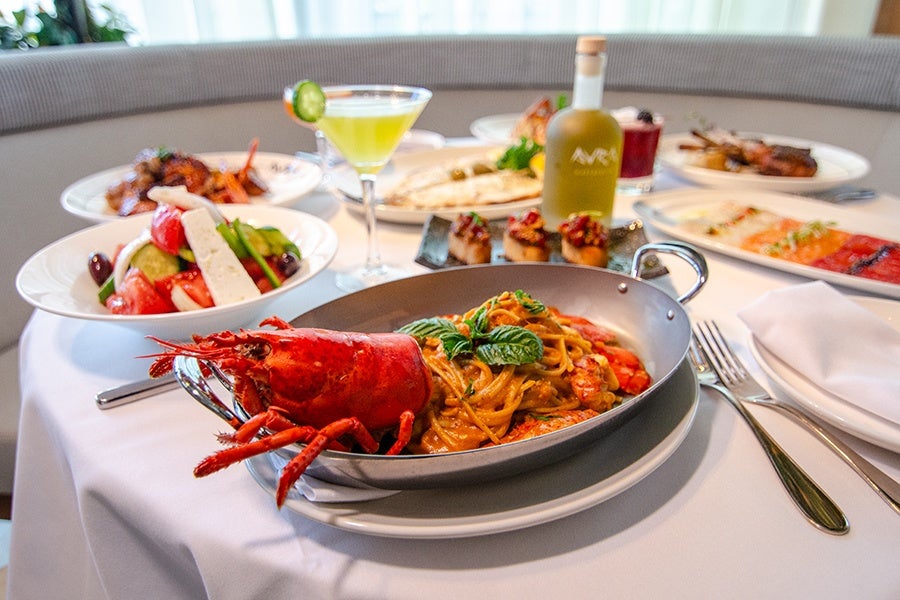
Avra Estiatorio. / Photo by Rachel Leah Blumenthal
Avra Estiatorio is betting on Boston’s appetite for fish. The upscale mini-chain of Greek-inspired seafood spots—with glamorous locations in Beverly Hills, Miami, New York City, and beyond—is now open in Back Bay, featuring simply garnished, charcoal-grilled fish, including Mediterranean imports like tsipoura and lavraki. Plus: towers of crispy zucchini and eggplant chips, pretty platters of sashimi, and hilariously large slices of chocolate cake and coconut pie.
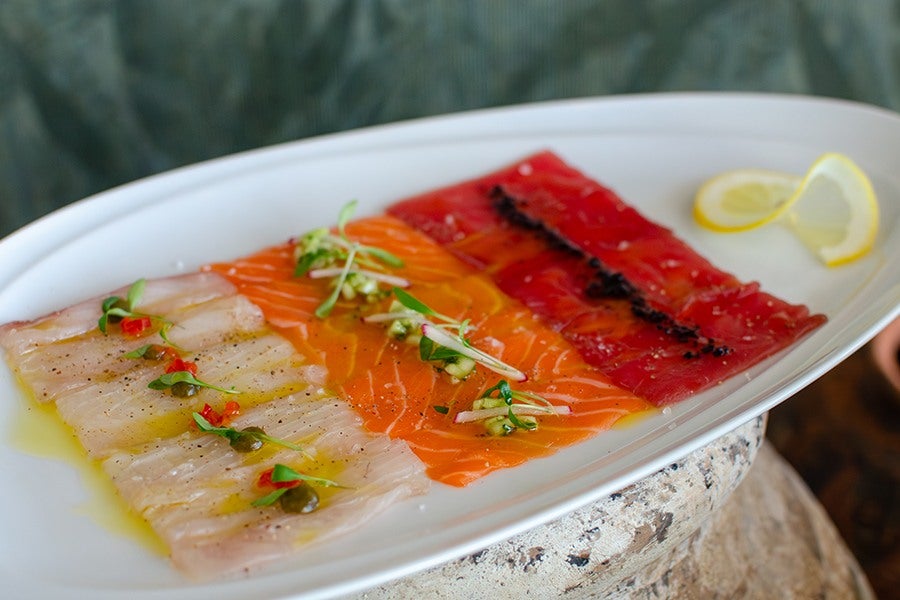
Avra Estiatorio’s sashimi platter. / Photo by Rachel Leah Blumenthal
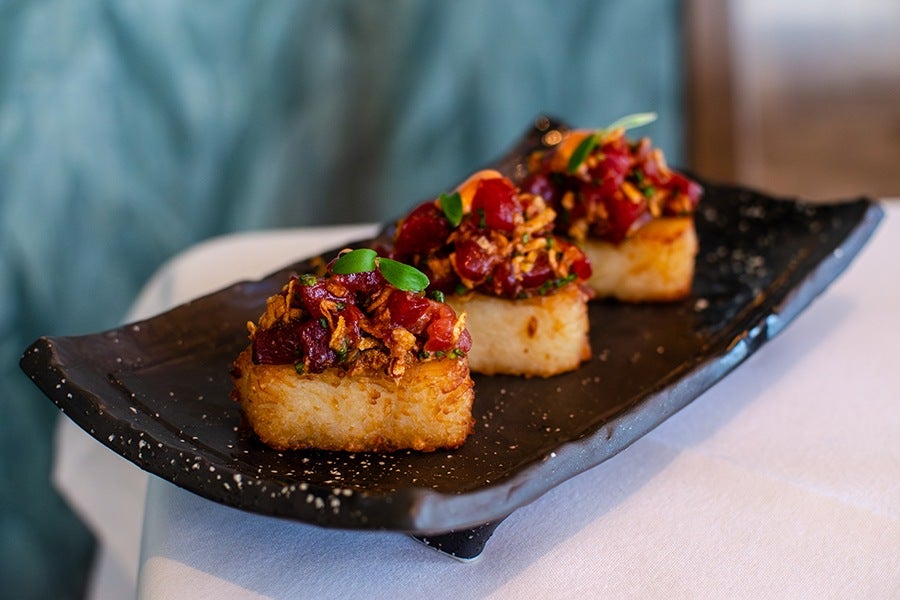
Avra Estiatorio’s spicy tuna crispy rice. / Photo by Rachel Leah Blumenthal
The sprawling second-floor location at the Lyrik development, atop just-opened Peruvian restaurant Rosa y Marigold, feels primed for special occasions, from the white tablecloths to the copious faux olive trees. Elegant, wing-like structures dangle above the marble bar, and several private dining rooms are event-ready. In the warmer seasons, terrace seating will be available on Lyrik’s upper level, an unlikely oasis perched above the Pike.
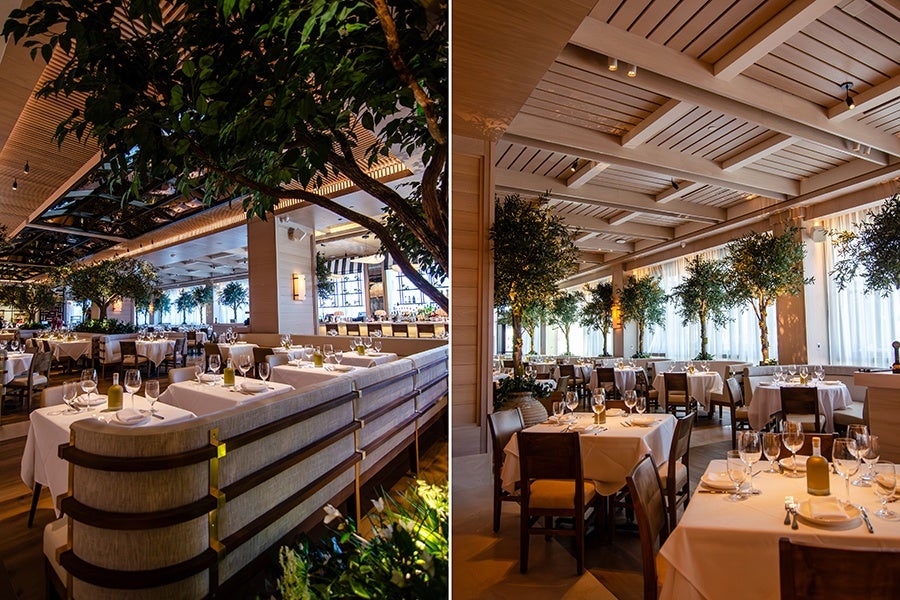
Avra Estiatorio. / Photo by Rachel Leah Blumenthal
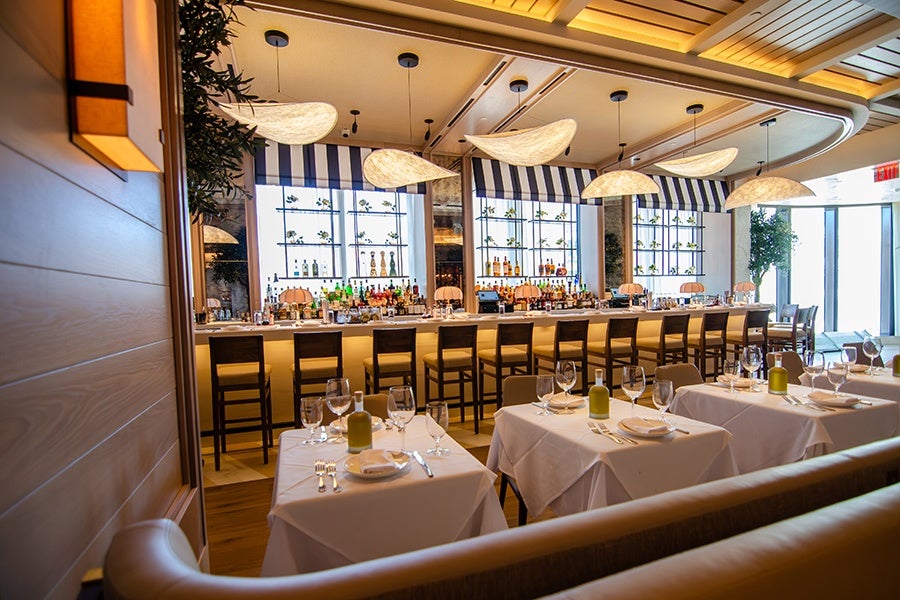
The bar at Avra Estiatorio. / Photo by Rachel Leah Blumenthal
Diners are encouraged to swing by the fish “market,” a display brimming with whole specimens on ice, to choose their seafood and peer through the large window into the kitchen. “Everybody wants to experience the fish market,” says Avra cofounder Nick Tsoulous—but for those who want to stay at the table, staff will present options on a tray. Many of the selections are from the Mediterranean, but Boston, of course, has plenty of its own great seafood, and “we love [sourcing] locally, if available,” says Tsoulous. Next, the fish is grilled, deboned, and finished with ladolemono sauce, a Greek mix of olive oil and lemon. (The Avra team seems particularly proud of the restaurant’s olive oil; there’s a bottle on each table. It’s from a small family farm in the Peloponnese and is a first-harvest oil, which has a bolder taste than oils from later harvests.)
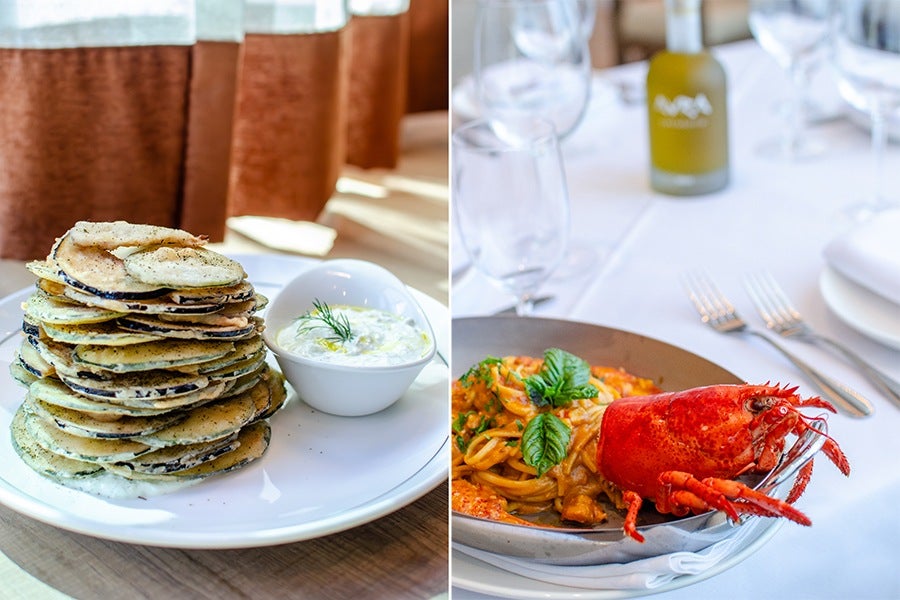
Avra Estiatorio’s chips (crispy zucchini and eggplant with tzatziki) and lobster pasta. / Photo by Rachel Leah Blumenthal
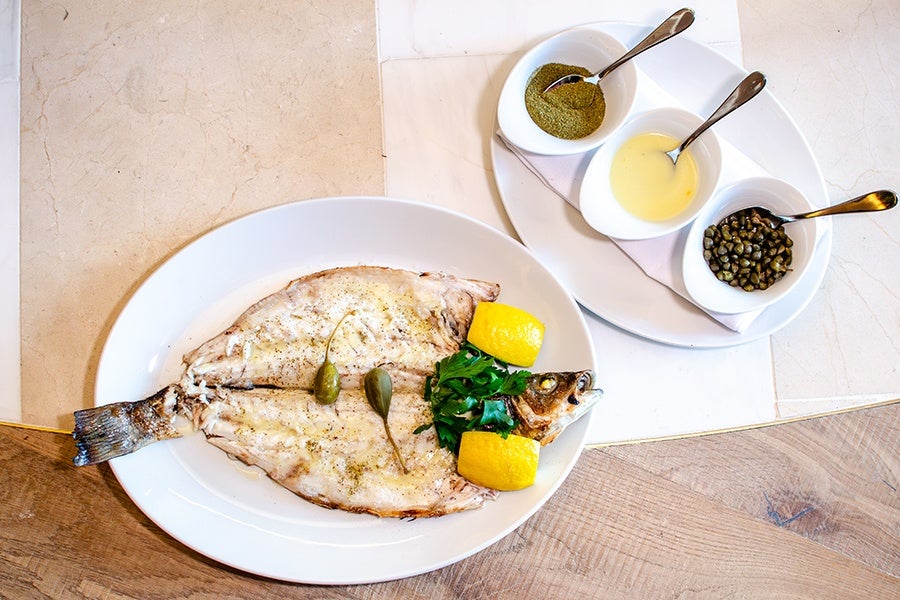
Avra Estiatorio’s whole fish, grilled and served with ladolemono. / Photo by Rachel Leah Blumenthal
While the fish is the star of the 26-year-old restaurant group—more precisely, “Greek seafood with Mediterranean influence,” says Tsoulous—there’s also “a great selection of meats” and other dishes, all meant to be shared. Start with a Greek salad, says Tsoulous, featuring Kalamata olives, feta, tomatoes, peppers, and onions, and then an appetizer such as grilled octopus with caper and red wine vinaigrette. Next, raw fish of some kind, whether a sashimi platter of Faroe Island salmon, big eye tuna, and hamachi or lavraki ceviche with a bit of heat from jalapeño. Grilled fish-market selections and other entrees come next—lobster pasta, for instance, or Colorado lamb chops—followed by celebratory, somewhat over-the-top desserts.
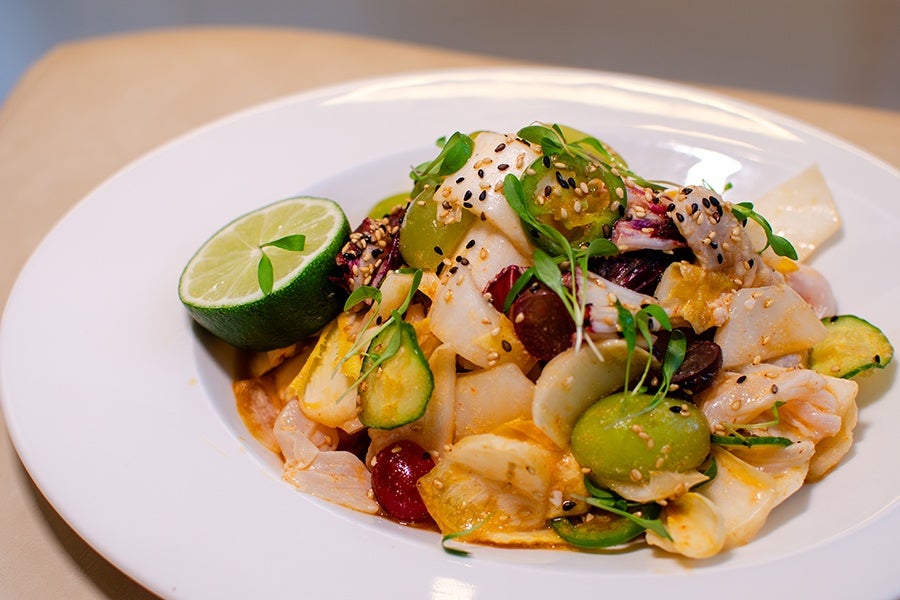
Avra Estiatorio’s lavraki ceviche. / Photo by Rachel Leah Blumenthal
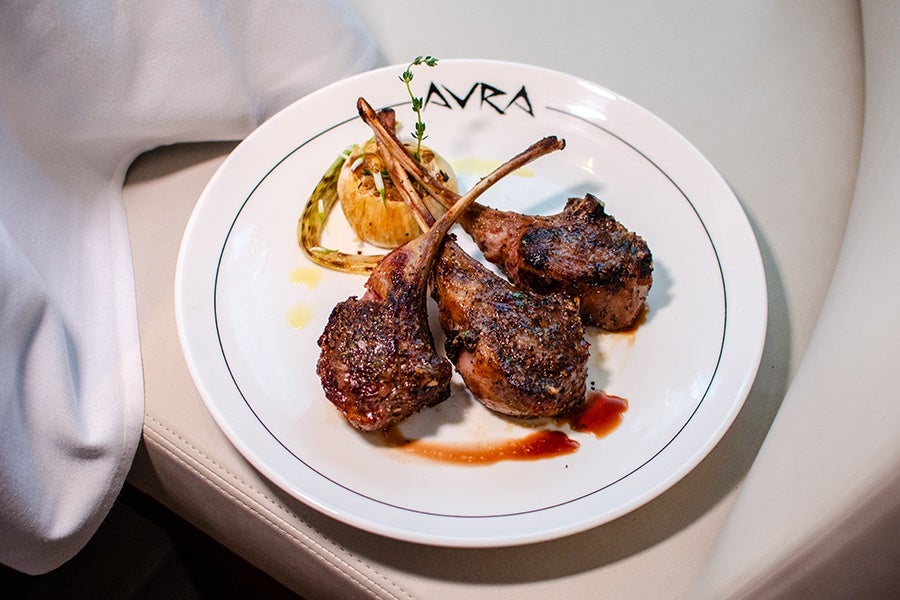
Avra Estiatorio’s lamb chops. / Photo by Rachel Leah Blumenthal
This is the eighth location for Avra, which Tsoulous founded in 2000 in New York City’s Midtown East with Nick Pashalis, his longtime business partner in other food endeavors, and Marc Packer, cofounder of Tao Group Hospitality (which is behind major restaurant and nightlife destinations in New York, Las Vegas, and elsewhere). The Avra founders waited 16 years before opening a massive second location elsewhere in the city, and expansion continued from there. Avra tends to attract A-listers and power players wherever it opens, but its roots are humble: The restaurants are inspired by Tsoulous’ coastal Greek hometown of Nafpaktos, where he grew up fishing with his father and uncles and feasting on their catch with family.
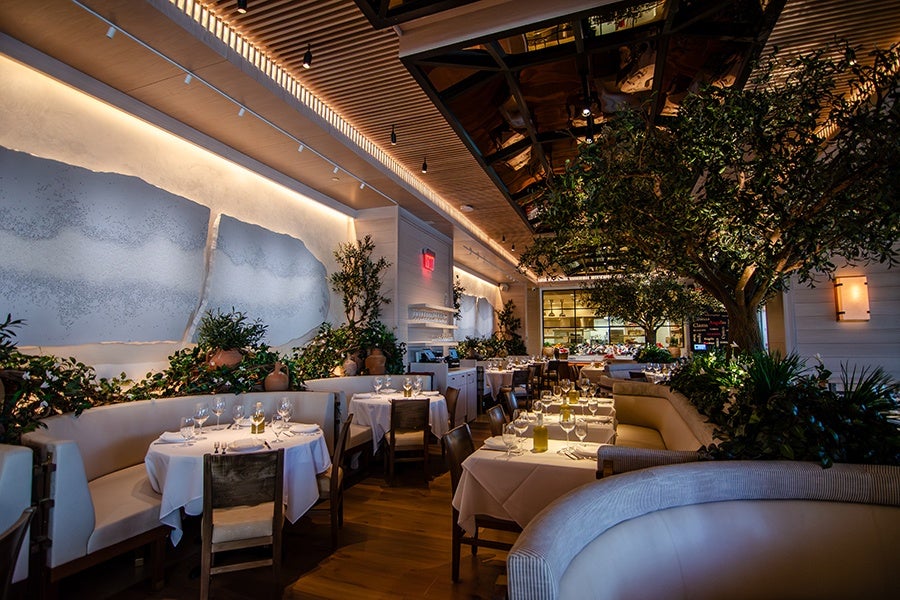
Avra Estiatorio. / Photo by Rachel Leah Blumenthal
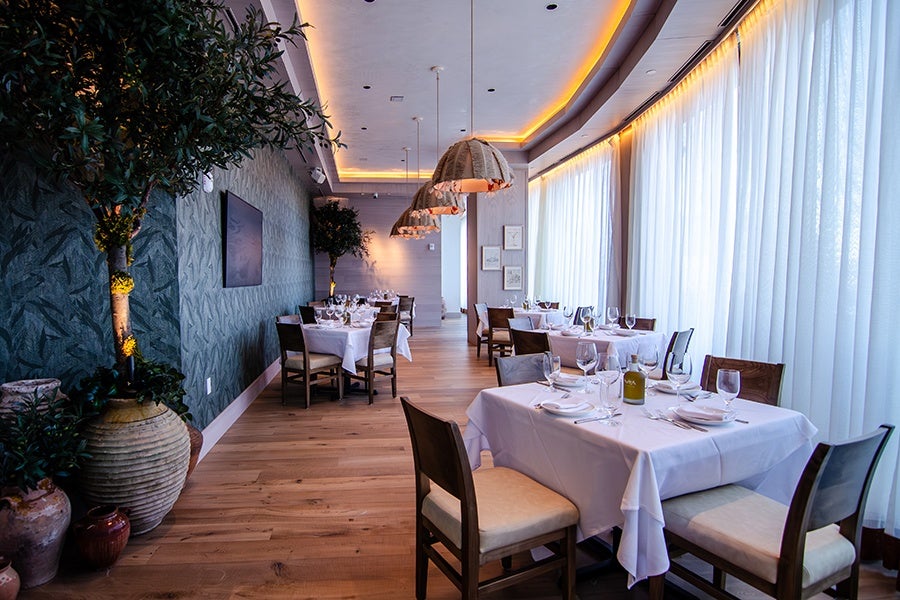
Avra Estiatorio. / Photo by Rachel Leah Blumenthal
“We like Boston, and we think it’s a big fish town,” says Tsoulous, and it felt like the time was right to open here. “We think there’s not enough food here the way we do it, and not a lot of Greek seafood restaurants.” Besides, says Tsoulous, Boston has a big Greek population: “I think they’re very anxious to come in and try our menu.”

The fish “market” at Avra Estiatorio, where diners can choose fish to be prepared. / Photo by Rachel Leah Blumenthal
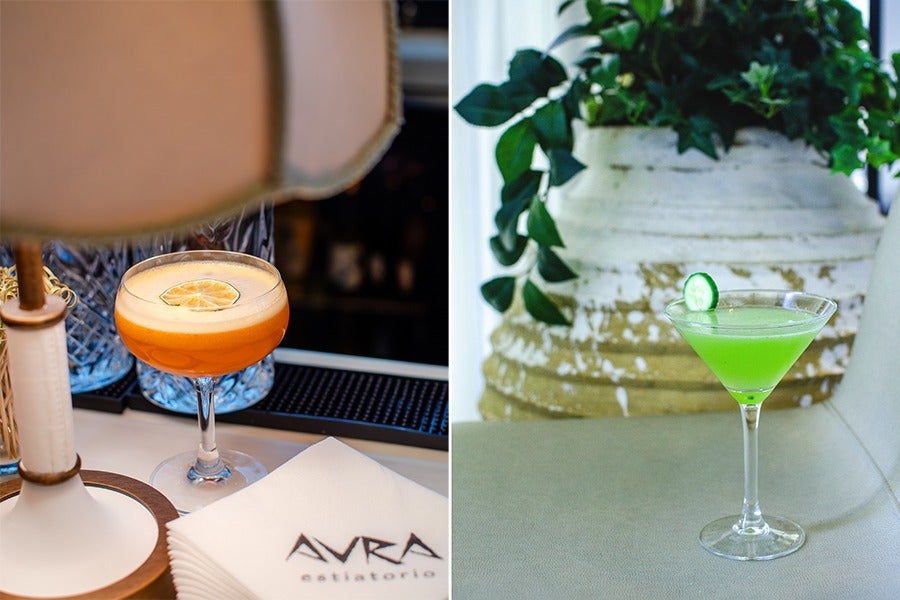
Cocktails at Avra Estiatorio. / Photo by Rachel Leah Blumenthal
400 Newbury St. (at the upper level of the Lyrik), Back Bay, Boston, 617-592-8888, theavragroup.com.

Avra Estiatorio’s coconut pie. / Photo by Rachel Leah Blumenthal
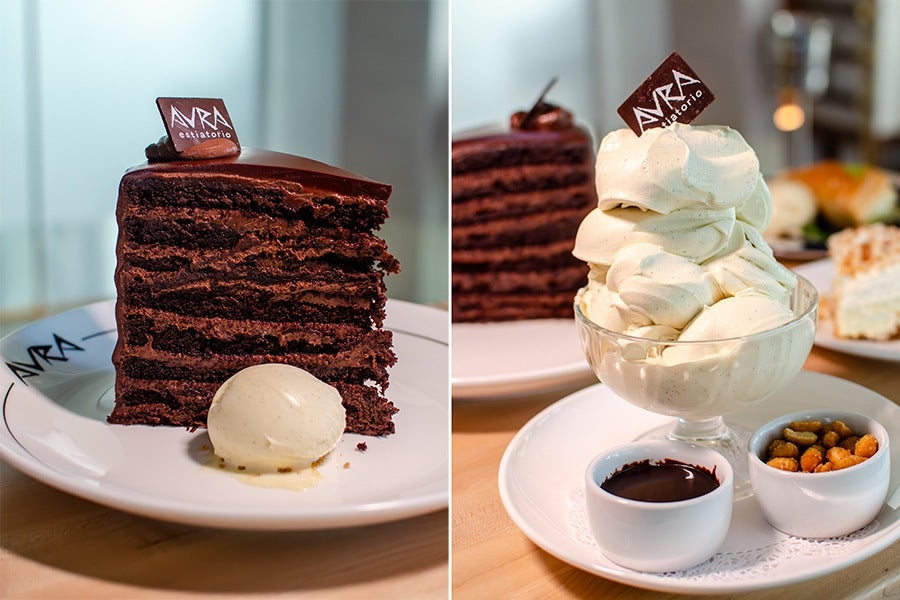
Chocolate cake and ice cream at Avra Estiatorio. / Photo by Rachel Leah Blumenthal
Nantucket Boutique Birdie Soars with Color, Craft, and Island Charm
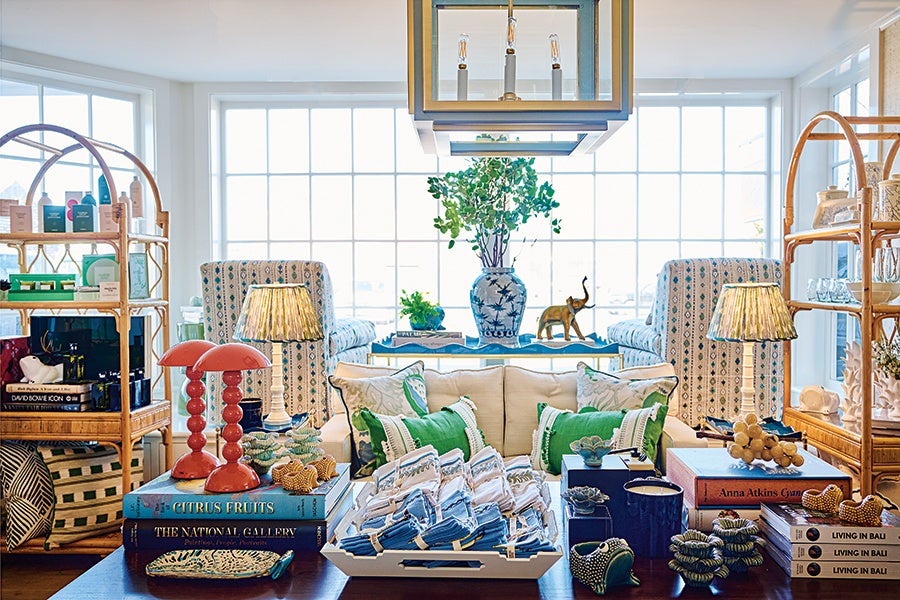
Among Birdie’s treasures to enliven the home are lighting, linens, and artful accessories. / Photo by Jane Beiles
On Nantucket, interior designer Nina Liddle is spreading her wings with Birdie, a new boutique that brings her playful, design-savvy mix of home décor and fashion to the island.
Named after her childhood nickname, Birdie reflects Liddle’s penchant for curating the unexpected. The light-filled Washington Street shop brims with distinctive finds from Europe and Africa—pieces that surprise as much as they delight. “I wanted it to feel very curated,” Liddle says. “Things people aren’t seeing everywhere else.”
Liddle has long dreamed of opening a store, even before launching her successful design firm, Nina Liddle Design. But with her interiors business flourishing, retail was put on hold—until now.
Inside Birdie, her vision comes to life. Decorative Jean Roger ceramic frogs sourced in Paris sit alongside whimsical South African pottery by Cape Town artist Gemma Orkin. Handmade Fermoie lampshades, their patterned textiles glowing in the windows, signal Liddle’s signature style: chic yet lighthearted.
Fashion, too, finds its place here. Racks are filled with breezy womenswear from designers such as Paris’s Thierry Colson, New York’s Merlette, and India’s Hemant & Nandita. Accessories—from South African jewelry to handknit Mexican handbags—add an international flair.
Perhaps the most personal touch is a custom pillow program, which allows customers to select from an array of fabrics to create bespoke designs. It’s an idea straight from Liddle’s interiors practice, where textiles often transform a room.
For Liddle, Birdie is the fulfillment of a long-held vision: a boutique that blends her interior design sensibility with her instinct for discovery. More than just another shop, it’s a reflection of her eye, her travels, and her playful approach to living well.
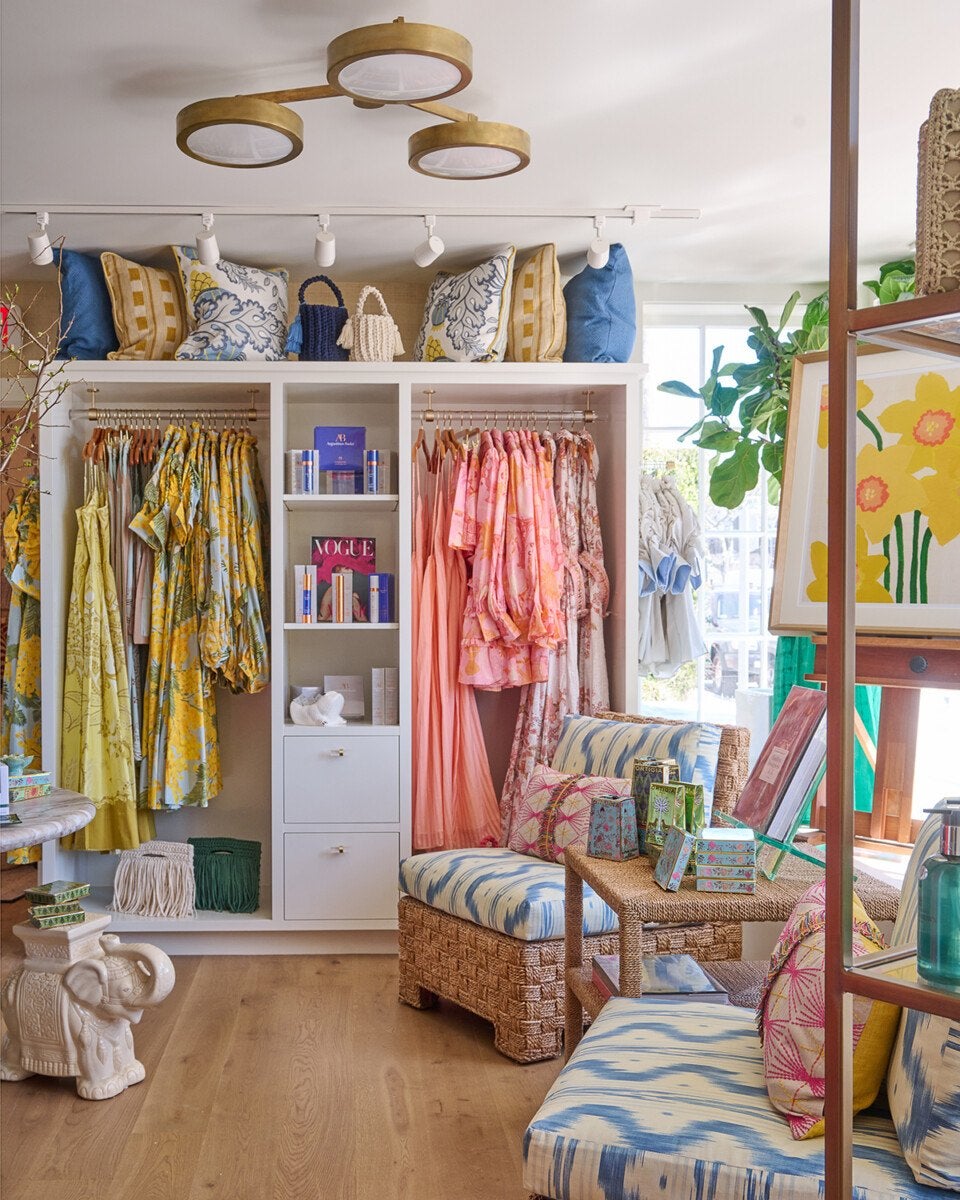
Photo by Jane Beiles
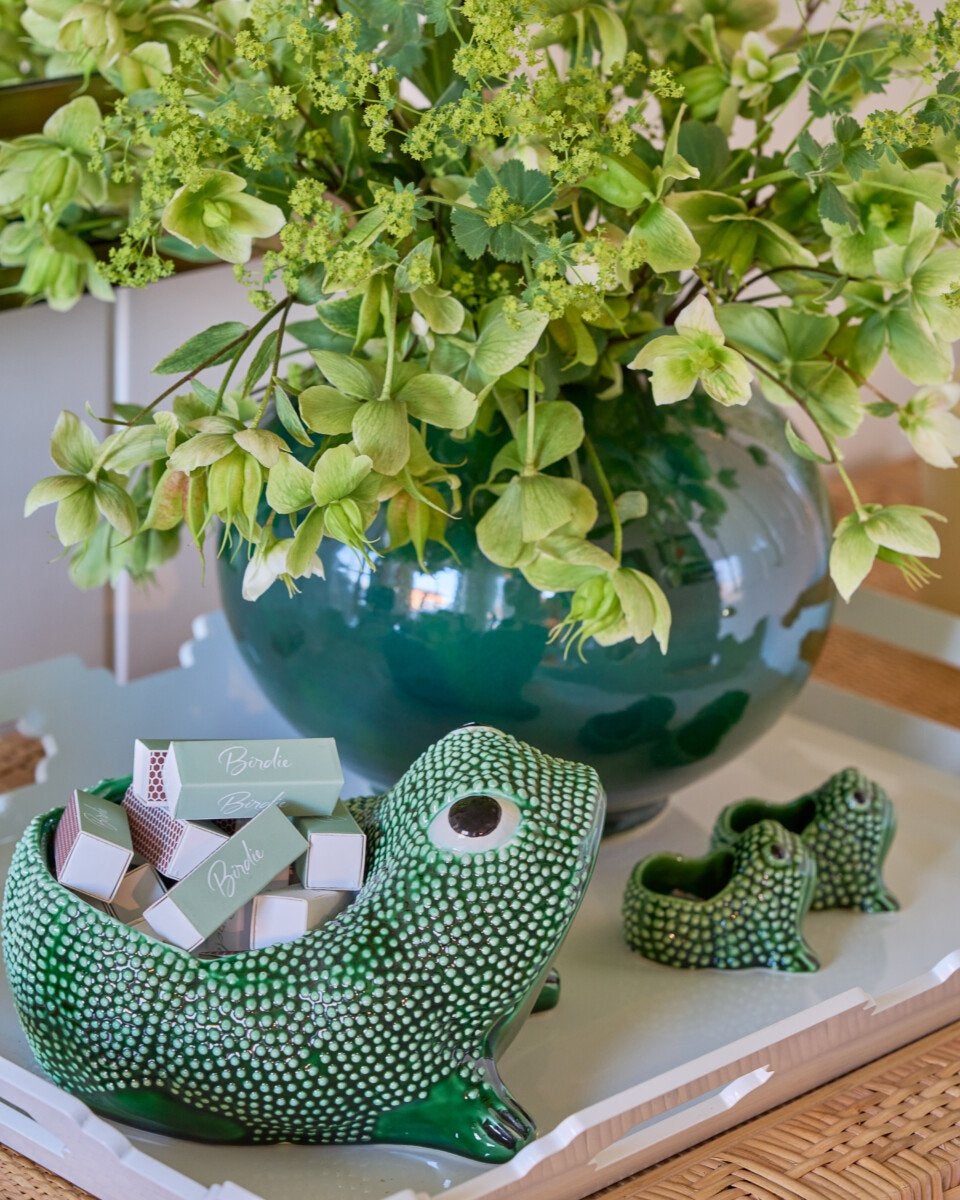
Jean Roger ceramic frogs sourced in Paris at Birdie. / Photo by Jane Beiles
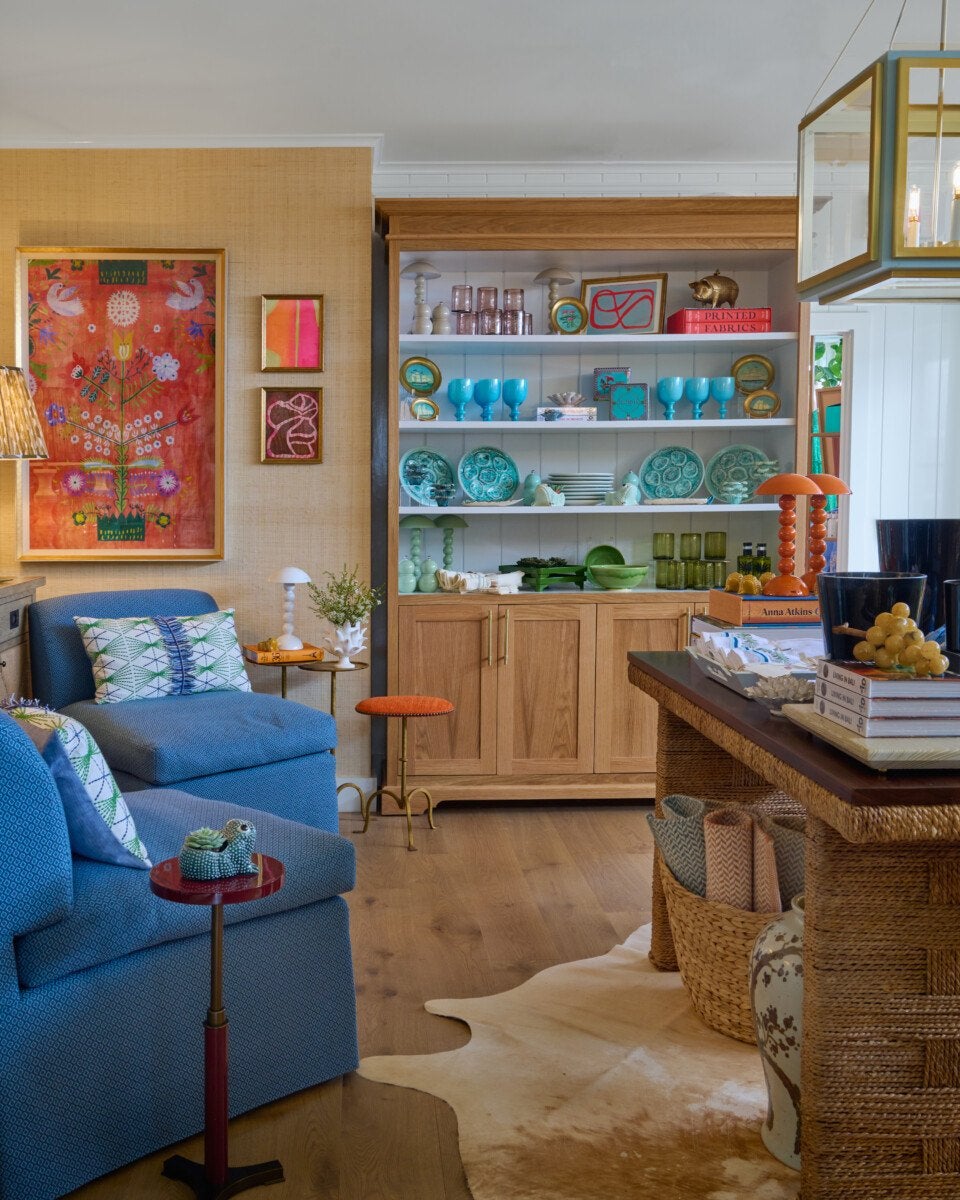
Photo by Jane Beiles
First published in the print edition of Boston Home’s Winter 2026 issue, with the headline “Birdie Takes Flight.”
Boston’s Newest Steakhouse Is an Intimate, Underground Space
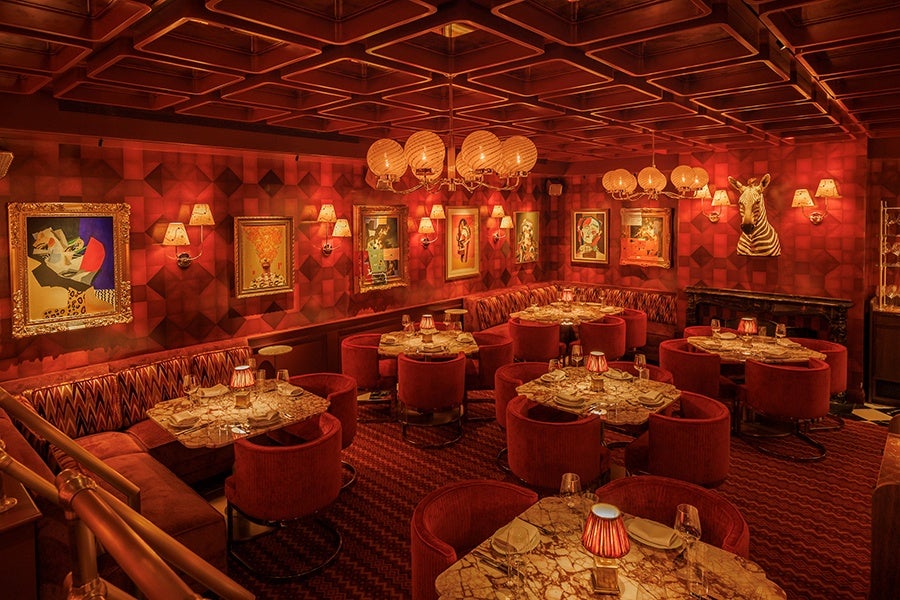
The Zebra Room. / Photo by Josh Jamison
Has anybody ever walked into a white-tablecloth steakhouse and thought, more wood paneling, please? Chris Jamison is betting you haven’t. And with the Zebra Room, opening downtown April 15, the COJE Management Group CEO hopes to add a unique spin to the Boston steakhouse scene with a “nontraditional take in a more intimate, laidback setting,” he says, complete with 1970s vibes, very cold martinis, and an atmosphere that “feels more like a living room than it does a restaurant.”
With a hefty array of nightlife-leaning restaurants and venues under their belts (including Mariel, Coquette, and Yvonne’s), the COJE team has set out to create something a little more grown-up here in the space below Yvonne’s, a focus that started with their late 2025 opening of the cozy sofa-filled cocktail lounge My Girl in Boston’s Post Office Square. (“I’m 42 now, and how do I want to spend my nights?” Jamison said at the time. “Going to dinner, and then going somewhere with a good soundtrack, sitting back, and grabbing some martinis.”) The Zebra Room takes it a step further: “This is a restaurant and dining bar first, a major departure from what we’ve traditionally done,” says Jamison, whose other venues tend to feel nightclubbier. “We’re trying to hit some notes for the cross-section of our clientele who have been asking for something like this for a long time.”
Beneath the main level of sibling restaurant Yvonne’s, the Zebra Room is hidden through a secret bookshelf door inside Yvonne’s subterranean Library, in a room that has gone through a couple iterations over the years, most recently as an event space called the Gallery. “Over the last year or so, we kept thinking that there was an opportunity to use the space better,” says Jamison. “We’ve seen an interesting trend [domestically and globally] toward much smaller, higher-touch restaurants. All of ours are huge.” So, the Zebra Room was born. “It’s a wholesale departure from what we’ve seen for steakhouses in Boston,” says Jamison, particularly size-wise, with just 10 tables and a small bar. (The tiny Bogie’s Place nearby, tucked between the Wig Shop cocktail bar and JM Curley, is another rare exception.)
The design, too, is meant to subvert Boston steakhouse expectations: “There’s a common thread of huge, corporate-forward spaces with wood paneling, the boys’ club [ambience],” says Jamison. “We designed this beautiful room [to be] super intimate, elegant, and comfortable, sort of a throwback to the 1970s ‘conversation pit’ vibe.” That means the dark red space is full of lots of soft surfaces, from banquettes to carpets, says Jamison. “The whole room is full of fabric.” Bold patterns on the wallpaper, floor, and furniture contrast the softness, along with colorful contemporary art by Junar Rodriguez, Halim A. Flowers, King Paris, Eser Gündüz, and Francisco Valverde.
Several food references go back a century further than the design, an homage to the iconic Locke-Ober, the restaurant that stood for over a century in the space that now houses Yvonne’s and the Zebra Room. The 1875 salad—endive, radicchio, blue cheese, bacon lardons, Medjool dates—is named for Locke-Ober’s founding year. And there’s lobster Savannah, a Locke-Ober signature that lands on the Zebra Room menu as two pounds of the shellfish, baked with sherry cream sauce, blue oyster mushrooms, gruyère, and buttered crumbs. Says chef Tom Berry, who runs culinary operations across COJE: “It was really important to capture the essence of a steakhouse without being too formulaic. But we also [wanted to give] a little bit of a nod to Locke-Ober without being too heavily into that.”
One must-try dish, as far as Berry is concerned: onion beignets, “sort of a riff on onion rings without being super crunchy.” It’s essentially a pâte à choux batter, he says, with grated onion, dehydrated onion, and Comté cheese, piped into doughnut molds and fried. The center is filled with boursin crème fraîche, with Ossetra caviar on top. “They’re intense, unique bites, and hopefully people are going to gravitate toward them,” says Berry.
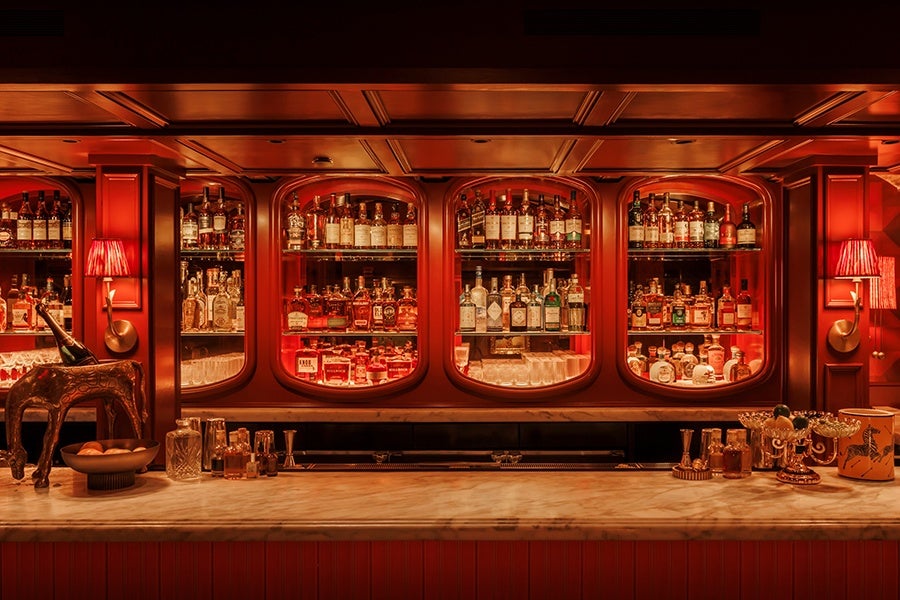
The bar at the Zebra Room. / Photo by Josh Jamison
As for the steaks, it’s “a nicely curated selection of different cuts and also different farms and producers,” says Berry, with options ranging from a Brandt Beef flat iron (“approachable and cooks beautifully,” says Berry) to the Olive Snow wagyu NY strip from Michigan’s Stonefall Farm (“the marbling is just insane,” he says, describing this one as “super premium”—to the tune of $135 for a 12-ounce cut). Among the non-beef options: dry-aged pork chops; a rack of lamb from the Australian company Mottainai, which touts its product as “the wagyu of lamb.” They’re not too gamey and “well-tailored to the American palate,” says Berry.
Sides are important; this is a steakhouse, after all. “I wanted to have a mix of familiar and unique,” says Berry. He’s particularly excited about the “baked potato flattie,” a baked potato squashed paper-thin in a dough press, dressed with salt, cream with thyme and garlic, and Comté, and broiled. “It becomes sort of a hybrid of a loaded baked potato and au gratin,” says Berry, once it’s garnished with boursin crème fraîche, shoestring fries, scallions, and “a bacon upgrade, of course, if you’re interested. Hopefully that’ll be an iconic dish here.”
One of the desserts brings the Zebra Room back around to that 1970s feel: the Watergate sundae, a play on the Watergate salad, which was born of Kraft Foods’ 1970s debut of instant pistachio pudding mix. “Our version is pistachio ice cream with caramelized pineapple, cherries, walnuts, pistachios, and meringue,” says Berry, “a cool riff on the 1970s pudding dessert.”
The cocktail program blends nostalgia with modernity, with COJE’s director of bars Ray Tremblay putting his “signature tweak” on steakhouse classics, says Jamison. The Zebra Negroni, for example, gets added depth from strawberry, rhubarb, and olive oil, while the Fat Cap Manhattan is a complex concoction with wagyu fat and coffee and mole bitters. “We’re doing a big freezer martini program,” adds Jamison: “total subzero, absolutely frozen bottles,” inspired by the Dukes martini in London, which is “the crispest, coldest, purest cocktail you’re ever going to have.”
The wine list, meanwhile, focuses on this side of the pond, with COJE’s corporate wine director Nick Morisi highlighting American picks, particularly Napa. This domestic emphasis is new among COJE’s venues and is inspired by the 50th anniversary of the 1976 Judgment of Paris, in which Californian wines bested French in a blind tasting. Still, there are classic global selections as well, from regions like Burgundy, Tuscany, and beyond.
The Zebra Room’s hidden location, intimate space, and exclusive-feeling reservation system (by request, or through the third-party membership-based Dorsia platform) give the restaurant the feel of a private club. (Incidentally, a private restaurant is among the group’s forthcoming late-2026 projects at the Post Office Square building that houses COJE venues Mariel and My Girl.) But it’s open to the public, as long as you can nab a reservation or, with luck, a walk-in bar seat. It’s poised to be worth the effort: From the 1870s to the 1970s to today, this nostalgic, comfortable restaurant might be just the thing to turn the Boston steakhouse scene on its head.
The Zebra Room opens April 15 and serves dinner Tuesday through Saturday. Reservations are by request or via the membership-based Dorsia platform, with potential walk-in availability for bar seats. 4 Winter Pl. (enter through Yvonne’s), Downtown Crossing, Boston, zebraroom.com.
Retired Police Dogs Could Get a Pension, If This State House Bill Passes

Illustration by Jeannie Phan
The hours and days following the marathon bombings were harrowing for Newton Police K-9 Dakota. Together with his human partner, he helped secure downtown Boston after the attack and, days later, doggedly pursued suspect Dzhokhar Tsarnaev through the streets of Watertown. Like many first responders, he returned changed. Dakota developed what would later be recognized as canine post-traumatic stress disorder, becoming fearful, withdrawn, and unable to function. At the time, there was no formal diagnosis, no treatment protocol, and no clear plan for dogs whose service left lasting trauma. Euthanasia was considered.
Instead, Dakota was brought to James LaMonte, who took the German shepherd mix into his training facility and began developing a tailored rehabilitation program. That work not only saved Dakota’s life but also became the foundation for the K9 PTSD Research Center in Seekonk, a nonprofit dedicated to treating retired military and law-enforcement dogs suffering from trauma. Dakota’s recovery—and the larger issue of post-service care for working dogs—is documented in the 2023 film Healing Dakota, now streaming on Amazon Prime.
Thirteen years later, as Boston prepares for another marathon, Dakota’s story has resurfaced in a new place: the State House. Dakota’s Law, a bill currently before the Massachusetts Legislature, would create a state-managed fund to help cover medical and trauma care for retired police dogs—support that did not exist when Dakota left service. Filed in January 2025 by state Representative Steven Xiarhos and others, the proposal has advanced out of committee in consecutive sessions, an important step in a legislature where only a small fraction of bills ultimately become law. “I was so impacted by James’s care of these dogs,” says Xiarhos, who in 2022 was successful in passing Nero’s Law, which allows injured police K-9s to be treated and transported by EMTs. Under the new proposed legislation, the fund would be administered by a committee and distributed through grants for eligible K-9 care.
In the meantime, LaMonte continues to house and care for retired and wounded K-9s—often for the remainder of their lives—operating entirely through donations. “Too many nights I went to sleep carrying a quiet fear and a heavy weight on my heart—the worry of not knowing if I would have the money if something serious happened [to one of the dogs], if an unexpected surgery or medical emergency put their life on the line,” LaMonte says. “Dakota’s Law would change everything. It would mean their care is no longer uncertain. It would mean their future is protected.”
This article was first published in the print edition of the April 2026 issue with the headline: “Dakota’s Law.”
Related: The Heartrending Tale of Kitt the Police Dog
Dreamy Peruvian Restaurant Rosa y Marigold Opens in Back Bay
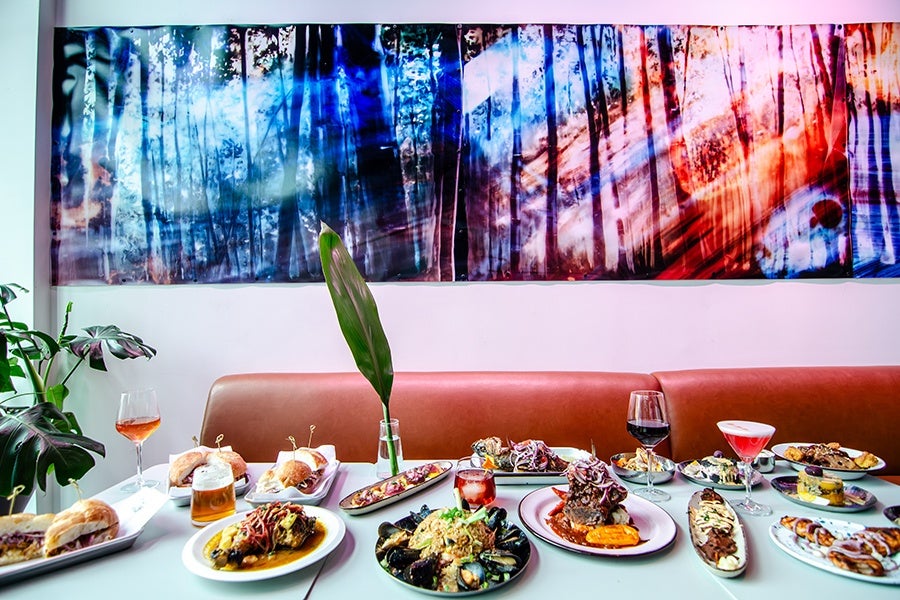
A spread of food at Rosa y Marigold in front of a photographic print by Cambridge-based Matt Saunders. / Photo by Rachel Leah Blumenthal
It’s been 13 years since JuanMa Calderón and Maria Rondeau started hosting dinner parties in their Cambridge home. Since then, the couple—a Peruvian filmmaker and a Guatemalan architect, respectively—have opened three Peruvian restaurants: the tiny Celeste in Somerville’s Union Square, the big-city-swanky La Royal in Cambridge, and the experimental Esmeralda in Vermont. Now, their biggest venture yet: Rosa y Marigold, a 100-seat restaurant on the ground floor at Back Bay’s Lyrik development. “We are more confident,” says Calderón, who’s the group’s executive chef. “At Rosa y Marigold, we’re being braver.” That means bolder dishes like anticuchos de corazón (beef heart skewers) and a packed schedule of weekday lunch, weekend brunch, and daily dinner service. Lots of live music, too. “With a new restaurant, it’s time to arrive,” says Calderón as the acclaimed team finally makes its Boston proper debut. It’s big and it’s ambitious, but Rosa y Marigold feels firmly moored to the joyous, community-building ethos of its elder siblings.
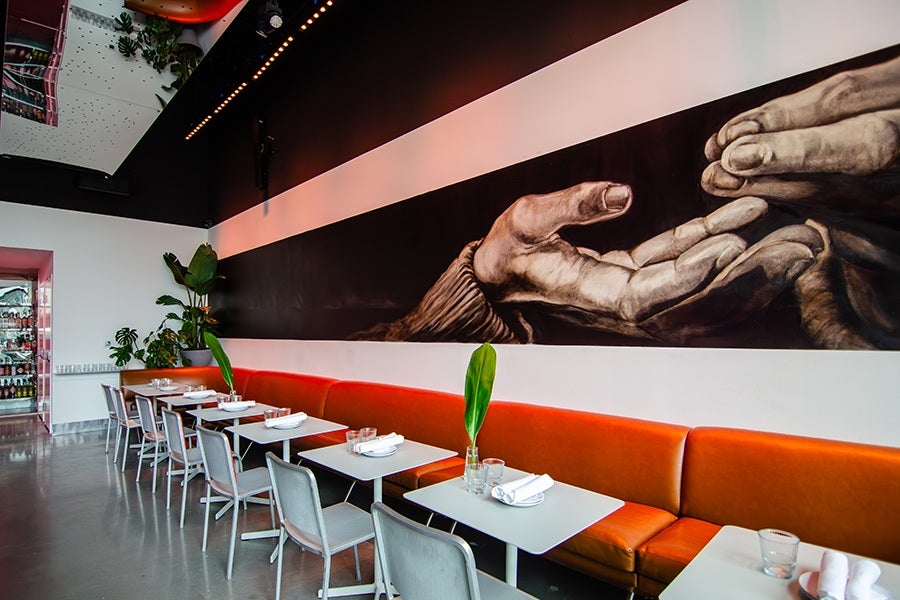
Rosa y Marigold features a mural by Wellesley-based artist Daniela Rivera. / Photo by Rachel Leah Blumenthal
The new restaurant’s concept is rooted in duality, like the book for which it’s named. Rosa y Marigold is inspired by Marigold and Rose, a novel by the late Nobel Laureate poet Louise Glück, “who was a very dear friend of ours,” says Rondeau (the restaurant’s designer and general manager). “She was a very big supporter of Celeste and always encouraged us to move forward.” The book reads like a fable, says Rondeau, describing two infant twin girls “who don’t have the gift of speech yet, but do have the gift of imagination, and they project. One is very creative and interested in the world as a visual; the other is more interested in the concepts behind things. So, [the book explores] how these two live as one—they’re separate, yet they’re together.”
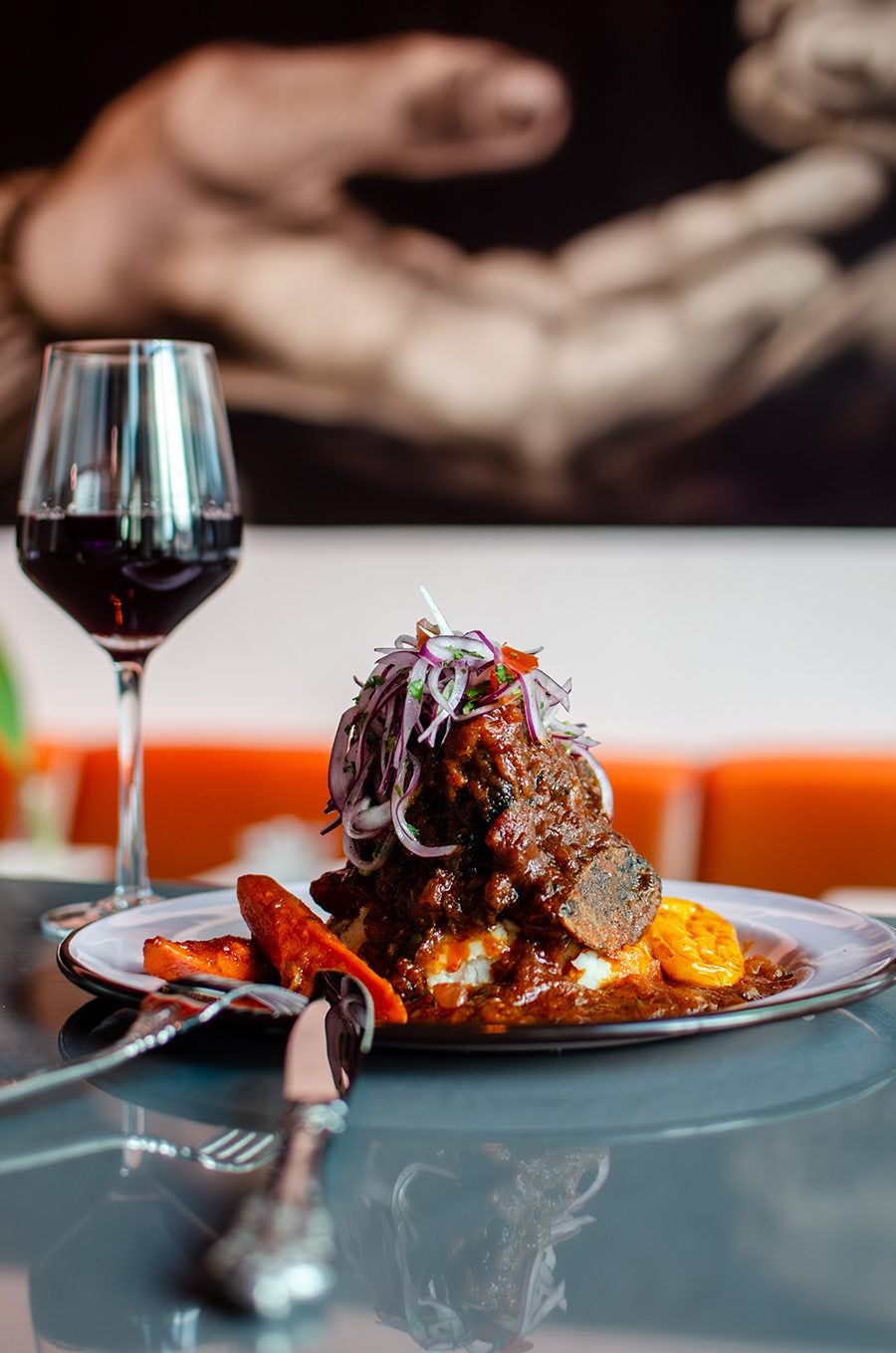
Rosa y Marigold’s asado de costilla con pure de papas—braised short rib in panca, mole, and red wine reduction, with potato puree. “It’s based on a very traditional Peruvian dish called asado, which is made with roast beef,” says Rondeau, “but we wanted to portion it differently and give it a richer flavor, so we made it with braised short rib. It’s a little bit of a spin on ossobuco, also.” / Photo by Rachel Leah Blumenthal
Duality manifests in various ways. For one, Rosa y Marigold is equally suited to day and night; Rondeau and Calderón are excited to finally be in a neighborhood with enough mid-day bustle to support weekday lunch service, when they’ll highlight sánguches, Peruvian sandwiches. Plus, the menu is a balance between tradition and modernity, from classic ceviche and street-food anticuchos to contemporary spins on steak frites (with huacatay butter and fried yuca) and the homey Peruvian dish asado (made here with artfully plated short rib instead of roast beef). “When I go to Peru to explore and research, I always go looking for the very traditional things,” says Calderón, “but in Lima, a lot of things are happening in cuisine. So, I always come back with the two parts: whatever I was looking for from my memories, and all the new things happening there.” And Lyrik itself embodies duality, too, perched at the intersection of neighborhoods and the crossroads of locals and tourists.
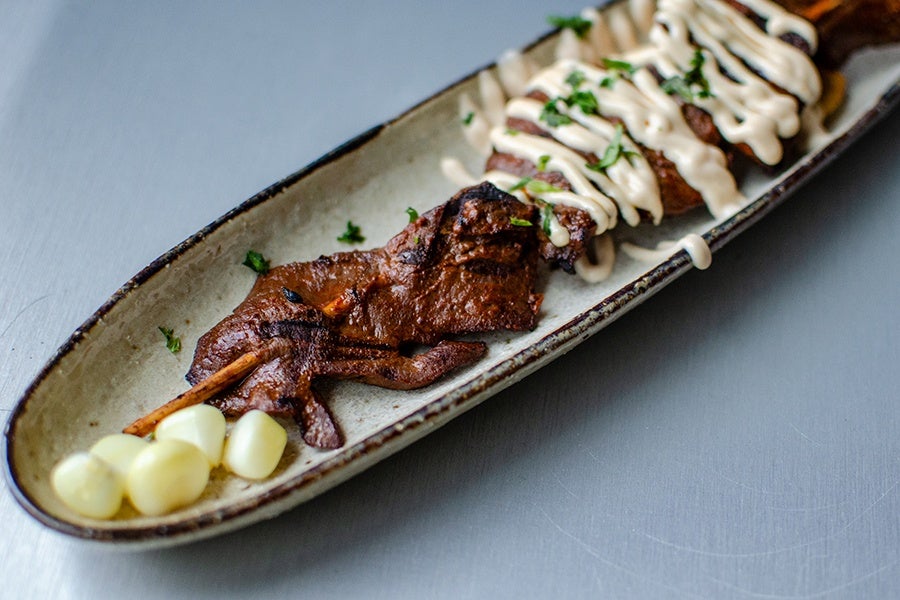
Rosa y Marigold’s anticucho de corazón, a beef heart skewer made with aji panca marinade. The restaurant also offers shrimp and pineapple anticuchos and vegan portobello anticuchos. / Photo by Rachel Leah Blumenthal
Compared to the menus at Celeste and La Royal, the anticuchos de corazón are one of the most notable new dishes at Rosa y Marigold. “Every neighborhood [in Lima] has a lady on the corner serving this every night,” he says of the ubiquitous street food. “It’s very old, coming from the slaves’ time, when the only meat they could eat was [offal].”
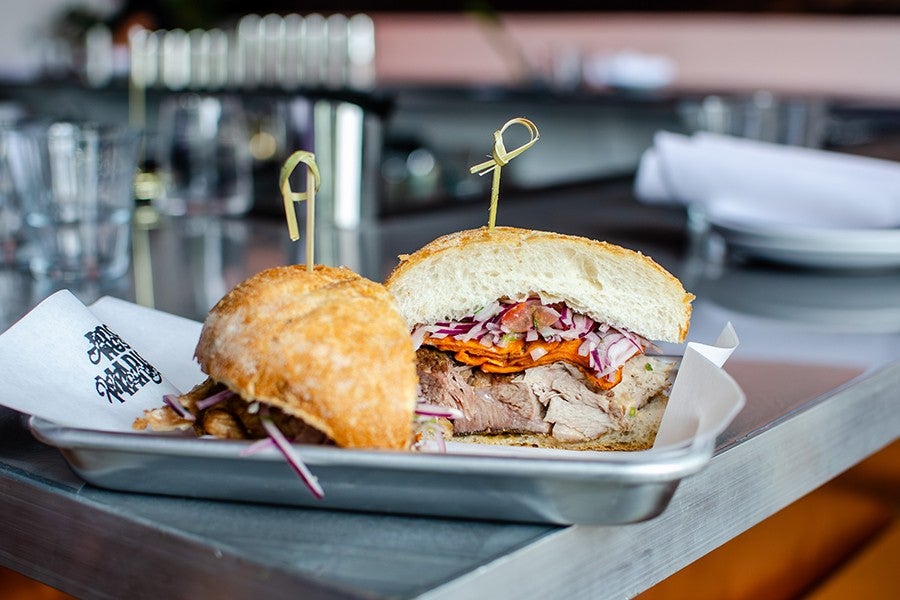
Rosa y Marigold features seven sánguches, Peruvian sandwiches, on its lunch menu. This is pan con chicharrón, deep-fried pork with sweet potato and salsa criolla, traditionally enjoyed on Sundays but always available here. / Photo by Rachel Leah Blumenthal
The sánguches are also new, and they’ve been on Rondeau and Calderón’s minds for ages, but lunch just didn’t work for the Celeste and La Royal locations, which don’t have as much midday foot traffic. (“In Peru, [sánguches are] pretty much what you eat in bars when you’re drinking beers,” says Calderón, and they’re also often a breakfast food. In Boston, they feel like a perfect fit for lunch.) Try the pan con chicharrón first, deep-fried pork with sweet potato—it’s a classic sandwich recently declared the best breakfast in the world in an internet contest (but equally tasty at any time of day). Traditionally it’s eaten on Sundays; Sundays are “the reason for a reunion, and people arrive to have a big breakfast,” says Calderón. Rosa y Marigold will thankfully serve it every day, though.
Rosa y Marigold. / Photo by Rachel Leah Blumenthal
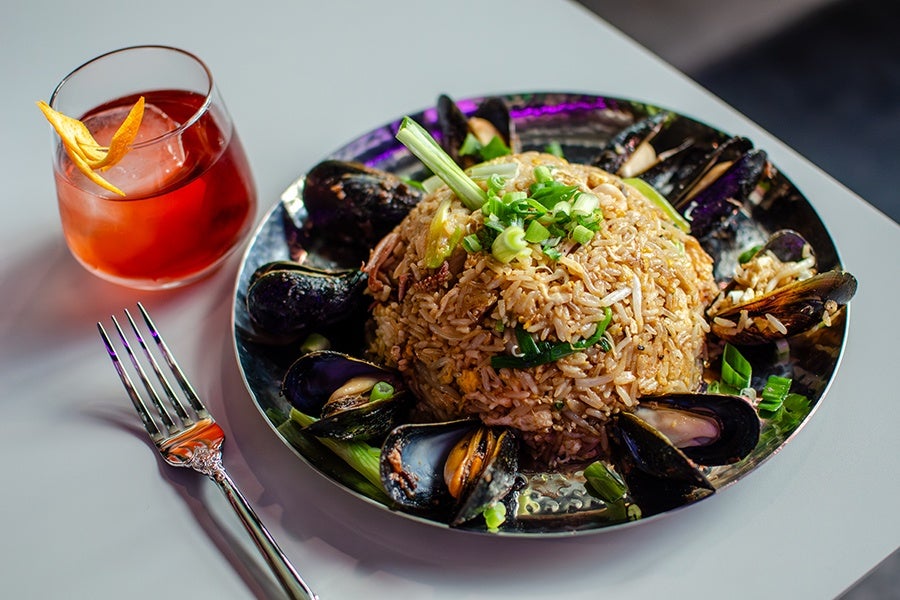
There are plenty of familiar threads, too, among Rosa y Marigold and its siblings. To drink, for example? “Always a lot of pisco sours and versions thereof,” says Rondeau. Here, one version is spicy thanks to the South American Rocoto pepper; another, the Newbury Sour, incorporates chicha morada (a purple corn-based drink) and black currant cassis, its color mirroring the dreamlike purple lighting in parts of the restaurant. Calderón’s emphasis on chifa (Peruvian-Chinese dishes) continues here as well, with dishes such as chaufa de mariscos, stir-fried rice with seafood, and wonton de camaron, fried shrimp dumplings with a sweet-and-sour tamarind sauce. “[Making the wontons] one by one helped me a lot during all these days [of opening the restaurant],” says Calderón.
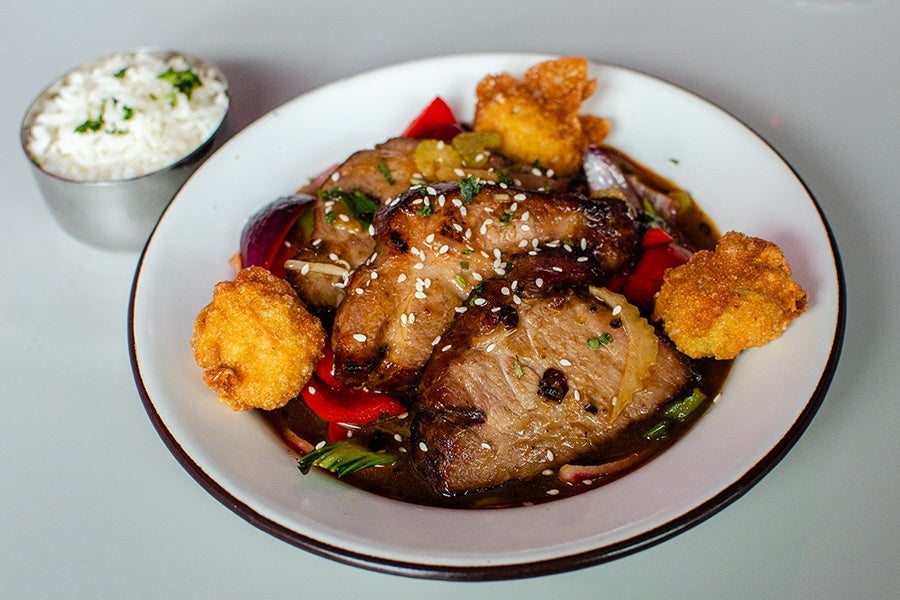
Rosa y Marigold’s chanchito asado—Chinese-Peruvian roasted pork, hoisin sauce, and sautéed vegetables—pictured here with wonton de camaron, fried shrimp wontons. / Photo by Rachel Leah Blumenthal
Adds Rondeau: “It’s therapeutic; he meditates when he makes them.” And those dinner-party roots have not been forgotten. At each of the group’s restaurants, “the design revolves around the open kitchen,” says Rondeau. “That’s really what we’re all about: kind of sharing, kind of performance.”
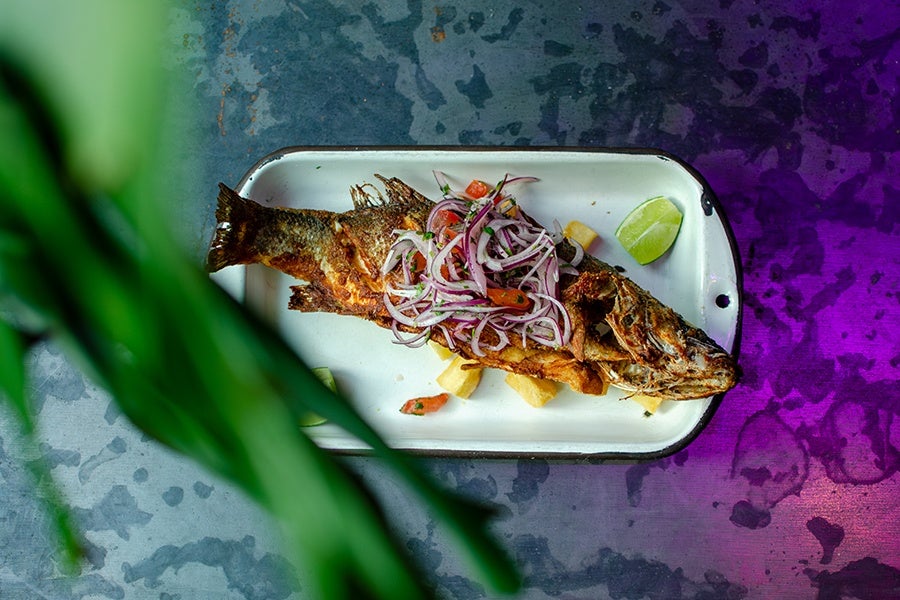
Rosa y Marigold’s frito pescadito con papa dorada y salsa criolla, deep-fried whole branzino with potatoes and salsa criolla (tomato and onion). / Photo by Rachel Leah Blumenthal
Of the group’s locations, this is the least neighborhood-y on its surface—the plentiful tourists and students come and go—but Rondeau and Calderón are confident that they can cultivate a community here. “When we came to this location,” says Rondeau, “we had this idea of food and bringing people together,” a lifeblood that courses through all their projects. With long hours, from lunch to late-night, and live music collaborations from Berklee and other local institutions and groups, it seems like the right pieces are in place to achieve that goal. “There’s a huge demographic here completely different from what we see [at our other locations]. We have tourism, because we’re at the hub of Boston, and we have students, and we have the neighborhoods: the Back Bay, Fenway, the South End. We see it as an opportunity to grow.”
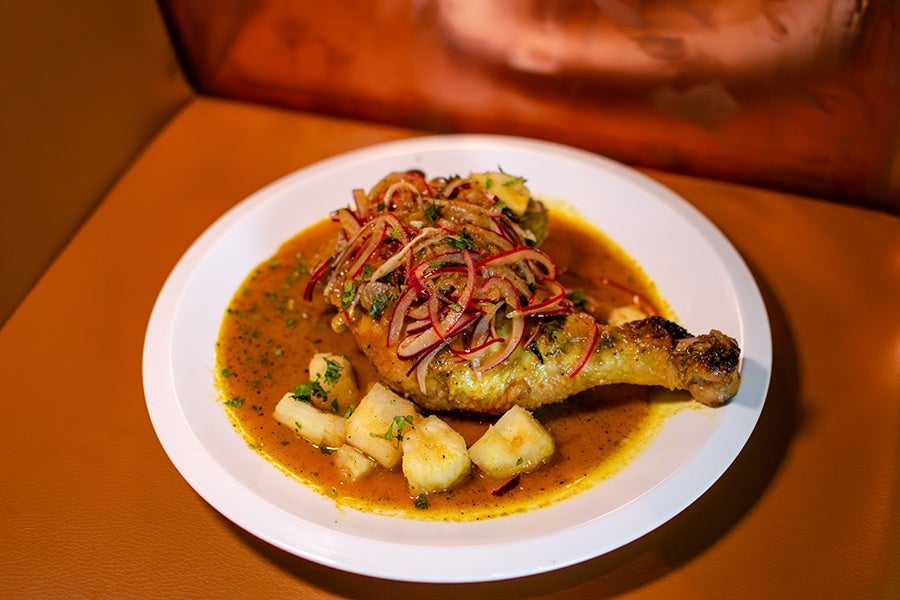
Rosa y Marigold’s pollo al limón: braised chicken, aji amarillo, lime, red onions, and rice. This is “a classic from JuanMa’s mom’s kitchen,” says Rondeau. (It’s traditionally called ceviche de pollo, which leads some English speakers to mistake it for a raw chicken dish. The name actually refers to the flavors of ceviche, not the preparation.) / Photo by Rachel Leah Blumenthal
Community within the restaurant group itself is essential to Rondeau and Calderón as well, and key to the decision to open this fourth venue. “One of the really important things for us is growing from within our team,” says Rondeau. Celeste’s first employee, Jose Saravia, who started as a dishwasher, is a partner in Rosa y Marigold, as is Lauren Harder, who is La Royal’s landlord and general contractor. “Our restaurants are really about us as a family,” says Rondeau, and that chosen family keeps growing.
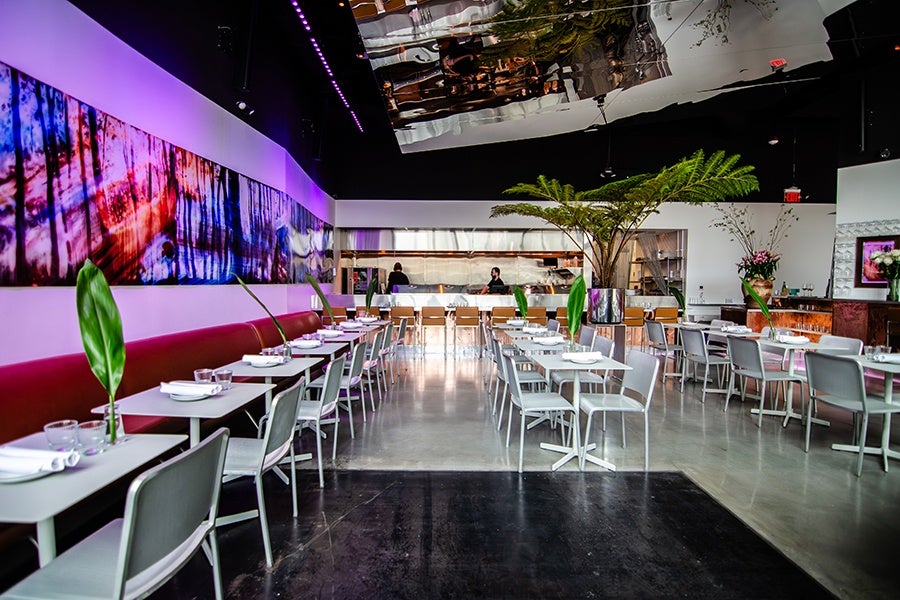
Rosa y Marigold. / Photo by Rachel Leah Blumenthal
Since Rondeau designs each of the group’s restaurants, Rosa y Marigold feels like a seamless continuation of its older sisters. Grander in scale, sure, but intimate and lovely just the same. Of note are large mirrors on the ceiling, meant to “augment the space and give the idea that you’re looking beyond,” says Rondeau. “They let you observe, taking it all in, [feeling] that you’re part of something.” One wall is covered by a striking mural of “hands describing food you love,” as Rondeau explains it; it’s by Chilean-born, Wellesley-based artist Daniela Rivera, who also did pieces for Celeste and La Royal. Another wall features an almost otherworldly forest-like landscape, a photographic print by Cambridge-based Matt Saunders.
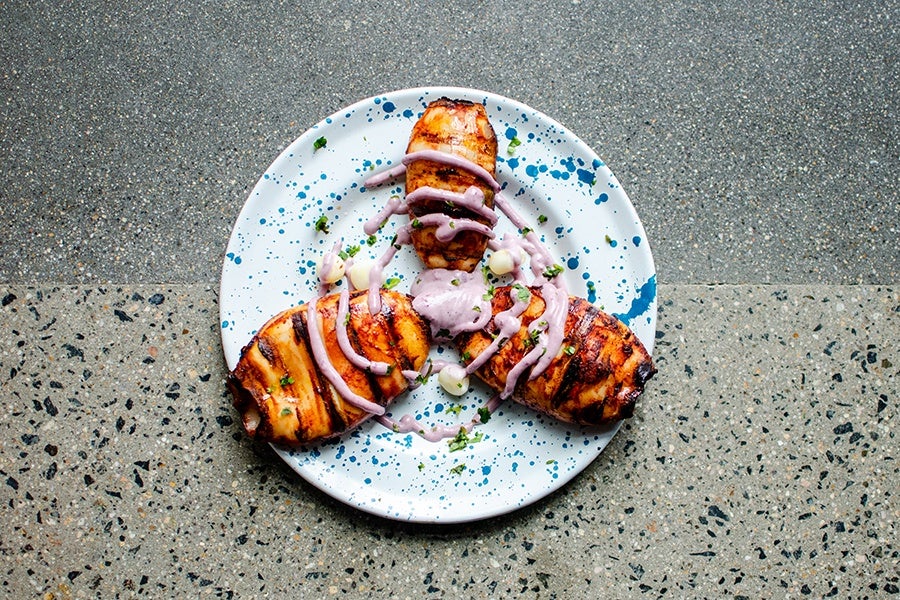
Rosa y Marigold’s squid al olivo, grilled squid with black olive mayonnaise. It’s one Rondeau’s favorite dishes on the menu. / Photo by Rachel Leah Blumenthal
With duality at its core, Rosa y Marigold is equal parts an evolution for the group and recommitment to its siblings’ foundation, from Calderón’s expressions of Peruvian cuisine to Rondeau’s artistic design that balances homey and trendy. “A new restaurant is an opportunity to keep creating, keep playing, and keep experimenting,” says Calderón. “We’re ready to say, ‘This is who we are, and this is what we have.’ We can keep exploring Peruvian culture.”
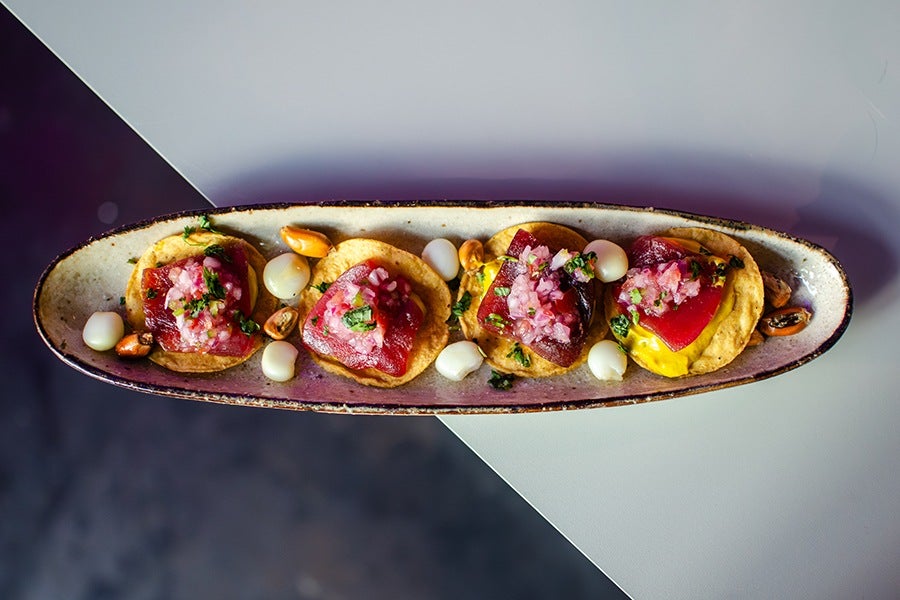
Rosa y Marigold’s tostaditas de atún: cured salmon and avocado salsa madre. / Photo by Rachel Leah Blumenthal
Rosa y Marigold opens in mid-April, serving daily dinner, weekday lunch, and weekend brunch; reservations available via Opentable. Watch for live jazz on Wednesday nights and Sundays during brunch, with an expanded live music and schedule coming soon, spanning various genres. 400 Newbury St. (Lyrik Back Bay), Back Bay, Boston, rosaymarigold.com.
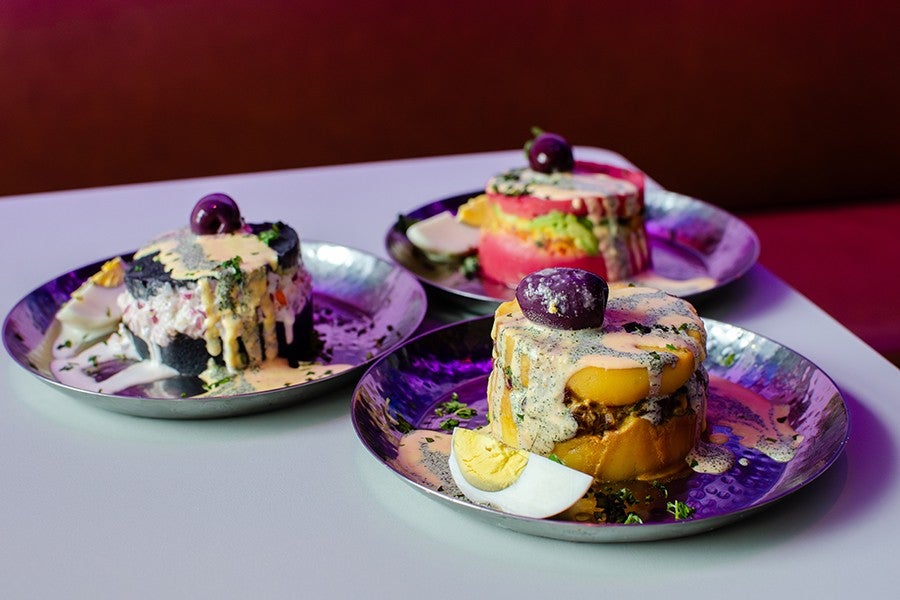
Rosa y Marigold’s causas—riced potato with lime, aji amarillo, and olive oil, served cold. The yellow one features tuna tartare; red—beet, tomato, and avocado; black—squid ink and shrimp. / Photo by Rachel Leah Blumenthal
Can Steven Pinker Save Harvard?
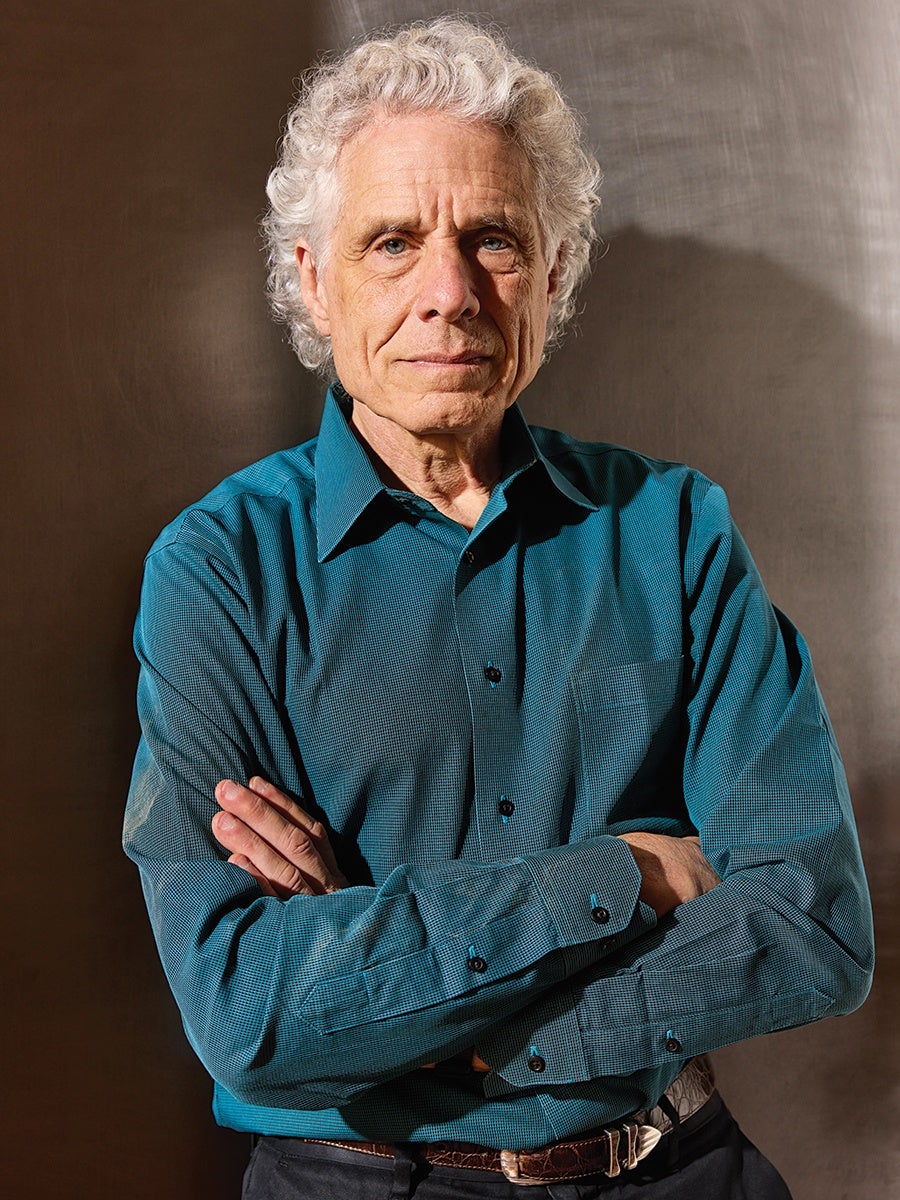
Photo by Ken Richardson
Steven Pinker is one of the most famous—and divisive—academics in America. A cognitive psychologist at Harvard, he’s spent five decades writing about how we think, picking fights with the left, and wading into culture wars that most professors avoid. Bill Gates calls him a favorite writer. His critics call him a cover for racists. He’s been accused of providing intellectual ammunition to the alt-right, and of dismissing inconvenient evidence when it doesn’t fit his theories. He’s also, right now, one of the loudest voices pushing Harvard to change.
My introduction to him, though, was surprisingly gentle.
The past few years, Pinker has turned his attention to what’s happening at Harvard itself—a lack of academic freedom, the monoculture he sees taking over, and the groupthink undermining research and education. What first caught my eye was something he wrote for the Boston Globe in 2024, on how Harvard had been handling student protests over the war in Gaza. Pinker wrote about teaching Sunday school as a young man, leading students through moral dilemmas with no obvious right or wrong answer. Now, he said, he found himself “wishing that my august institution taught its students this skill.”
Which demands a pointed question: If Harvard isn’t teaching students to think through hard problems for themselves, what, exactly, is the mission of the university?
This struck me as bold, since Pinker draws a paycheck from Harvard, but even more to the point, it seemed quite reasonable. And calm. Also, right at the heart of what we need to figure out about higher education.
It gets immediately complicated, however, given that a lot of people, including President Donald Trump, have been asking the same questions in a much harsher way. Trump has had a great deal to say about our elite universities, especially Harvard, and none of it is good. This has put Pinker in a bind between the woke and Trump. Between indoctrination from the left and whatever the Trump administration is. So Pinker has written not just about the monoculture at Harvard, but, lately, about the fallout if the Trump administration is able to drastically cut the school’s federal funding.
Pinker has fashioned himself as a public intellectual—someone who takes on big issues and demands that we do, too. It’s tricky territory. Of course, he could make a left turn and simply shut up. But speaking out, having his say, is what he does and wants to do, and—though he can be shy about admitting it—enjoys doing.
Pinker is taking this moment on not by jumping up and down, but in the same clear-as-a-bell way I first discovered—by getting right to the problem. In “Harvard Derangement Syndrome,” which ran in the New York Times last May, he argued that universities are obsessed with implicit racism and sexism but blind to a bigger problem: “my-side bias,” the tendency to believe whatever our political tribe believes. Universities, he wrote, should expect faculty to “leave their politics at the classroom door.” To that end, he even suggested “a bit of D.E.I. for conservatives.”
But Pinker’s critics—and there are many, especially in academia—argue that he’s guilty of exactly what he decries: my-side bias, ideological blinders, a willingness to engage with far-right figures in ways that give them legitimacy. He says he doesn’t set out to spark controversy—though he seems to welcome it when it comes. But it’s a double-edged sword in a dangerous time: Pinker has leaped into the fray of what ails Harvard—and higher education in general—starting with his own questions about our universities: What are they doing? Who are they for? Where are they going?
But there’s another question, one that goes to the core of what he’s all about, as Pinker tries to change the culture at Harvard: Is he the right guy for the job?
Something large was always at play for Pinker, who grew up in a Jewish community in Montreal. His kindergarten teacher told his mother he was the smartest kid she ever taught. His parents had bought a set of the World Book Encyclopedia—Pinker as a young boy devoured them. He loved science and math. His mother was a big reader, someone who knew everything. He asked her, at 17, “How do you get a job in a think tank?” She suggested he become a psychiatrist, but Pinker wasn’t interested in going to medical school. A college professor, then; this, they could agree on. They’d drive to McGill University together—Pinker lived at home all through college, “in the Canadian style,” he says—as his mother was working on a master’s in education. She brought home books on psycholinguistics that triggered an early interest—it was the era of Noam Chomsky getting famous in the revolution of cognitive science—and in his office in Cambridge, Pinker turns to look up at his books: “In fact, I have some on my shelves. I know exactly which ones they are.” Never mind that it was also the era of unemployed Ph.D.s; Pinker knew what he wanted. It took him all of three years to get a doctorate at Harvard in experimental psychology after graduating from McGill. He moves fast.
In his office, Pinker, on sabbatical, is informal, wearing a sweater and jeans, and the cowboy boots he’s known for that give him another inch. His famously spectacular curly hair has been trimmed down a bit, though it’s still spectacular. He’s smaller than I anticipated, and I realize that he’s generally so good-looking in photographs that I was expecting a commanding presence, but that’s not Pinker’s style. He’s eager, almost, to please—and a little edgy. He shifts often in his chair as we talk for three and a half hours—as if he can’t quite get comfortable; Pinker, 71, sprained a tendon in his hip two years ago, which ended his running, but he’s still an avid bicyclist. In his book How the Mind Works, he wrote: “Well into my procreating years I am, so far, voluntarily childless…ignoring the solemn imperative to spread my genes. By Darwinian standards I am a horrible mistake.… But I am happy to be that way, and if my genes don’t like it, they can go jump in the lake.” His third wife, Rebecca Newberger Goldstein, is a philosopher and novelist. He’s a professed liberal Democrat, though Pinker often gets accused of being a closet conservative. He takes on, with gusto, whatever I ask.
It quickly becomes obvious that the world comes alive for Pinker when it can be studied, understood, and explained. For a long time, he was mystified about why his father, who’d grown up dirt poor in Montreal after his parents emigrated from Poland in the 1920s, didn’t use his law degree, instead supporting his family by selling clothing in small Quebec towns; Pinker’s father himself never explained why. But then Pinker discovered the research of Thomas Sowell, a conservative economist and social theorist, on how ethnic groups often cultivate particular expertise over time and take it wherever they end up; for Pinker’s father, the Jewish cultural capital of commerce and finance—or, specifically, the garment industry—developed over centuries became the sure thing in order to move on from a childhood so destitute that a neighbor had to knit him mittens to survive a Montreal winter, since his parents couldn’t afford to buy them.
Sowell’s research, Pinker says, “actually helped me understand my own upbringing.” His research pushed against “the dominant mode of explanation that says the only differences among ethnic groups is how they’re treated from the outside, in terms of racism and prejudice. He argued that the traits within a culture matter as well.” With that, Pinker’s father wasn’t a victim of his circumstances, but part of a cultural tradition.
Pinker took his method of understanding, of needing to know and how he needed to know, into cognitive science. The Guardian once wrote of him, “No matter the topic of conversation, he will reach for a wider theory or study to explain it: the universality of facial expressions, the roots of physical attractiveness, the moral awe people feel for Noam Chomsky, why zebras have stripes.”
Pinker found more than a profession—he discovered a method. And the power of his books is in their insistence on going wherever the facts lead. After writing about language for academics, Pinker crossed over to a general audience with The Language Instinct in 1994, which made the case for the biological basis of language and hit big. In The Blank Slate, published in 2002, Pinker argued against a prevailing orthodoxy that we’re born without any innate characteristics, shaped entirely by environment and culture. Instead, he made the case that genetics plays a significant role in how our minds work and who we become. The Better Angels of Our Nature (2011) detailed the long-term historical decline in violence, and Enlightenment Now (2018) made the case for reason and science creating a world of well-being and possibility foreign to earlier epochs. Those last two got Pinker a lot of heat for putting a sunny spin on the way things are now, especially among left-leaning thinkers who have called him a cheerleader for Western capitalism, blind to the inequalities it produces. And The Blank Slate has gotten Pinker criticized over the idea that biology is destiny, which leads into dangerous territory: racial differences, eugenics, the question of who gets to define human nature and why.
Biology as destiny is not what Pinker seems to be up to in The Blank Slate. In a nutshell, he argues that there are genetic differences between people, and that acknowledging this is not inherently a bad or dangerous thing; rather, it’s something to be understood. When he made this argument nearly 25 years ago, it was highly controversial. It still is.
In The Blank Slate, Pinker had three central beefs with academic orthodoxy. First: that human nature does not exist. Second: that our minds and bodies exist apart from each other. Third: that we are born innately good. Instead, he had come to believe many traits are universally human; that our minds are an information processing system plugged in to the hardware of our brains (“I think that intellectuals are just kind of squirrelly about that,” Pinker says. “They’re squeamish about the idea that the mind is just the activity of the brain.”); and that, while we are quite capable of doing good, it is not the underlying state of humanity. Pinker takes the basic position of philosopher Thomas Hobbes, who wrote that the condition of man is a war “of every man against every man.” In other words: The natural state of human beings is guided by self-interest and engaged in an ongoing struggle for power and resources.
Pinker says the book was not meant to stoke controversy, but explore what already existed. “I thought that the moral emotions had crept into the science, distorting the way scientists could do and report their research,” Pinker says. “And so the major goal of the book was to drive a wedge between them, so that if, for example, you thought that there were differences between men and women, that did not imply that you were against equal rights for women or condoning prejudice and harassment of women.”
Pinker’s frustration comes through in The Blank Slate—a sense that we’ve gotten human nature wrong. I read a passage to him from the book:
“The blank slate has also served as a sacred scripture for political and ethical beliefs. According to the doctrine, any differences we see among races, ethnic groups, sexes, and individuals come not from differences in their innate constitution, but from differences in their experiences. Change the experiences—by reforming parenting, education, the media, and social rewards—and you can change the person.”
I say to Pinker: “You’re close to take-no-prisoners territory there, don’t you think?”
“It’s provocative,” he says, and thinks for a moment. “I am after, just relentlessly after, clarity. I just want the idea to be as identifiable, visible, clear, understandable as possible.”
In the preface of The Blank Slate, Pinker quotes Anton Chekhov: “Man will become better when you show him what he is like.” I ask him whether that underpins what, when all is said and done, he believes he’s really about.
“I probably should have used that as an epigraph,” he says, pleased that we land on something so direct and simple. “If there’s a kind of moral passion behind my work, that would capture it.”
And now, Pinker says, The Blank Slate feels newly relevant:
“The idea that political and moral equality require sameness, which is one of the fallacies that I tried to expose, has come back with a vengeance in wokeness,” he says. And that winds him up a bit: “The idea that there is no such thing as biological sex, that sex is an arbitrary label assigned at birth, like a first name, or the bad biology that would say sex is a continuum—these are meant as ways to safeguard, but weren’t something I conceived of when writing The Blank Slate. If they were, I would have put them in there.”
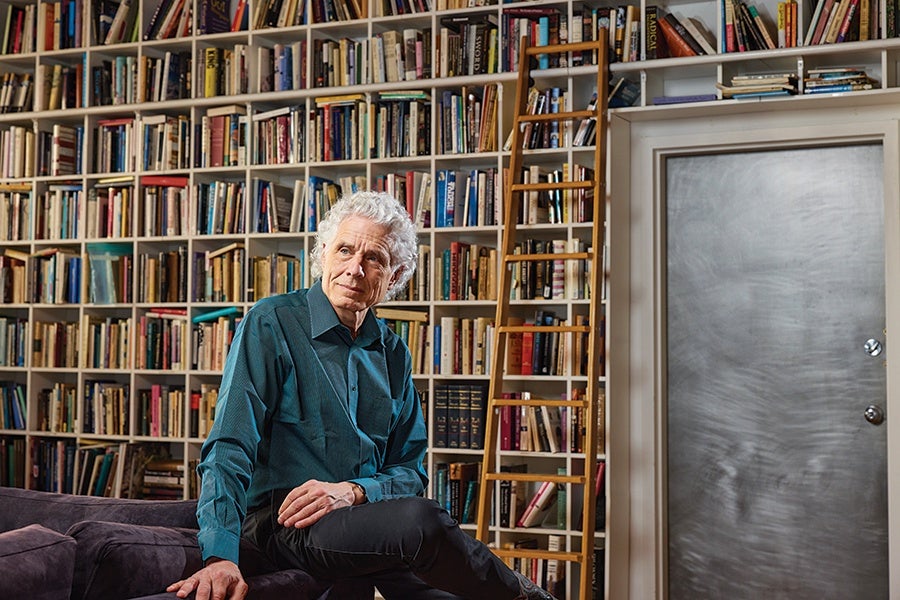
“I am after, just relentlessly after, clarity,” says Pinker, shown here in his Cambridge home. / Photo by Ken Richardson
But why take this sort of thing on, given the risk?
The Blank Slate was much praised for opening up the nature-nurture debate—it was shortlisted for the Pulitzer, but it also garnered some now-wait-a-minute reviews that sometimes attacked Pinker for oversimplifying things. Louis Menand, author of The Metaphysical Club, a Pulitzer-winning intellectual and cultural history of late-19th- and early-20th-century America, reviewed the book skeptically in the New Yorker. Pinker’s villains, Menand wrote, were “social scientists, progressive educators, radical feminists, academic Marxists, liberal columnists, avant-garde arts types, government planners, and postmodernist relativists.” His heroes were cognitive scientists and ordinary folks. “I wish I could say that Pinker’s view of the world of ideas is more nuanced than this,” Menand wrote.
It isn’t just Pinker’s conclusions that have drawn fire—it’s his method. “By far the nastiest and most aggressive academic responses I have seen come from humanities professors when there are ideas from the sciences that they see as encroaching on their territories,” Pinker told the Chronicle of Higher Education in 2019. “That’s when you get rage and withering condescension.” It’s not hard to find.
Samuel Moyn, a professor of law and history at Yale, reviewed Enlightenment Now for the New Republic, arguing that Pinker’s conclusions were too narrow. “Behind this self-styled posture as a man of evidence and science,” Moyn tells me, “I think he’s a man of faith who won’t confront the evidence that doesn’t go his way. I think there’s so much that he’s sweeping under the carpet that it’s hard not to wonder what could lead him to extrapolate from a few data points to a big theory that’s so simple-minded.”
And Daniel Smail, a Harvard history professor, wrote a withering takedown of The Better Angels of Our Nature for an academic journal, dismissing Pinker’s optimism about civilization as naive. His verdict: “Better Angels is not a work of history. It is best understood as a work of moral and historical theology.”
Pinker, as is his way, calmly rejects the Moyn and Smail appraisals, though he admits this sort of thing makes him angry, and small wonder why: The accusations that Pinker is “a man of faith” or that he was writing “historical theology” strike at the most basic underpinning of his approach: Chasing the facts as he finds them, on the way to making his case for the way things really are. The charge, essentially, is that Pinker is guilty of his own my-side bias. “Those reactions of both Moyn and Smail, I think, are outrageously false,” Pinker says.
Pinker has his defenders in academia, too. David Buss, an evolutionary psychologist at the University of Texas, calls Better Angels “extremely accurate. People have criticized that work, and I think unfairly, because it just violates all of our intuitions.” And even Moyn gives Pinker credit for “advancing the public conversation” in writing “accessibly” for a broad audience.
In other words, the debate over Pinker’s work has never really been settled—it’s ongoing, and it’s personal.
This isn’t for the faint-hearted, being a lightning rod, especially given the past decade’s atmosphere. In late 2017, for instance, during a panel discussion at Harvard about free speech, Pinker said, “Political correctness has done an enormous amount of harm in the sliver of the population that might be—I wouldn’t want to say ‘persuadable,’ but certainly whose affiliation might be up for grabs. The often highly literate, highly intelligent people who gravitate to the alt-right: Internet savvy, media savvy, who often are radicalized in that way.” Pinker was actually arguing that by shutting down debate, the left was pushing smart, contrarian people toward the alt-right—not because the alt-right was correct, but because it was the only place willing to engage certain questions.
Still, the right had a field day. Neo-Nazi website the Daily Stormer ran a headline that read, in part: “Harvard Jew Professor Admits the Alt-Right Is Right About Everything.” The left hammered Pinker for giving ammunition to extremists, regardless of his intent.
And this is the pattern: Bad actors and dark thinkers have appropriated Pinker’s research and writing for their own ends—and Pinker has done little to stop them.
Charles Murray, coauthor of The Bell Curve in 1994, which linked IQ differences among races to genetics, has since cited The Blank Slate to support his views. Last year, Pinker appeared on the Aporia Podcast, an outlet that supports a revival of race science. In 2024, the Guardian reported that one of Aporia’s cofounders, Matthew Frost, once said that he’d been recruiting mainstream writers to give the podcast “legitimacy via association.” Pinker gave them an hour. After the Guardian chastised him for appearing on Aporia, Pinker told the newspaper he only agreed to be interviewed after the outlet “attacked” his views on human progress. He also said he believes it is vital to persuade audiences one disagrees with, which is why he appears in media with diverse political orientations.
Pinker likes to say he manages his “controversy portfolio carefully.” But that means the trouble he might get into—not the trouble he creates for others by lending his credibility to people like Murray, with whom he engages rather than dismisses. Late last year, he and Murray had a back-and-forth in the Wall Street Journal about Murray’s views on “terminal lucidity” proving the existence of the soul; Pinker, ever skeptical of faith, chastised Murray for reaching beyond the data. But the debate itself was the point: Whether Pinker won the argument didn’t really matter—Murray got the platform, a serious intellectual exchange with a Harvard cognitive scientist.
Nicolas Guilhot, a professor of intellectual history at the European University Institute, has long tracked Pinker’s thinking and writing (including a tough review of Enlightenment Now in 2018 for a diplomacy and foreign policy journal). I asked him whether Pinker bears any responsibility for how his work gets used.
“Of course he can’t prevent people from running with his ideas,” Guilhot told me in an email. “But he is at the very least cavalier about what he knows are the possible—and probable—implications of the views he peddles. This is all the more problematic because there are no progressive policies to point to that would latch on to his view of human nature, while there is a plethora of right-wing and reactionary agendas that are based on it. None of this is an accident, and Pinker is very much a participant of the recent restoration of a deterministic idea of ‘nature’ that has seamlessly connected neoliberal projects (of which he is definitely a representative) to reactionary ones.”
I put this to Pinker directly: You insist on following evidence wherever it leads. Do you take any responsibility for who has followed your work—and where they’ve taken it?
“If I have been misleading or unclear in a way that would egg on deplorable actors, I would take responsibility for that,” Pinker says. “But if I express things perfectly clearly—there’s a huge world out there. I can’t take responsibility for how some random person out on Twitter interprets a paper or an interview if there’s no content in the interview that would actually egg on or encourage them. And I can’t boycott every forum whose members hold some opinion that some third party finds repugnant.”
Then, of course, there is Jeffrey Epstein.
Epstein collected heavyweight intellectuals, and in terms of funding and gifts seemed to have a particular affinity for Harvard. Pinker attended a few gatherings where he was present, but claims he never liked Epstein.
In 2008, Pinker’s friend and Harvard colleague Alan Dershowitz defended Epstein, who had been charged with soliciting prostitution from a minor. Dershowitz had consulted Pinker for help interpreting the wording of a statute concerning the use of the mail to solicit minors to engage in prostitution or sexual activity. For that crime, Epstein pleaded guilty and served 13 months in prison.
Pinker says he doesn’t blame Dershowitz for defending Epstein, nor does he believe he did anything wrong by helping interpret the law. “I believe in the Sixth Amendment’s guarantee of legal representation of the accused,” Pinker says. “If I had known then what I know now about the extent of Epstein’s crimes, and that it would be used in his defense, I might have second thoughts.”
But Pinker got an early clue about just who Epstein was, and it didn’t stop him from showing up.
In the Epstein document trove released by the U.S. Department of Justice, more than 430 results mention Pinker—often emails about events Epstein buddies John Brockman, Pinker’s literary agent, and theoretical physicist Lawrence Krauss wanted Pinker to attend (many emails are included several times). The only one from Pinker himself—to an Epstein assistant in March 2012, four years after the conviction—said he’d be “delighted to meet with him” when Epstein visited Harvard. “I probably shouldn’t have said yes,” Pinker says now, “but I was being polite—he was a donor to Harvard.” (Pinker says they didn’t ultimately meet up.)
In 2014, as part of a project he was working on, Krauss invited Pinker to help organize a conference at Arizona State University on the origins of violence after the publication of Better Angels. At the end of the event, Krauss asked Pinker to allow Epstein to come say hello, Pinker says. Someone snapped a picture, which now lives online.
“I would not have agreed to do anything that was associated with Epstein or branded with him,” Pinker says. “If I was perhaps more assertive, maybe less polite and Canadian, when Krauss said, ‘Will you let Epstein come over to your table and sit down with you?’ I could have said no. Probably I should have said no. I didn’t say no.” He also didn’t say no to organizing a conference largely funded by Epstein.
Pinker dismisses criticism of his connections as guilt by association—whether it’s Murray or Epstein, he insists that proximity isn’t endorsement. But the pattern is visible: years of polite yeses, a willingness to lend his credibility to people and platforms that most academics would avoid. At some point, the accumulation starts to speak for itself.
Which brings us back to Harvard—and whether Pinker is the right person to lead the university out of its current trouble.
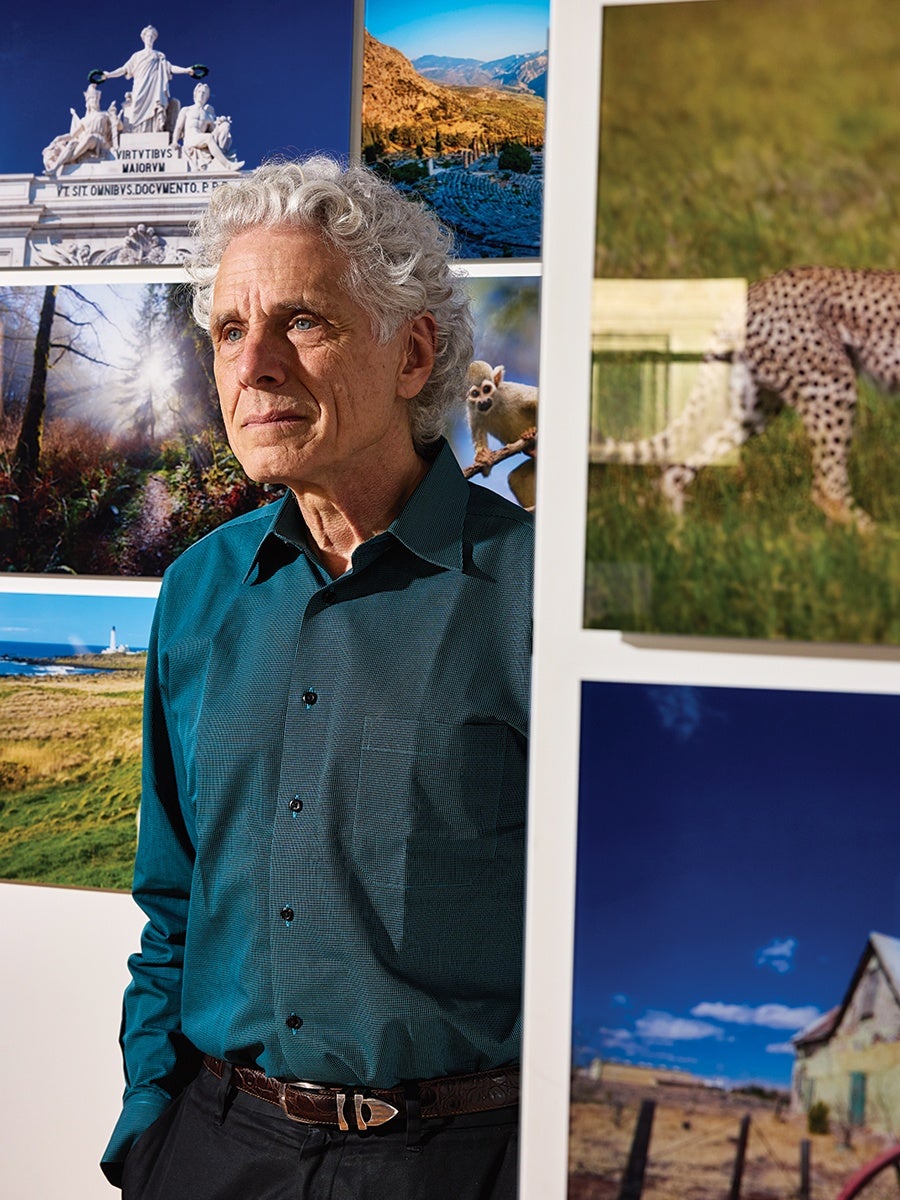
Pinker, part of the Council on Academic Freedom that has been shaping policies at Harvard, has both critics and defenders in the world of academia. / Photo by Ken Richardson
The most important piece that Pinker has written about Harvard—and, really, higher education in general—was “Harvard Derangement Syndrome” last year for the New York Times, as the Trump administration’s threats on funding and problems within the university coalesced. It was a cry for sanity and a path forward. He prefaced it with: “I’m hardly an apologist for my employer when I say that the invective now being aimed at Harvard has become unhinged.”
Pinker pointed out that he had written “The Trouble With Harvard” for the New Republic back in 2014, which called for an admissions policy based on merit and took on the idea that professors should be engaged in their students’ self-discovery: “Perhaps I am emblematic of everything that’s wrong with elite American education, but I have no idea how to get students to build a self or become a soul.” In 2023, he wrote a five-point plan for the Globe on how Harvard could save itself, and “How I Wish Harvard Taught Students to Talk About Israel,” the piece that first caught my eye, along with others on problems at the school.
In “Harvard Derangement Syndrome,” Pinker made the case for proportionality. Yes, Harvard has serious problems—he’d been saying so for years. The appropriate treatment, Pinker argued, was to diagnose which parts need which remedies—not to “cut its carotid and watch it bleed out,” as he believed Trump and his allies were attempting to do. The school’s core mission was at risk, Pinker argued: If there’s fear of asking certain questions, then research is crippled, just as it would be by the government slashing funds to conduct it. And that funding is not a privilege for Harvard, but necessary to help us advance our understanding in any number of big ways.
Pinker ended his piece with a sort of call to arms, quoting physicist David Deutsch: “Everything that is not forbidden by laws of nature is achievable, given the right knowledge.” To cripple the institutions that acquire and transmit knowledge, Pinker wrote, “is a tragic blunder and a crime against future generations.”
But writing op-eds is one thing. Could Pinker actually change anything?
In 2023, Pinker and five copresidents, along with dozens of other Harvard faculty, formed the Council on Academic Freedom at Harvard, made up now of some 200 members, which regularly challenges university policies and pushes for change. For Pinker and others on the Council, evolutionary biologist Carole Hooven essentially getting driven out of Harvard as a lecturer was a turning point—she had said in an interview in 2021 that the biological definitions of male and female are essential to science, then was summarily accused of transphobia, the fallout of which continued into 2023. “That’s kind of what DEI officers are empowered to do,” Pinker says: “The fact is, there is very little racism, misogyny, homophobia, and transphobia on modern university campuses, especially in a Northeastern elite university like Harvard. So there’s actually nothing to root out—they’re going to have to be increasingly ingenious and energetic in interpreting things as transphobic so that they’ve got something to do.” Hooven had been Pinker’s teaching assistant as a graduate student, and he ended up bringing her back as an associate in his lab at Harvard.
A week before Christmas in 2023, two members of the Harvard Corporation, Paul Finnegan and Tracy Palandjian, asked members of the Council to join them for a private dinner at Bar Enza in Cambridge. It was a shocking invite: The Corporation runs Harvard, and they’re notoriously secretive. “It’s almost like the Politburo-watchers in the era of the Soviet Union,” Pinker says. “But this was at the moment of the university’s deepest crisis.” Then-president Claudine Gay was getting hammered for her handling of demonstrations over the October 7 Hamas attacks on Jews in Israel; she had testified before Congress two weeks earlier, and in early January, she would resign. “In a rare moment of openness, the Corporation was actually soliciting some faculty opinions,” Pinker says. Like a principal calling the mouthiest students down to the office to ask: How do I run this place?
The meeting was cordial, but Pinker and three other Council members were direct: “Large sectors of the country hold Harvard in contempt,” Pinker says he told Finnegan and Palandjian. “This is the Corporation’s problem.”
The meeting warranted an article in the New York Times a couple of days later, which didn’t please the Corporation; Pinker says the Council didn’t reach out to the paper. But he didn’t mind the exposure, writing to his Council colleagues (and sharing the emails with me): “They’re a legitimate target of reporting by the national media—the days when they could run Harvard like a private blue-blood Bostonian club are gone.” And this: “The public has a legitimate interest in knowing what led to this mess, and the Corporation is part of the story. To be honest, they screwed up in picking Claudine, they probably screwed up in keeping her, they screwed up in their plagiarism investigation [of her], including threatening the New York Post with a defamation lawsuit, and they screwed up in their public pronouncements.”
It was clearly go time, with Pinker leading the charge. His involvement and directness have given other faculty the courage to take public stands. Eric Maskin, the Nobel-winning economist and a copresident of the Council, puts it this way: “Steve has been effective within the Harvard community in emboldening people who were inclined in that direction not to shut up.” An interesting admission: that a Nobel laureate would think twice about the risk before speaking out.
The Council had only the one direct meeting with the Corporation. But they were just getting started. Pinker and former Harvard Medical School dean Jeffrey Flier kept writing occasional opinion pieces and worked back channels, especially through private conversations with Alan Garber, the president who replaced Gay; he proved much more open to their initiatives. The Council pushed for applicants to faculty jobs in arts and sciences to no longer be required to write diversity statements, “which pretty clearly,” Pinker says, “eliminated anyone who isn’t a woke ideologue or a skilled liar.” The Council also pushed for institutional neutrality on issues that don’t directly affect the university, given how Harvard got into trouble, in particular, for Gay’s waffling rhetoric on demonstrations over the war in Gaza.
Both initiatives were adopted by Harvard.
Within Garber’s first few months as interim president after Gay resigned, he formed a working group on open inquiry and constructive dialogue at Harvard. It’s impossible to say how much the Council’s pressure—the op-eds, the behind-the-scenes meetings with Garber—got the ball rolling, but the working group’s report that October was clear in concluding that the lack of open inquiry is a crisis for higher education.
For Harvard to officially admit that, Flier says, is a big deal, and he is enthused: “Every time I write an article or an op-ed, I wonder ‘Will someone try to cancel me or destroy me now?’” Flier says. “That is less common today because there’s more awareness of this and there’s more opposition to it, and the people who used to do it are more afraid of doing it now. That is a huge change. And unless you lived through it, you wouldn’t see the change.”
Pinker is more cautiously optimistic. “I see green shoots,” he says. In his “Harvard Derangement Syndrome” piece, Pinker wrote, “Young people are shaped by peers more than most people realize.… In many cases, students’ politics are no more attributable to indoctrination by professors than are their green hair and pierced septums.” What can you do about that? Yet at least both the Corporation and Garber are speaking the Council’s language now, in public statements on academic freedom when Garber’s tenure was extended beyond 2027. “I think he was always on board,” Pinker says, “but he would not have prioritized it if not for our pressure.”
The Council will keep looking into graduate student education on academic freedom, Pinker says (given that many undergrads spend more time being taught by grad students than professors), and intellectual diversity of the faculty (affirmative action for conservatives, as Pinker half-jokingly puts it). They also plan to study—per Pinker’s obsession with data—how universities actually work. “Universities are surprisingly ignorant of how universities work,” he says. Pinker insists he’s gotten no pushback at Harvard for any of his public criticisms, or his push now for change.
But the greatest threat to Harvard, Pinker says, is from the outside: “that the Trump administration will attempt to cripple it using every means at its disposal. That with a compliant Supreme Court, it may not even matter if Harvard has the law on its side, which I think it does.”
It’s tough to predict where that will end, or how open to different points of view the university will really become. But something does feel different. The university is on notice. Pinker and the Council will keep pushing—as if taking a page from the wokeness playbook in keeping everybody on high alert. We’re watching.
Pinker is convinced he’s pursuing the truth as he finds it. His method has made him a star. It’s also left a trail of complications.
As always, Pinker is convinced he’s pursuing the truth as he finds it. His method has made him a star. It’s also left a trail of complications—the associations, the bad actors who cite his work, the questions about what doors he’s opened and for whom.
Whether that makes him the right person to lead Harvard out of its current troubles is a question the university will have to answer for itself. Pinker, for his part, shows no signs of slowing down. He carries on as if he is certain his work and beliefs deserve whatever airing he decides to give them.
It brings to mind the line Pinker quotes in The Blank Slate, from Chekhov: “Man will become better when you show him what he is like.”
The question now is whether Pinker applies that same scrutiny to himself and the way he operates. Harvard may be waiting on the answer.
This article was first published in the print edition of the April 2026 issue, with the headline,“Man of Reason.”
This Newton Interior Designer’s Home Is a Masterclass in Slow Decorating
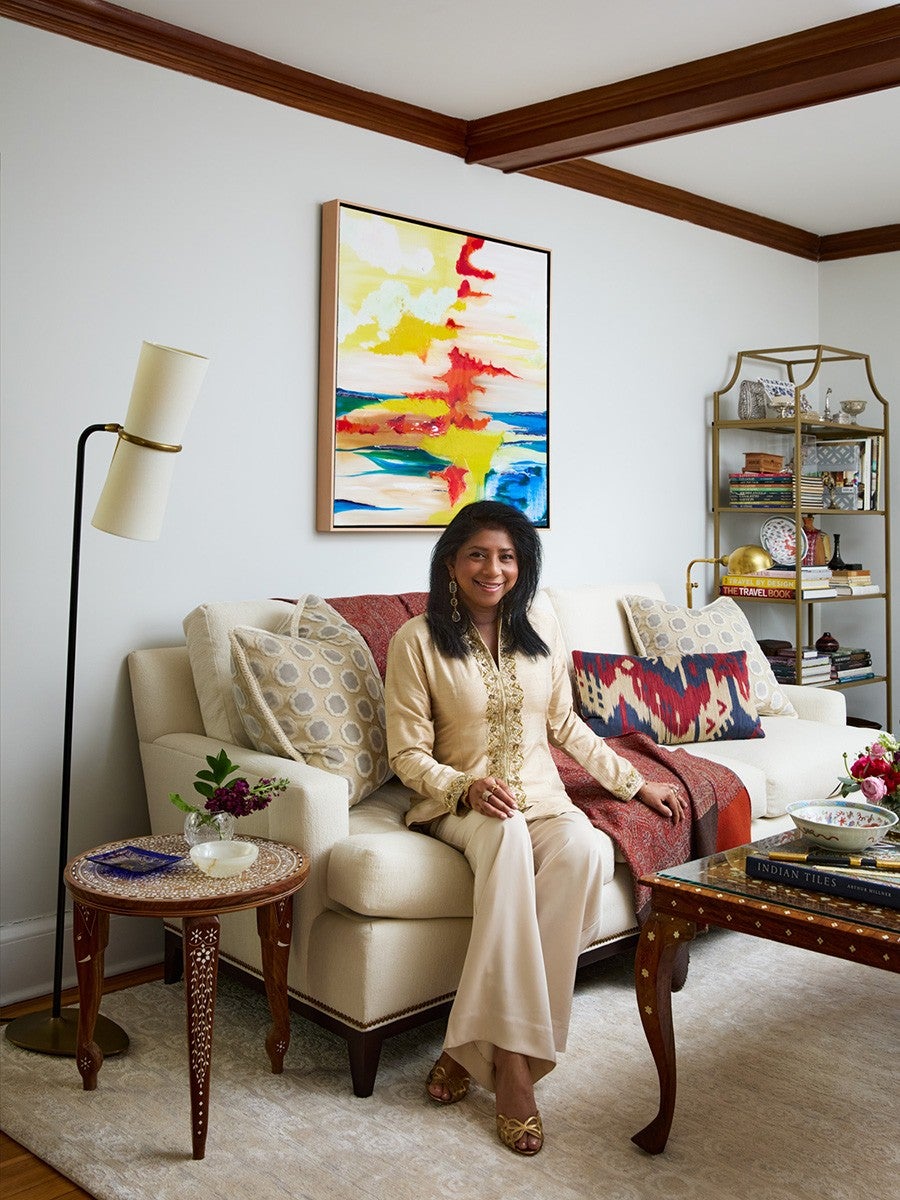
Vani Sayeed sits on her living room sofa, upholstered in fabric by Kravet. The antique Kashmiri coffee table with teak inlay is a family heirloom; the modern floor lamp is by Visual Comfort. The art on the wall is her own creation. / Photo by Jared Kuzia
This article is from the spring 2026 issue of Boston Home. Sign up here to receive a subscription.
The entry foyer to Vani Sayeed’s Newton home is an example of her highly individualistic style. There’s a pair of handcarved Mexican chairs covered in a graphic Manuel Canovas fabric, a marble tabletop inlaid with lapis from India, a grand gold-leafed Spanish mirror, and a bow-front antique American dresser holding a marble-composite Venus de Milo that is most likely from Italy. All are grounded by a Turkish rug.
“Those Mexican chairs have been refinished three times,” says interior designer Sayeed. “Ten years ago, I bought the table on a whim; then it sat in storage for eight years. The mirror was a vintage find. The pieces are from all over the world, symbolic of a global sensibility.”
Sayeed embodies that global sensibility. Born in India, where she trained as an artist, she came to the United States as a young adult. After graduating from the University of Iowa, she launched her interior design career in San Francisco. Eighteen years ago, she, her husband, and two children moved to their Newton home, where she grew her business and brought personality to the 1,668-square-foot, three-bedroom, three-and-a-half-bath Dutch Colonial house built in the 1920s.
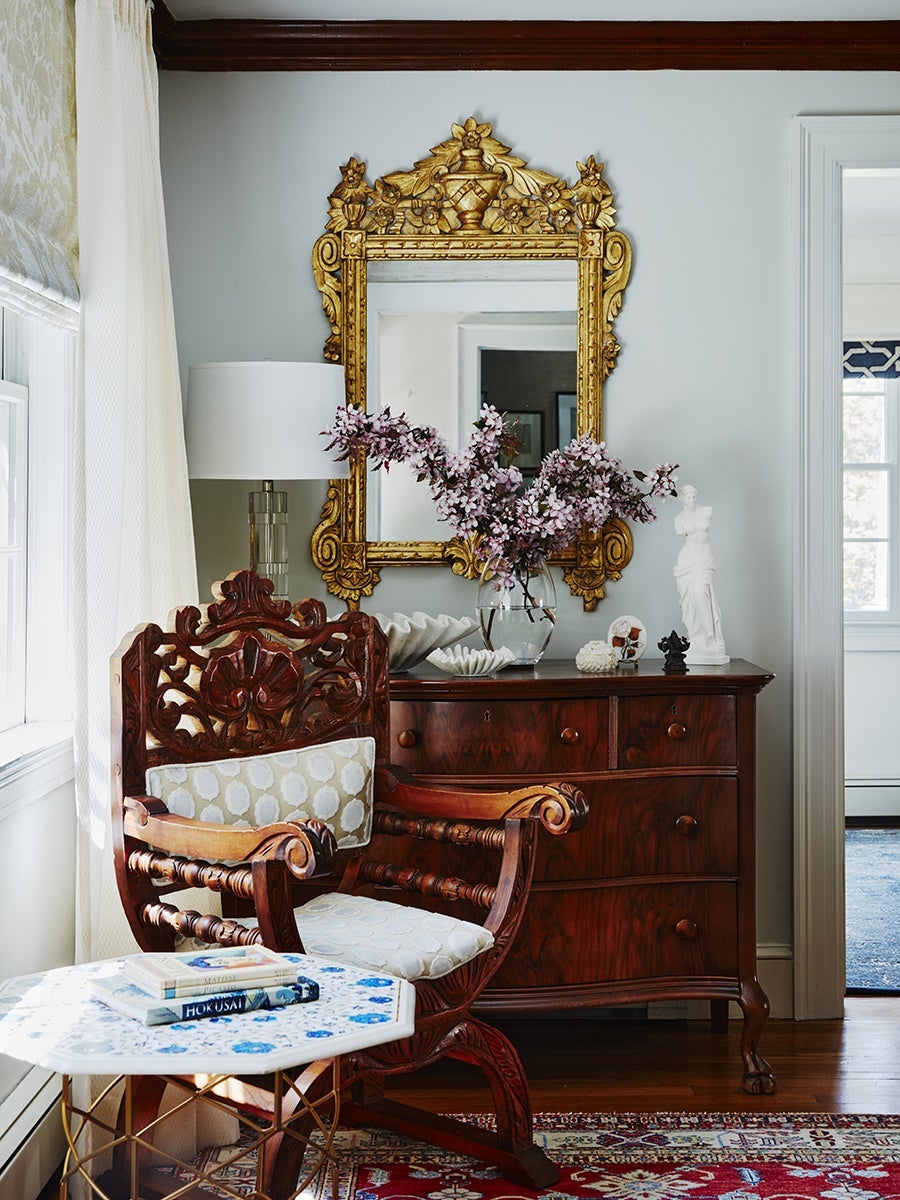
The entry foyer is furnished with a happy mix of pieces collected over time and all over the world, including an antique American chest, a lapis-inlaid tabletop from India, a Spanish mirror, and a carved Mexican chair. / Photo by Jared Kuzia
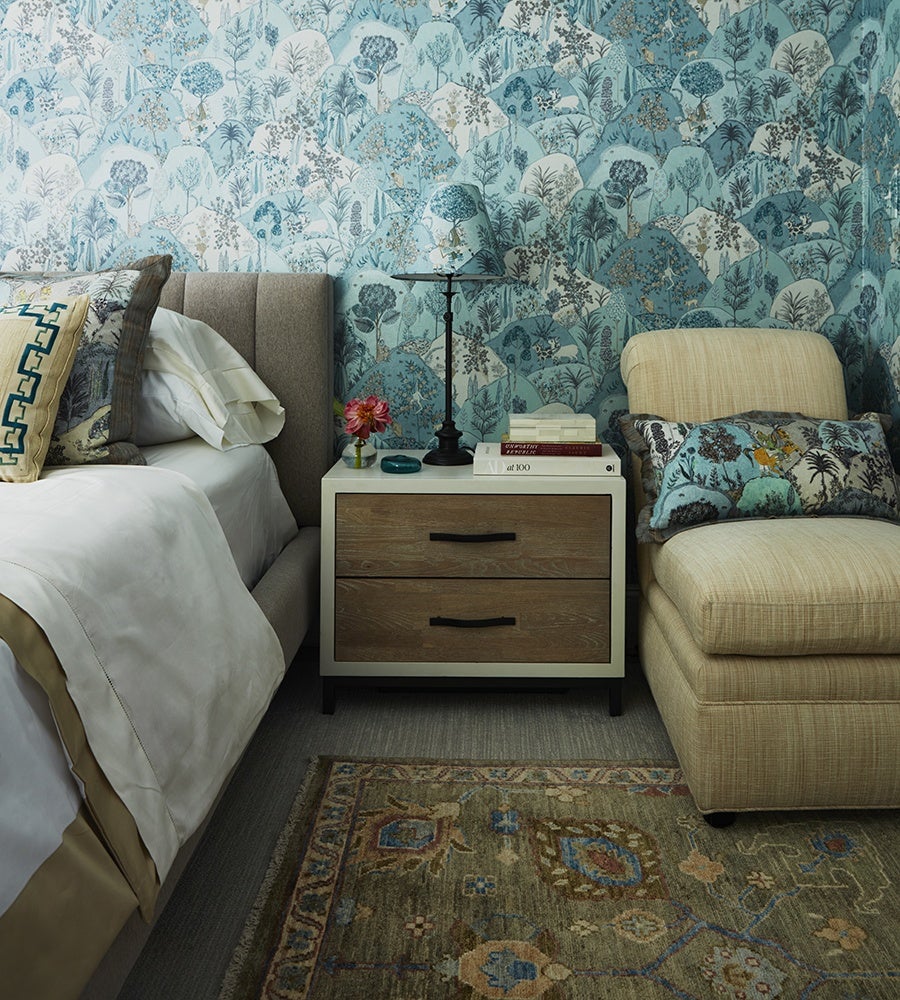
For the accent wall behind the bed in the primary bedroom, Sayeed chose a favorite landscape-inspired paper by Matthew Williamson for Osborne & Little. The pattern also covers throw pillows and lampshades. / Photo by Jared Kuzia
“When we purchased the house, it lacked character and style,” she says. “But it had good bones. There was no immediate rush to redo it; we had two small children, and we had to live in it to learn what the house needed.”
Living here soon taught her that the primary bedroom needed an en suite bath. Sayeed converted two closets into a bathroom, carving out a niche for a custom cherry vanity. Over time, she installed air conditioning, renovated the other bathrooms, and made upgrades to the kitchen with a new breakfast nook, counters, and backsplash.
“But we did not change the classic layout,” Sayeed says. “I like having separate rooms, with a dining room for formal entertaining and a living room where guests can gather.”
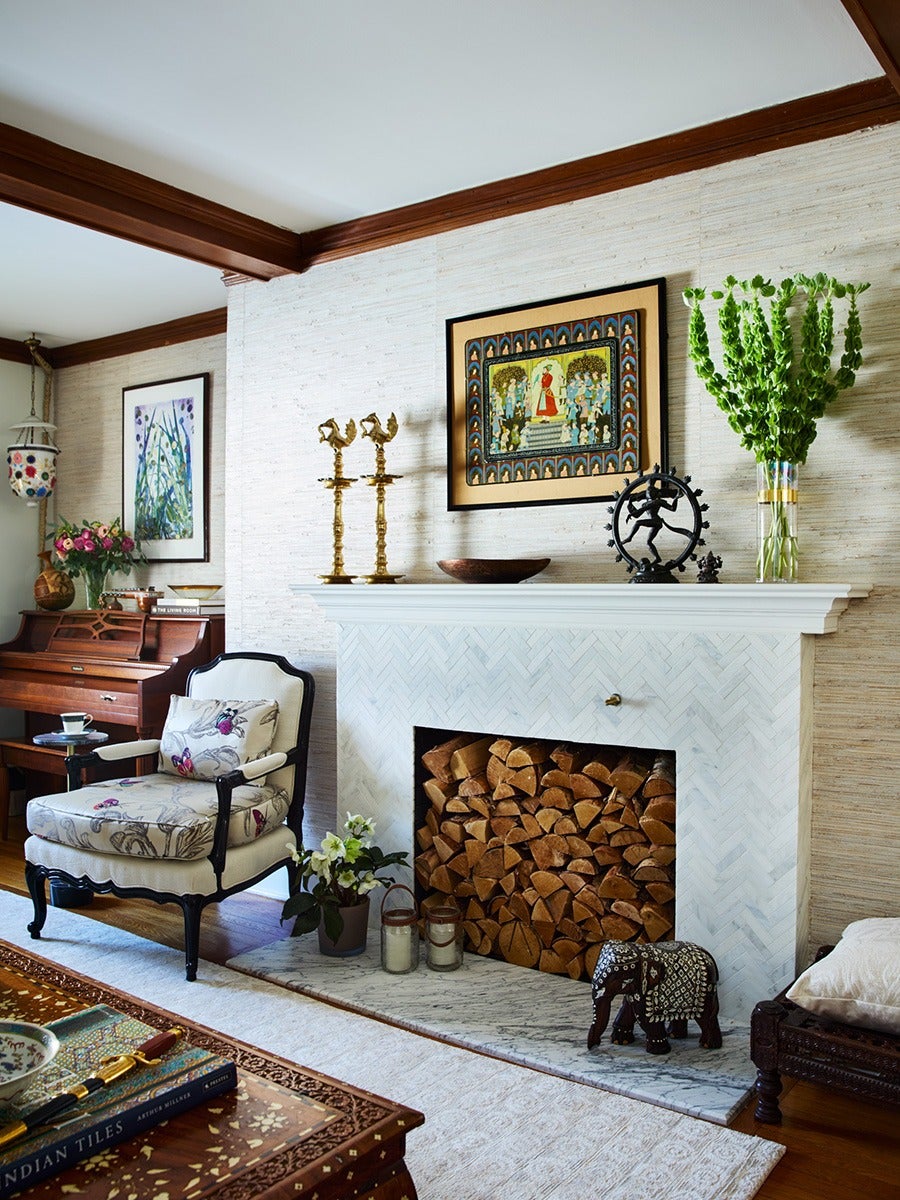
Above the living room fireplace, Sayeed displays a family heirloom, an Indian miniature painting. An antique fauteuil chair is upholstered with fabrics by Rubelli and Kravet. The paper on the fireplace wall is by Phillip Jeffries. / Photo by Jared Kuzia
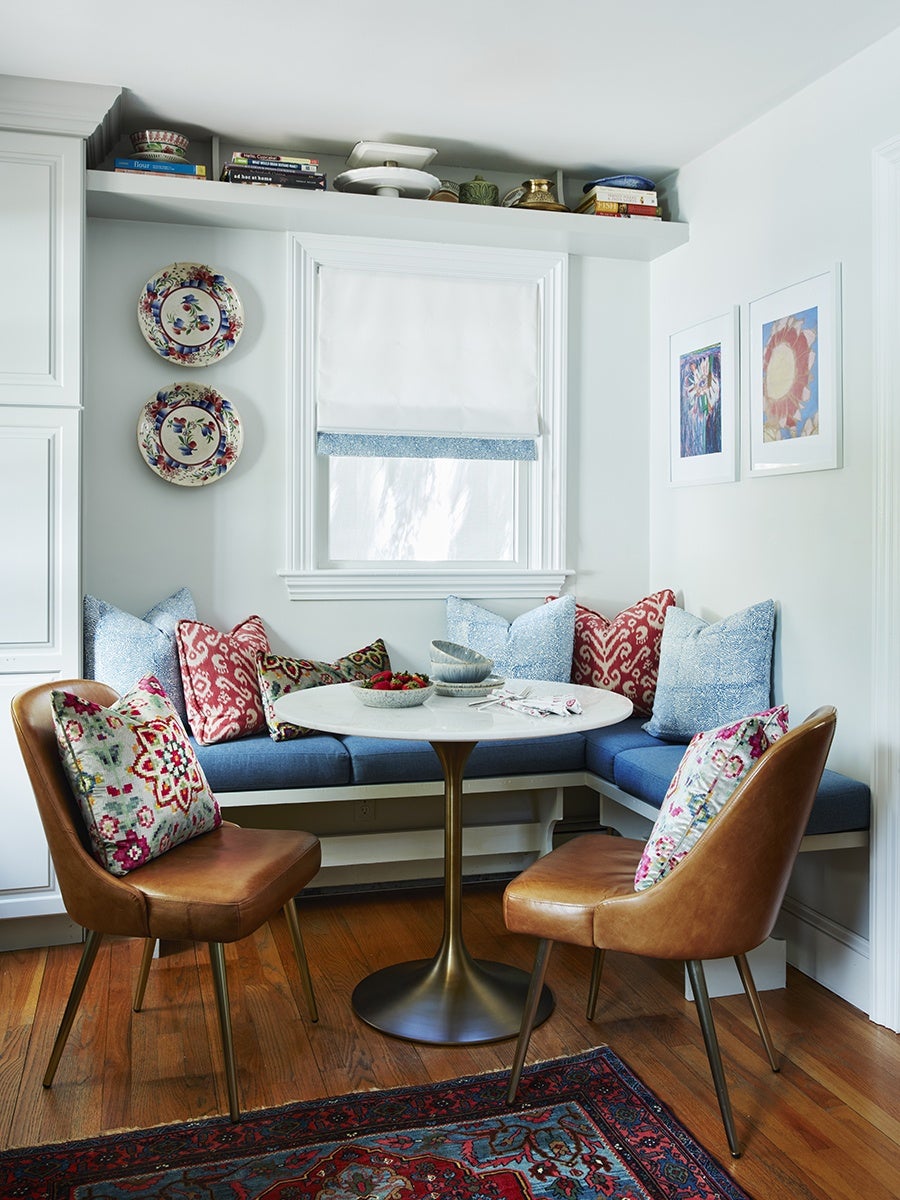
The breakfast nook is colorful and personal, with a built-in settee designed by Sayeed, plates that were her mother’s, and art created by her daughters when they were in kindergarten. / Photo by Jared Kuzia
Today, each of the rooms is a colorful, eclectic mélange featuring graphic wallpapers in saturated colors; family heirlooms; paintings by Sayeed, her children, and her artist friends; and classic pieces of furniture. The dining room, for example, combines a simple table and chairs with grasscloth wallcovering, a carpet in a saturated shade of red, and a ceiling papered in gold.
“The light reflecting off that ceiling paper makes people look good; everyone just glows,” Sayeed says. “That’s a great thing at dinner parties.”
She notes that her design process is reflective of her experiences and stories and, as such, never ends. She calls it “slow decorating.”
Her travels have taught her to appreciate a range of styles. “It’s a testament to my love of family, travel, my immigrant story, and my passion for collecting and design.”
“I love New England’s old houses, but I also really enjoy modern architecture: there’s a lot of beauty in all of it. The one thing I do not want is to be a conformist. When I create an environment for people, I see the world through their eyes,” she adds. “Each person’s home should be as individual as their personality. You should never be afraid to express yourself. After all, where else can you experiment if not in your own home?”
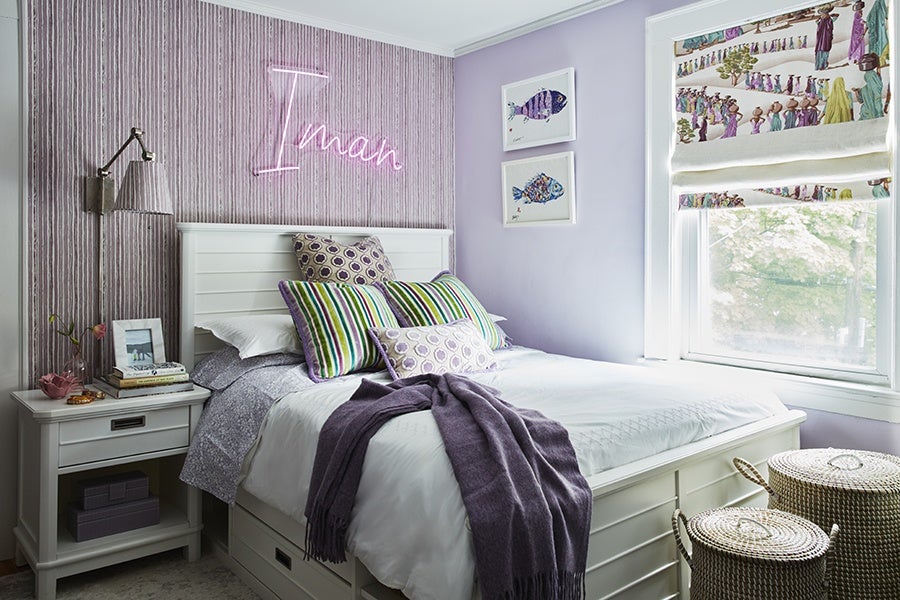
In a daughter’s bedroom, a Cowtan & Tout fabric pays tribute to the history of women and girls who walked for miles carrying water in Rajasthan. / Photo by Jared Kuzia
First published in the print edition of Boston Home’s Spring 2026 issue, with the headline “Life on Display.”
Do I Have to Run the Boston Marathon to Be a Real Bostonian?

Illustration by Dale Stephanos
Welcome to “The Salty Cod,” a monthly column in which humorist Steve Calechman grapples with uniquely New England dilemmas.
God, I hope not, because I screwed up big time. I grew up on the course, right at the top of Heartbreak Hill, and watched pretty much every race during my childhood, and nothing, not the chance to eat a lot of pasta or run by my own house, ever made me want to do it. Then again, not everyone who grows up in Winthrop becomes a pilot.
And that’s fine. We don’t have to do or like all sports. And marathons, especially, are nothing to trifle with. You can’t just show up at the starting line on a whim. You gotta run a lot. You gotta run outside in January. And you never hit a downhill and get to coast for a mile. It really is all you.
Some of us are happy to be on the sidelines and remind you of just that. Think about it, runners. I know you feel you’ve done something medal- and massage-worthy at the end, and maybe you have. But without the crowds, that Monday is just 26.2 miles on concrete. Are all the splits and intervals and lost toenails still worth it? Now think about what those fans are going through. Standing—most likely sitting—for three, four hours, cheering “You got it!” over and over and over again, meaning it each and every time, even making the effort to occasionally decipher your shirt in order to say, “You got it, Mike!”—all while not spilling a drop of their chili. Sometimes it’s also drizzling, maybe a touch chilly, and they still don’t quit. Who’s the marathoner now?
We all are. Is it the classic definition of one? No. But there are a lot of ways to be part of something. Sometimes it’s hoofing it. Sometimes it’s yelling supportive stuff at people we don’t know. But the thing we have in common is that we both willingly keep coming back because it makes us feel good. If it didn’t, we wouldn’t. “It’s not rocket science,” says Jeff Brown, psychologist for the Boston Marathon’s medical team and author of The Runner’s Brain.
It’s the basis for most traditions and rituals, and it’s a way to make something feel like ours. So no, you don’t have to run to be a part of the marathon. Now, a question for you, readers. What’s one of your traditions that could only happen here, one you wouldn’t miss for all the pasta in the world?
Got a question for the Salty Cod? Send it to [email protected].
Previously: Should Actual Bostonians Ever Go to Cheers, Faneuil Hall, or Mike’s Pastry?
This article was first published in the print edition of the April 2026 issue, with the headline,“Do I Have to Run the Boston Marathon to be a Real Bostonian?”
Wellness Hangouts Are the New Happy Hours

Illustration by Jeannie Phan
For years, wellness was a solitary pursuit—early-morning workouts, solo spa appointments, quiet meditation apps. Now, a more collective approach is taking hold, reframing self-care as something to be shared. From candlelit sound baths to evening spa takeovers to communal ice baths, group wellness experiences are emerging as a new way to socialize—one rooted in restoration rather than reservations.
At the forefront locally is Spa After Dark, a new monthly series at the Spa at Mandarin Oriental, Boston. Held on the third Wednesday of each month, the hotel opens the spa after hours for a guided contrast-therapy experience designed to be both social and deeply restorative. Guests rotate between the sauna, vitality pool, and cold-water immersion under the direction of a trained professional, who enhances the sauna ritual with essential oils poured over hot stones, creating waves of aromatic heat.
Spa director Heather Hannig says the concept grew from her own love of thermaculture—the ancient practice of alternating heat and cold for physical renewal. When she started working at the property last year, she realized that the spa’s private suite, sauna, and soaking pools made it possible to translate that ritual into a shared, guided activity. The goal was to create something experiential rather than transactional: guests in swimsuits moving through multiple rounds of heat and cold, then lingering in lounge spaces to rehydrate and connect.
The shift to a more social experience—complete with nonalcoholic beverages, electrolyte-rich drinks, and food designed to support the body—was intentional. “As opposed to a dinner out or a bar experience, we were seeing that there’s an appetite for more group experiences that are wellness-focused, where people can socialize in this setting,” says Danielle McNally, director of marketing and communications for Mandarin Oriental, Boston.

Courtesy Remedy Place Boston
This desire for collective wellness extends beyond hotel spas. At Remedy Place Boston, guests gather for communal ice baths, sauna sessions, and breathwork in a sleek, club-like environment that prioritizes recovery and connection. Release Well-Being Center in Westborough similarly taps into the power of group energy through workshops featuring sound baths, singing bowls, and guided practices aimed at nervous-system regulation. After all, these days, social currency isn’t about cocktails—it’s about how good you feel the next morning.
This article was first published in the print edition of the March 2026 issue with the headline: “The New Happy Hour.”
Related: Is Wellness Culture Ruining Social Fun?