Boston’s Newest Steakhouse Is an Intimate, Underground Space
The Zebra Room opens beneath sibling spot Yvonne’s, with 10 cozy tables, nostalgic vibes, and a secret entrance.
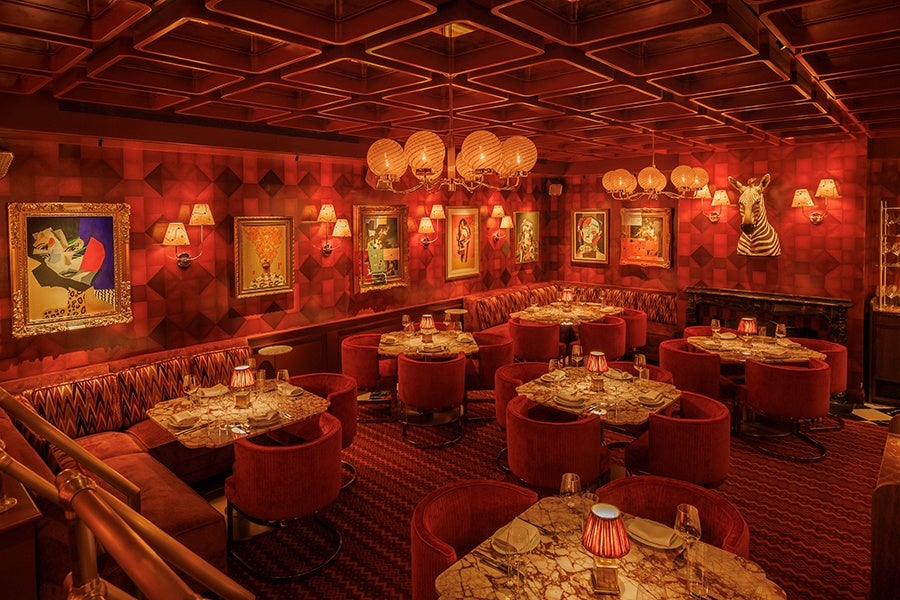
The Zebra Room. / Photo by Josh Jamison
Has anybody ever walked into a white-tablecloth steakhouse and thought, more wood paneling, please? Chris Jamison is betting you haven’t. And with the Zebra Room, opening downtown April 15, the COJE Management Group CEO hopes to add a unique spin to the Boston steakhouse scene with a “nontraditional take in a more intimate, laidback setting,” he says, complete with 1970s vibes, very cold martinis, and an atmosphere that “feels more like a living room than it does a restaurant.”
With a hefty array of nightlife-leaning restaurants and venues under their belts (including Mariel, Coquette, and Yvonne’s), the COJE team has set out to create something a little more grown-up here in the space below Yvonne’s, a focus that started with their late 2025 opening of the cozy sofa-filled cocktail lounge My Girl in Boston’s Post Office Square. (“I’m 42 now, and how do I want to spend my nights?” Jamison said at the time. “Going to dinner, and then going somewhere with a good soundtrack, sitting back, and grabbing some martinis.”) The Zebra Room takes it a step further: “This is a restaurant and dining bar first, a major departure from what we’ve traditionally done,” says Jamison, whose other venues tend to feel nightclubbier. “We’re trying to hit some notes for the cross-section of our clientele who have been asking for something like this for a long time.”
Beneath the main level of sibling restaurant Yvonne’s, the Zebra Room is hidden through a secret bookshelf door inside Yvonne’s subterranean Library, in a room that has gone through a couple iterations over the years, most recently as an event space called the Gallery. “Over the last year or so, we kept thinking that there was an opportunity to use the space better,” says Jamison. “We’ve seen an interesting trend [domestically and globally] toward much smaller, higher-touch restaurants. All of ours are huge.” So, the Zebra Room was born. “It’s a wholesale departure from what we’ve seen for steakhouses in Boston,” says Jamison, particularly size-wise, with just 10 tables and a small bar. (The tiny Bogie’s Place nearby, tucked between the Wig Shop cocktail bar and JM Curley, is another rare exception.)
The design, too, is meant to subvert Boston steakhouse expectations: “There’s a common thread of huge, corporate-forward spaces with wood paneling, the boys’ club [ambience],” says Jamison. “We designed this beautiful room [to be] super intimate, elegant, and comfortable, sort of a throwback to the 1970s ‘conversation pit’ vibe.” That means the dark red space is full of lots of soft surfaces, from banquettes to carpets, says Jamison. “The whole room is full of fabric.” Bold patterns on the wallpaper, floor, and furniture contrast the softness, along with colorful contemporary art by Junar Rodriguez, Halim A. Flowers, King Paris, Eser Gündüz, and Francisco Valverde.
Several food references go back a century further than the design, an homage to the iconic Locke-Ober, the restaurant that stood for over a century in the space that now houses Yvonne’s and the Zebra Room. The 1875 salad—endive, radicchio, blue cheese, bacon lardons, Medjool dates—is named for Locke-Ober’s founding year. And there’s lobster Savannah, a Locke-Ober signature that lands on the Zebra Room menu as two pounds of the shellfish, baked with sherry cream sauce, blue oyster mushrooms, gruyère, and buttered crumbs. Says chef Tom Berry, who runs culinary operations across COJE: “It was really important to capture the essence of a steakhouse without being too formulaic. But we also [wanted to give] a little bit of a nod to Locke-Ober without being too heavily into that.”
One must-try dish, as far as Berry is concerned: onion beignets, “sort of a riff on onion rings without being super crunchy.” It’s essentially a pâte à choux batter, he says, with grated onion, dehydrated onion, and Comté cheese, piped into doughnut molds and fried. The center is filled with boursin crème fraîche, with Ossetra caviar on top. “They’re intense, unique bites, and hopefully people are going to gravitate toward them,” says Berry.
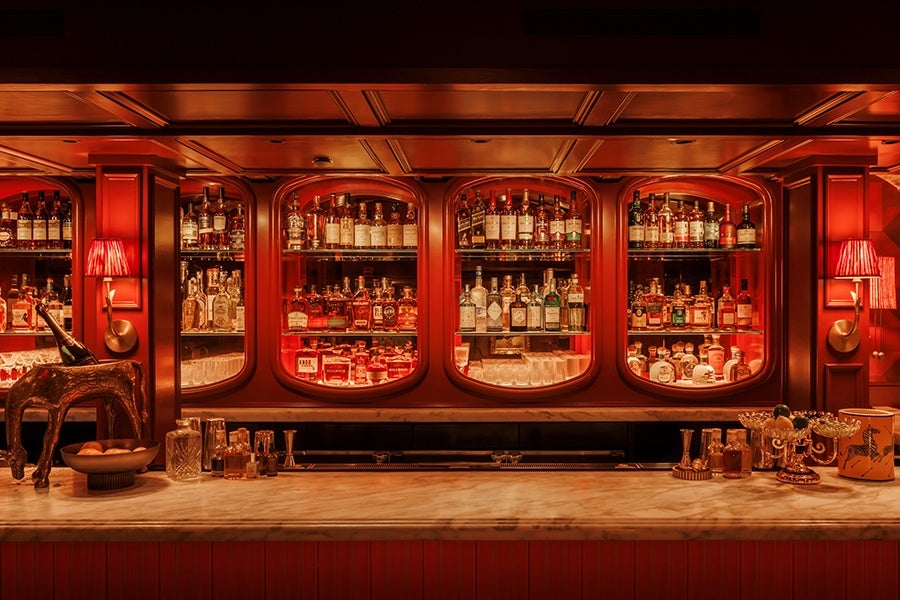
The bar at the Zebra Room. / Photo by Josh Jamison
As for the steaks, it’s “a nicely curated selection of different cuts and also different farms and producers,” says Berry, with options ranging from a Brandt Beef flat iron (“approachable and cooks beautifully,” says Berry) to the Olive Snow wagyu NY strip from Michigan’s Stonefall Farm (“the marbling is just insane,” he says, describing this one as “super premium”—to the tune of $135 for a 12-ounce cut). Among the non-beef options: dry-aged pork chops; a rack of lamb from the Australian company Mottainai, which touts its product as “the wagyu of lamb.” They’re not too gamey and “well-tailored to the American palate,” says Berry.
Sides are important; this is a steakhouse, after all. “I wanted to have a mix of familiar and unique,” says Berry. He’s particularly excited about the “baked potato flattie,” a baked potato squashed paper-thin in a dough press, dressed with salt, cream with thyme and garlic, and Comté, and broiled. “It becomes sort of a hybrid of a loaded baked potato and au gratin,” says Berry, once it’s garnished with boursin crème fraîche, shoestring fries, scallions, and “a bacon upgrade, of course, if you’re interested. Hopefully that’ll be an iconic dish here.”
One of the desserts brings the Zebra Room back around to that 1970s feel: the Watergate sundae, a play on the Watergate salad, which was born of Kraft Foods’ 1970s debut of instant pistachio pudding mix. “Our version is pistachio ice cream with caramelized pineapple, cherries, walnuts, pistachios, and meringue,” says Berry, “a cool riff on the 1970s pudding dessert.”
The cocktail program blends nostalgia with modernity, with COJE’s director of bars Ray Tremblay putting his “signature tweak” on steakhouse classics, says Jamison. The Zebra Negroni, for example, gets added depth from strawberry, rhubarb, and olive oil, while the Fat Cap Manhattan is a complex concoction with wagyu fat and coffee and mole bitters. “We’re doing a big freezer martini program,” adds Jamison: “total subzero, absolutely frozen bottles,” inspired by the Dukes martini in London, which is “the crispest, coldest, purest cocktail you’re ever going to have.”
The wine list, meanwhile, focuses on this side of the pond, with COJE’s corporate wine director Nick Morisi highlighting American picks, particularly Napa. This domestic emphasis is new among COJE’s venues and is inspired by the 50th anniversary of the 1976 Judgment of Paris, in which Californian wines bested French in a blind tasting. Still, there are classic global selections as well, from regions like Burgundy, Tuscany, and beyond.
The Zebra Room’s hidden location, intimate space, and exclusive-feeling reservation system (by request, or through the third-party membership-based Dorsia platform) give the restaurant the feel of a private club. (Incidentally, a private restaurant is among the group’s forthcoming late-2026 projects at the Post Office Square building that houses COJE venues Mariel and My Girl.) But it’s open to the public, as long as you can nab a reservation or, with luck, a walk-in bar seat. It’s poised to be worth the effort: From the 1870s to the 1970s to today, this nostalgic, comfortable restaurant might be just the thing to turn the Boston steakhouse scene on its head.
The Zebra Room opens April 15 and serves dinner Tuesday through Saturday. Reservations are by request or via the membership-based Dorsia platform, with potential walk-in availability for bar seats. 4 Winter Pl. (enter through Yvonne’s), Downtown Crossing, Boston, zebraroom.com.