Why Seth Moulton Is Running Against Ed Markey
The Salem congressman and Massachusetts Senate candidate talks generational change, the North Shore, and more.

Photo by Ken Richardson
Seth Moulton has made a career of picking fights with fellow Democrats—challenging Nancy Pelosi’s leadership, calling for generational change, and refusing to fall in line on cultural debates. So when he announced that he was running against Ed Markey in the 2026 Senate primary, the move felt practically inevitable. The four-tour Iraq veteran, North Shore native and current Salem resident is now making his case for the Senate at a moment when Massachusetts voters are squeezed by costs and increasingly skeptical of anyone in office. We recently spoke with him about term limits, trans sports, Ron DeSantis’s social skills, and whether he’d ever run for president again.
What’s the oddest interaction you’ve ever had on Capitol Hill?
There are, sadly, a number of disreputable people in Congress, but the guy who literally couldn’t even say hi to you was Ron DeSantis when he was in the House.
Aside from family and friends, what’s the thing you miss most about Boston when you’re in DC?
There’s nothing better in Boston than a Sox game in the summer.
People describe DC as a hornet’s nest, a snake pit, a shark tank, a cesspool, a swamp, whatever. What metaphor do you think applies to Washington?
[They say] it was built on a swamp, and sometimes I question George Washington’s judgment in putting it there, but I keep it in perspective by reminding myself that nothing in DC is as hard as Iraq.
What was it that led you to join the Marines just days after graduating from Harvard?
It was Reverend Peter Gomes and his challenge to us students to serve, to do something, to give back. He wasn’t advocating specifically for military service, but when I looked at all the different ways I could serve, I just had so much respect for the 18-year-old kids who put their lives on the line for our country that I felt I should do my part, too.
What was the scariest experience that you had in Iraq?
Well, unfortunately, I had a lot, and I don’t like telling war stories, so I won’t go into the details, but I’ll just tell you that I consider myself lucky to have come back in one piece and think all the time about the guys I served with who did not.
What is the most important lesson that you brought back with you from your military service?
That there are extraordinary Americans who come from wildly different backgrounds all across the country serving together. I mean, my platoon had rich and poor, Black and white, gay and straight. We had different religious beliefs, different political beliefs, and yet we were able to set aside those differences to do what was right for the country. And I want to see more of that kind of leadership and service in America today, including in our Congress.
You majored in physics—do you still read about physics, or do you follow physics magazines?
I don’t read physics magazines, but I love science and keep up with it in the news. I wasn’t smart enough to be a physicist, so here I am in Congress.
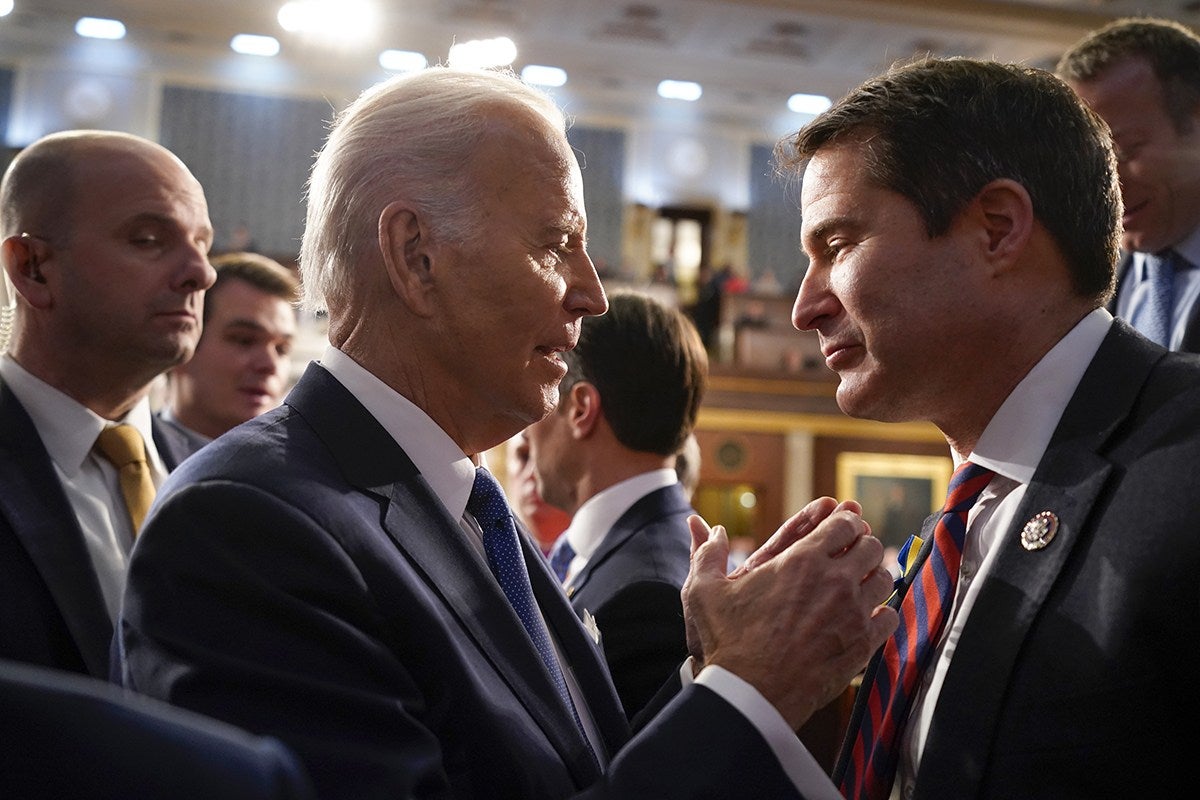
President Joe Biden talks with Representative Moulton after the State of the Union address in 2023. / Photo by Jacquelyn Martin-Pool/Getty Images
What led you to make the decision to run against U.S. Senator Ed Markey this year?
We can’t afford to wait six more years for new leadership in the commonwealth or the country.
Do you think that’s one of the biggest problems in Washington right now—stagnation?
I do. And stagnation is an especially big problem with the Democratic Party. I mean, we’ve seen the results with Ruth Bader Ginsburg, Dianne Feinstein, and Joe Biden, but we’ve also seen the results on the other side with Zohran Mamdani, Mikie Sherrill, and Abigail Spanberger, who all won huge Democratic victories as next-generation leaders willing to challenge the party establishment.
How do you feel about term limits?
I think we should have them, but I think we should pair them with campaign finance reform. Term limits tend to be more popular with Republicans, campaign finance reform tends to be more popular with Democrats, but both are widely popular with the American people, so each side could eat a little crow and do something good for Congress that will finally raise our esteem in the eyes of the people we represent. Right?
And Ed Markey has been in office for quite some time.
I respect his service, and I’ve voted for him in the past myself. I just think it’s time for new leadership. And with all due respect, he’s been elected longer than I’ve been alive.
Do you think bipartisanship is possible today, given the climate?
Yes, it is. I passed 988 [through the National Suicide Hotline Designation Act] under the first Trump administration by finding a Republican veteran I could work with. So it’s hard, but it’s necessary if we want to truly serve our constituents.
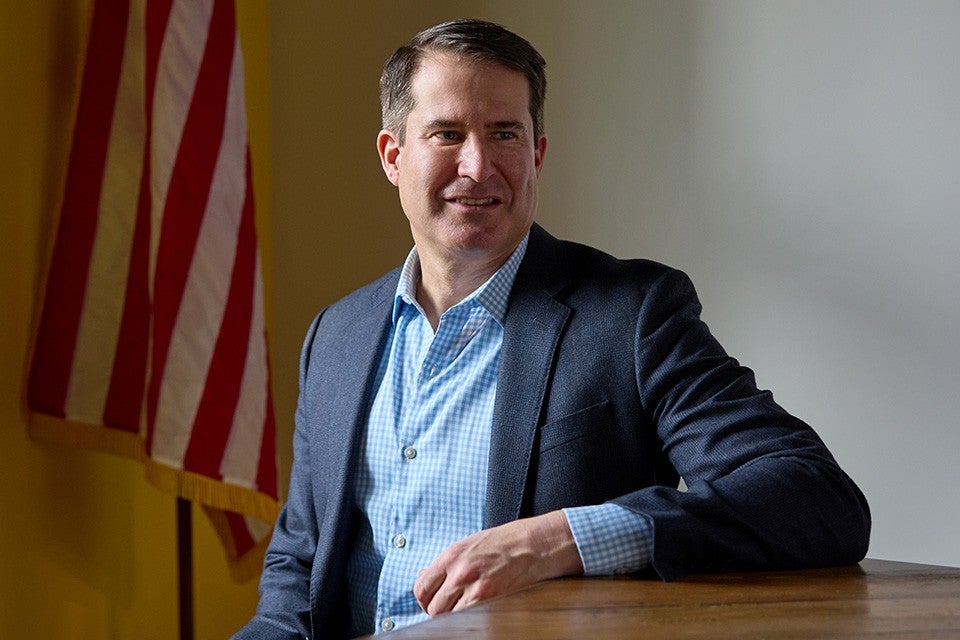
Photo by Ken Richardson
In 2024, you introduced the American High-Speed Rail Act, which proposes $205 billion in federal funding to create a national high-speed rail network. Right now, do you think that American rail lines are up to snuff?
Absolutely not. American rail service is pathetic, and it should be the best in the world. I mean, so many Americans don’t realize what we’re missing, and we should be able to get around the country faster than driving without squeezing yourself into a pressurized aluminum tube 30,000 feet in the air and hoping the door doesn’t blow out.
What part of your district intrigues you the most?
The city of Lynn, because it’s bursting with potential, but Lynners need more opportunities. A great example is the fact that Lynn is the same distance from downtown Boston as Brooklyn is from downtown Manhattan—same distance by train—but Lynn has one train an hour in the middle of the day, and Brooklyn has about one train a minute. My regional rail plan would do wonders for opportunity and economic development, and in Lynn and so many cities like it around the commonwealth.
Besides rail lines, what are the top three other things about infrastructure in the United States—bridges, roads, highways—that you think are most pressing?
We need to build more carbon-free energy infrastructure to bring down energy prices. And we’ve clearly failed to do that in Massachusetts, because energy bills are sky high, and people are turning down their thermostats this winter to save money. We also need to completely rebuild our education infrastructure. Here’s an example: Kids are voting with their feet today, standing in lines outside of vocational schools, because they know these jobs will not be automated out of existence. And the older generation in Massachusetts is debating how to ration these seats rather than building more to serve our kids.
What questions or requests do you most commonly hear from your constituents?
Right now? It’s all about affordability. People are understandably concerned that they won’t be able to afford healthcare. They won’t be able to pay their electricity bill.
Do you think that some form of compulsory public service should become part of the United States’ culture, even if it’s not military?
I don’t think national service should be compulsory, but I do think it should be expected that we all do something to give back to this great country, and that would not mean expanding the ranks of our military. It would mean dramatically expanding the opportunities for civilian service—Peace Corps, AmeriCorps, City Year.
You have always been very vocal about your opinion on the Iraq War. Looking back at what happened and the outcome, and having served four tours, can you encapsulate your view of the Iraq War?
Well, I ran for Congress because I saw the consequences of failed leadership in Washington over four tours in Iraq, and today I’m gravely concerned we’re going to play this movie again with Venezuela, which is why I wrote the legislation to prevent any funds from supporting ground operations in Venezuela.
Do you view China as our biggest rival or our biggest enemy?
As opposed to Venezuela? Yes.
Could you ever see China becoming a close ally?
It’s not impossible, but one of the biggest problems with our China policy is that we don’t have a long-term vision for where this will be in 30 years. But in the meantime, we have to do everything we can to deter and prevent a war with China. And getting distracted in Venezuela does not help, right?
So a recent controversy you were in was the whole trans sports question. Do you feel that your words were sort of twisted or misinterpreted?
I have a 100 percent voting record on trans rights, but I don’t believe we serve any minority we’re working to protect if we’re not willing to take on their issues and have tough conversations. Because otherwise, the only ones who set the agenda are the Republicans with hateful policies, which is exactly what we’ve seen in this Congress.
So was there any lingering bad blood between you and Nancy Pelosi?
It was tough for a time, but I’ve always heard that she has great respect for me because I’m willing to challenge the status quo when so many aren’t, and I feel the same way about her. We had a really lovely conversation about Christmas with our families on the House floor just yesterday.
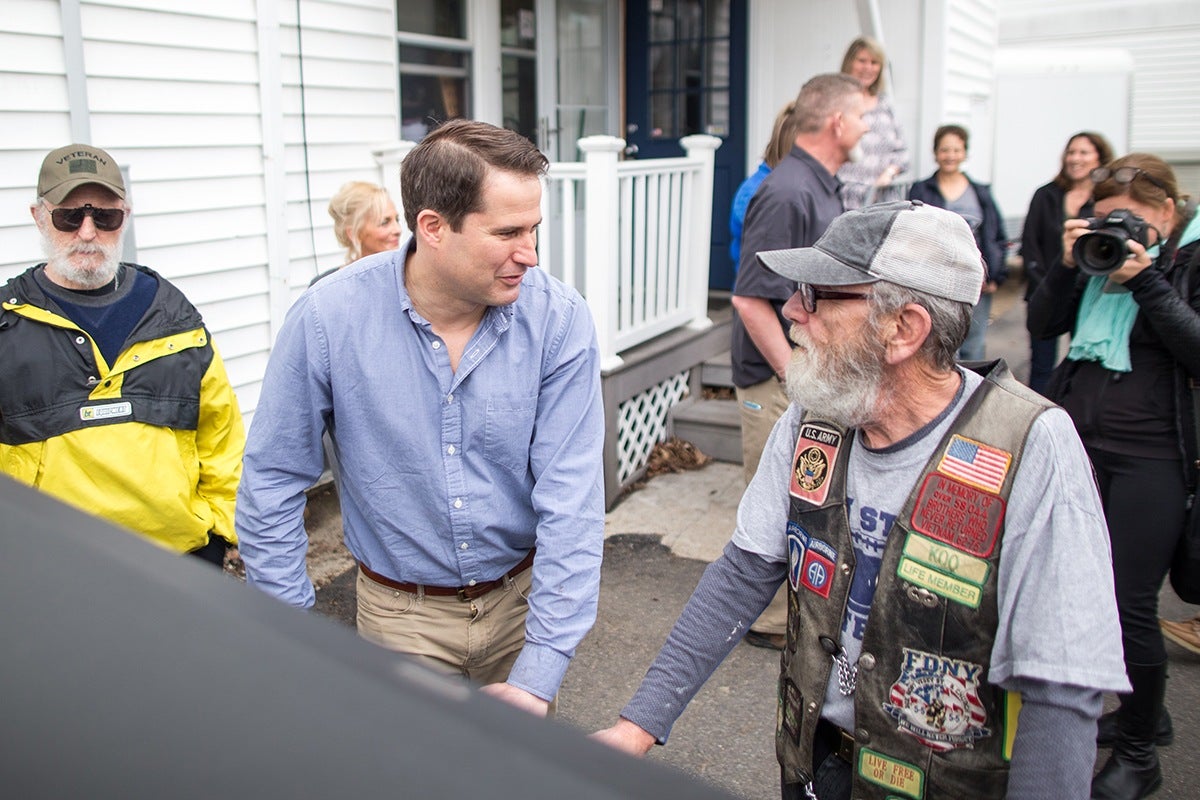
Back in April 2019, Moulton launched his presidential campaign in Manchester, New Hampshire. (Photo by Scott Eisen/Getty Images)
What about presidential aspirations?
Been there, tried that. I’m amazed you remember.
Well, who do you see as the frontrunner in the next election cycle?
Look, I think it’s important for the next generation of leaders to rise up, and that’s why people, including a past president, encouraged me to run several years ago, but I think it would be a huge mistake to designate that person now. We tried that in 2024, and it didn’t work out well for us. We need to win the midterms and then use that as a blueprint for 2028.
What is your single favorite thing about Salem?
Not the witches. Salem is so much more than Halloween. The Peabody Essex Museum is amazing. The restaurants are amazing, and it’s a great city to raise a family.
What is the one headline that you’d most like to read?
The headline I’d most like to see is, “School shootings are down 1,000 percent because we finally got weapons of war off our streets.”
What was the most emotional or heart-wrenching interaction that you’ve had with a constituent?
It’s meeting constituents whose sons or daughters have died from gun violence, because there are absolutely things we can do to prevent it. But it’s one of the best examples of how cowardly the Republicans in Congress are today.
Who is the person from history that you’d most like to have met?
Teddy Roosevelt. He was a Republican, but he was a progressive champion who was always willing to challenge the status quo. And he seemed to always have a good time doing it. The other person that I would have really liked to meet was Frederick Douglass, because I’ve always admired people who have political courage, and the influence he had, given where he began his life, took an unbelievable amount of courage, politically and otherwise.
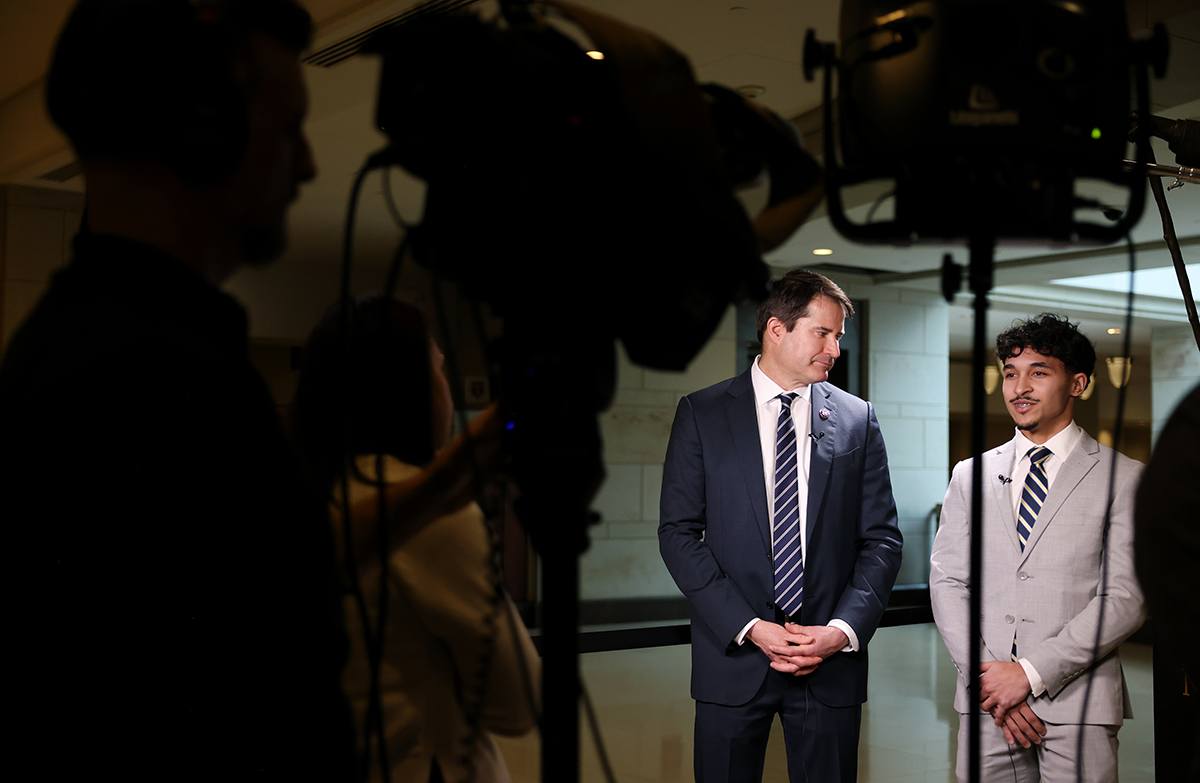
Moulton brought Marcelo Gomes da Silva, the Milford, Mass. teen arrested by ICE in May 2025, as his guest to the 2026 State of the Union address. / Boston Globe via Getty Images
By the Numbers
The Moulton File
Five stats on the candidate.
3
Number of degrees Moulton has from Harvard—BA, MBA, and MPP.
4
Number of tours Moulton served in Iraq as a Marine infantry officer.
7
Number of glasses of milk Moulton drank a day when he was in grad school at Harvard.
123
Number of days Moulton spent running for president in 2019.
2,116,539
Amount, in dollars, Moulton had raised for his Senate run through the end of 2025.
An earlier version of this article was first published in the print edition of the February 2026 issue with the headline: “The Challenger.”