When Did It Become So Hard to Make Friends?
Boston has a loneliness problem. I spent a winter—and more than a few awkward outings—trying to solve mine.
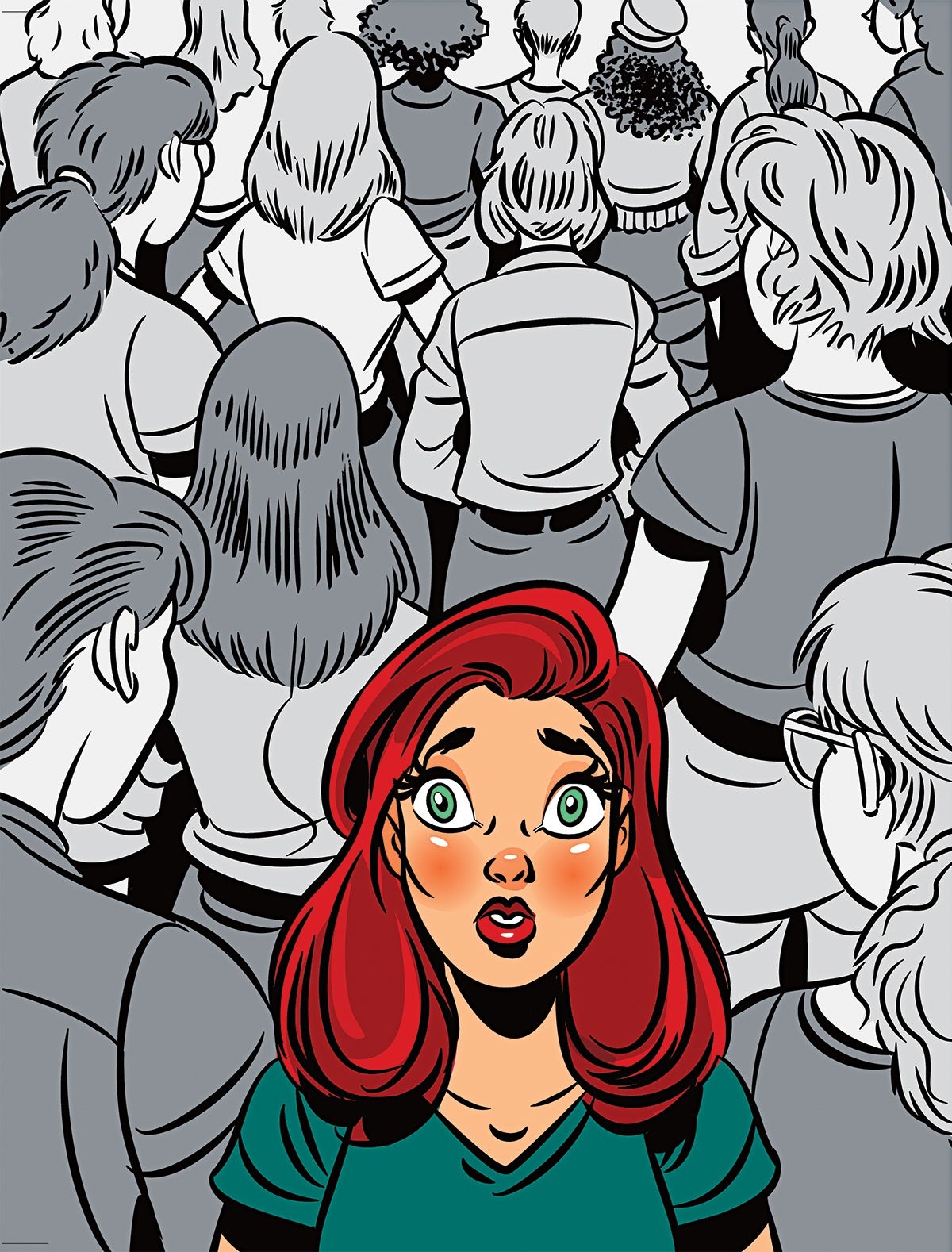
Illustration by Mark Matcho
I was on the T headed to one of my favorite restaurants in Boston when I found myself thinking about the last time I ate there. I’d been with three of my closest friends, all of whom were visiting from the different cities where they live. As the happy memory of great food and even better company flitted through my mind, anxiety about my upcoming meal curled deep in my stomach. Yes, I was headed to dine on the same delicious food I loved. But this time, every single one of my fellow diners was a complete stranger.
Welcome to the brave new world of making friends in Boston.
A few months earlier, I had realized something startling: I hadn’t made a new friend since college who wasn’t a friend of a friend, a friend of my husband’s, or someone I met at work. I consider myself a social person. I like people. And yet making friends as an adult had somehow become impossible, especially in Boston, where friendliness isn’t known as our defining trait. Hence the question that had been nagging me for months: How do people actually meet people nowadays?
It turns out I’m not unique in this—it’s essentially a universal conundrum. Which is exactly why I ended up at Café Sauvage in the Back Bay sipping a limoncello spritz, having dinner with strangers.
I signed up for this dinner through Timeleft—an international platform that opened shop in Boston in 2024 with the goal of “turning strangers into friends.” The company organizes weekly dinners, bringing together six people, selected to dine together based on their answers to a short online survey.
Groups like these are having something of a moment in Boston. Just this past year, Base, a national platform that bills itself as “designed for people who value depth, curiosity, and authentic connection,” also opened here. Base organizes events and dinners where conversation is focused on a particular topic—and it involves an application, a phone interview, and a monthly membership fee of $100 or more on top of the costs of the individual events. (Friendship, it turns out, isn’t always free.)
These are just two of the many social groups that have cropped up in Boston in recent years, each with its own particular focus. Need people to take walks or work out with? There’s a group for that. Prefer crafting to exercise—or any one of dozens of other hobbies? There’s one for everything, from needlepoint and knitting to video games. There are supper clubs and cocktail meetups and even groups to find people to go clubbing with—yes, really. Think these gatherings sound superficial and can’t possibly facilitate deep connections? There are groups for that, too—those that promise to skip right over the small talk and rocket you headfirst into deeply personal conversations.
All these groups share a common goal: helping people find connection, something ever more elusive these days.
Whatever their focus, all these groups share a common goal: helping people find connection, something ever more elusive these days. In 2023, the surgeon general declared that our loneliness epidemic constituted a public health crisis.
Perhaps counterintuitively, rates of loneliness are even higher in cities, and Boston is no exception. A recent study based on 2024 Census data found that some 43 percent of adults in the Boston metro area reported feeling lonely, which is above the national average. Meanwhile, across the state, 25 percent of 18- to 24-year-olds and 13 percent of all adults reported that they “usually or always” feel isolated from others, according to the 2023 Community Health Equity Initiative survey.
“People want to be seen and valued and connected, but when the rubber meets the road, it can be hard,” says Kristen Lee, a clinical social worker and behavioral science professor at Northeastern University who studies social connection. “It’s challenging to find that community. People are trying to creatively find a way to make connections when it’s not necessarily readily available. That’s why we’ve seen [these groups] arise; they give more opportunity and inroads that aren’t organically happening.”
So are these social groups the antidote to the epidemic? The promises of community, connection, and friendship sure sound like it. But do they really work? And if they do, what does “work” even mean?
I am not the only person who found herself having trouble making friends in Boston—I’m just a little less motivated than some. Take Rebekah King. She moved here from California in 2022 and went online to find roommates. “I noticed there were a lot of people like me who were looking for connection and didn’t know where to find it,” she says. So she started a small Facebook chat that is now an 8,000-strong group of women and nonbinary people in their twenties and thirties, dubbed Boston Babes, that held 119 events last year alone. Eight thousand people. One hundred nineteen events. All because she needed a roommate.
Ana Baptista had a similar experience when she moved to Boston from Venezuela more than a decade ago and found it hard to find the time and space to connect with people—not to mention, we were a bit standoffish. She recalls an incident that many Bostonians have experienced some version of—the time she told someone she liked their jacket. “And they just stared back like, Why are you talking to me?” she said.
Like King, she decided to create the community she couldn’t find. She launched Girlfriends in 2018 as a group centered around activities that help facilitate friendships. Today, it has more than 400 members and hosted more than 60 events in 2025 alone, from dance and cooking classes to picnics and boat rides. “Making friends doesn’t need to be hard,” Baptista says. “You need to be in a space where it is fostered.”
These aren’t the only homegrown social groups. The Jar, founded in Boston in 2019, gathers guests to experience a piece of art—a painting, a comedy show, a poetry reading—then prompts them with thematic questions to discuss with everyone in the room. Participants are encouraged to bring one person they know well, two they see often, and two “unusuals,” people different from them in some significant way. “We don’t care where you work. Nobody gives a shit where you went to school,” says founder Guy Ben-Aharon. “We go from zero to intimacy really quickly.” One common kickoff question: What’s something you were known for as a child? Meanwhile, Skip the Small Talk, another Boston-born group now in 20 cities worldwide, takes a similar approach with speed-dating-style conversation prompts designed to bypass small talk entirely.
Maria Colalancia, who started the supper club the Aperitivo Society in early 2023 with the mission of good food and good conversation, has a theory about why so many of these groups have started popping up all over town. “I think there’s a hunger to get away from being so chronically online,” she says. “It’s silly that an introduction has to be an online transaction. People just want to get out from behind their phones.”
The quest for a more analog way of meeting people is something researchers are noticing, too. “We are seeing a drastic change in society in terms of social ties. Especially after the COVID pandemic—we have Zoom, and everything is virtual, and we don’t know our neighbors anymore,” says Koichiro Shiba, an assistant professor of epidemiology at BU’s School of Public Health who studies the health effects of human relationships and communities. In a world where we’re arguably more connected—virtually, constantly—than ever before, he says, there’s a real missing piece. “That’s maybe partly why people are trying to go back to the old days and trying to make connections in person.”
It isn’t just how we interact that has changed, but where. “Third places”—the bars and coffee shops and neighborhood haunts that aren’t your home or your office, where you become a regular, where everybody knows your name (yes, like that bar)—have been disappearing. The neighborhood bars are shuttering. Coffee shops have become coworking spaces with espresso, everyone hunched over laptops, earbuds in, sealed off in their own little productivity bubble, nursing a $7 oat milk latte like it’s a desk rental fee.
I wouldn’t consider myself lonely, exactly. But I do want more friends who live in my city, not scattered across state lines. Making them, it occurred to me, takes a certain kind of muscle—and mine had been slowly atrophying for years. All these groups promising connection and community? I wanted to know if any of it was real—or if I’d just end up with awkward small talk and a $60 candlemaking class to show for it.
Over the course of this winter, I went to a handful of events to test how well these groups actually worked. They ranged from a watercolor painting class to crafting meetups, dinners, and a comedy show. I approached them all with mild apprehension, worried they would feel like networking—performative or contrived, with everyone wanting something from everyone else, except instead of a job, that elusive something was friendship.
And sometimes, that was exactly how it felt. The watercolor class was my first attempt. I sat down with four women, and we bonded, sort of, over how horribly our paintings were turning out. But most of the conversation centered around the basics: where we lived, how long our commutes were, and how high our electricity bills are in the winter. Thrilling stuff. In all the moments that were stilted, awkward, and semi-silent, I was painfully aware of how hard we were all trying and getting nowhere.
But the more groups I tried, the more natural it began to feel. At a meetup of the Boston Drunken Knitwits (a knitting group, though they welcome all handcrafters, including cross-stitchers like me), I felt like I had found my people. We traded stories about failed projects, admired each other’s work, and swapped advice, all while working on our own stuff.
Here’s what I learned: Putting yourself out there in a room of strangers, hoping some of them like you enough to talk to you again, is terrifying. But if nothing else, it was nice to be out of my house, talking to people in person rather than through my computer or phone screen—sharing my favorite hobby, which I usually do alone on my couch, with others. The approach to community was structured, sure. But the conversations themselves? They felt real enough.
Despite my skepticism about just how many real friendships can emerge from these groups, some have an impressive track record. Take Iliana Barrientos, 32, who joined Girlfriends after moving to the Boston area from Florida. She met a now-close friend during a Midnight Runners event, and the two clicked and spent the whole night talking. Recently, they took their respective boyfriends to an EDM festival. Luce Kelly, 28, joined the same group in 2024 after moving to the Boston area. She’s hosting an upcoming birthday dinner with eight women she met through the group—all of whom, she says, she never would have met organically otherwise. “They work in different sectors, or they live in different parts of the city or in other suburbs,” she says. “There would have been no overlap whatsoever with a single one of the people who are my friends now.”
Then there’s Alfredo Rojas, 37, who’s found that activities hosted by the Boston-area “Make Friends After College” Facebook group (20,000-plus members of all ages) facilitate more lasting friendships—ones that continue outside the events—than other groups he’s tried. Meanwhile, Dan Cross, 39, discovered that his once-wide friend group had started to dissipate as he got older—marriages and kids made meeting up more difficult. After trying one singles-focused meetup group, a few of the members spun off and created their own hiking group, hitting up New England’s mountains throughout the year. “I’m not the most social or outgoing person, so events like these help bridge the gap,” he says.
But not every event is a winner. Diane Darling, 60, went to a dinner where one woman was so combatively political that it left the entire table stunned into uncomfortable silence. Another woman told me about an event where she was one of just a few women in a room full of men. What was meant to be a platonic community gathering had the air of a singles mixer—and she was married. Someone else described attending events where it felt like everyone already knew each other. And worse: The connections she thought she had made ended as soon as the event did. She never saw any of them again.
The night of my Timeleft dinner, I walked in my front door to find my husband with a smirk on his face, ready to hear what he assumed would be a horror story about my evening with strangers. Instead, I launched into no fewer than 15 minutes of breathless recap: how I’d waited outside in the cold for an extra 10 minutes because I was so nervous; how I genuinely liked every woman I spent dinner with; how I had developed a newfound desire to add Yellowstone National Park to our travel bucket list and go hiking in the White Mountains this summer. I was nearly bouncing off the walls with excitement, thinking that maybe, just maybe, this time I had made some new friends.
One woman and I discovered early on that we went to the same heated Pilates studio in Harvard Square, and we promised we’d see each other in a class. (It struck me then: Someone I could be great friends with might be right under my nose, if I ever bothered to look up and talk to them.) But in the more than two dozen workout classes I took in the two months following that dinner, I never saw her again—or maybe I did, and in the haze of the 100-degree room, I’d forgotten that I promised to look for her. Either way: We didn’t connect again.
For weeks, I counted it as a failure in the friendship department. Which, if I’m being honest, it was. But here’s the thing about adult friendship—the issue I kept bumping up against all winter: The groups can put you in the room. They can hand you the conversation starters and seat you next to someone who also loves heated Pilates and has strong opinions about Yellowstone. But they can’t do the rest. You have to put in the work. You have to fight the inertia, the voice in your head that says, She probably doesn’t remember you anyway, the exhaustion that makes it so much easier to just go home and watch TV. Real friendships aren’t built in a single dinner. They’re built in the follow-up—the text, the coffee, the showing up again.
So I took a leap. I messaged the woman from Pilates and asked if she wanted to go to a class together. She said yes. We’re going next week, and maybe we’ll grab coffee or a drink after. We might not become best friends. But then again, you never know. And that’s the whole point.
This article was first published in the print edition of the March 2026 issue “Let’s Be Friends—Please?”